



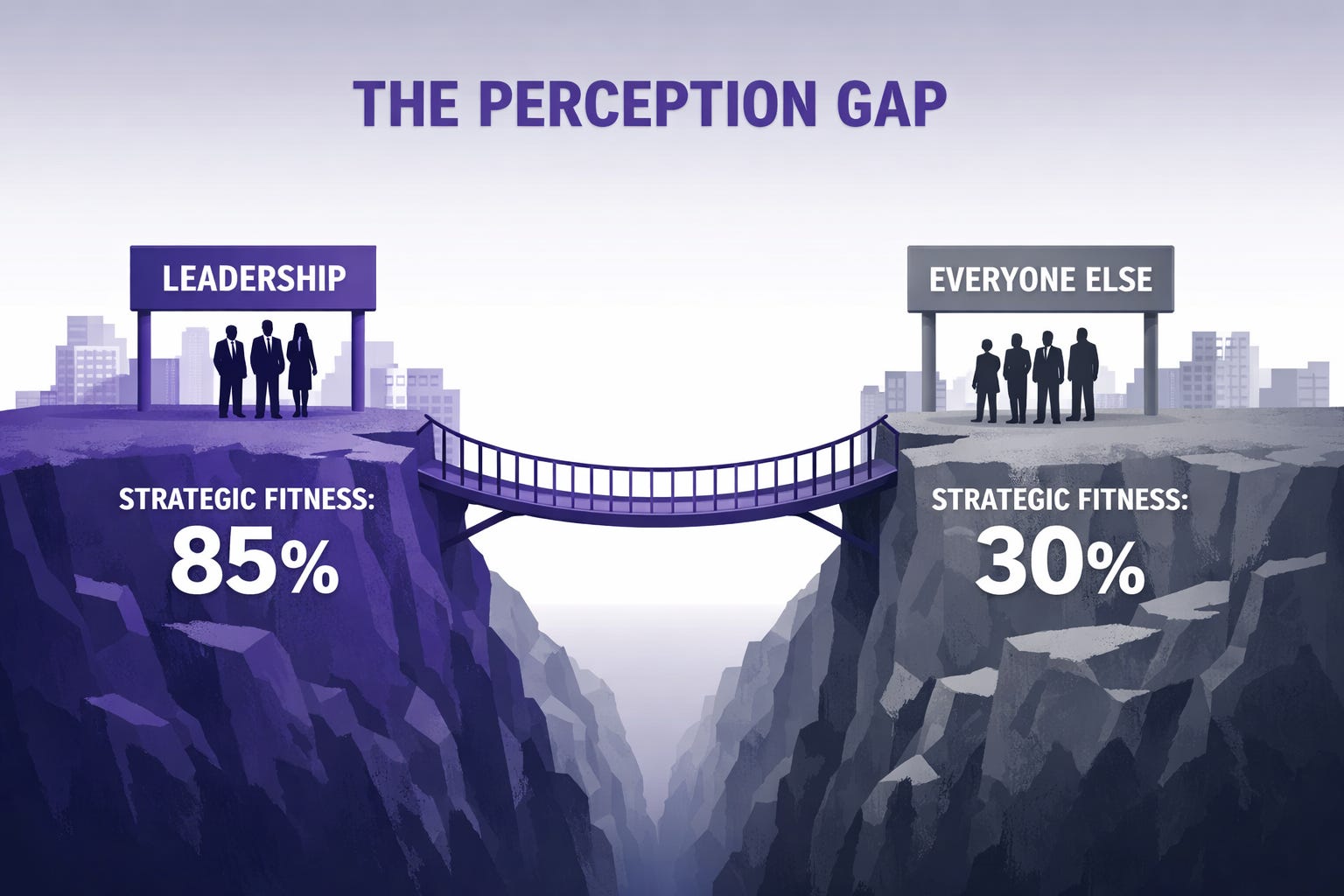
On Tuesday, we shared the first two findings from our State of Strategic Fitness survey. The headline: Executive Directors rate their organizations’ strategic fitness at 8.0 out of 10. Senior leaders one level down say 4.83, and Consultants say 4.91. The gap shows up on every specific behavior we measured, and it’s widest on exactly the items that require honest self-assessment. We called it the perception gap. If you missed Part 1, read it here.
Today: two more findings that explain why the gap persists, and why, left alone, it gets worse. Then: what we’re building to do something about it.
3. The Biggest Organizations Are the Most Broken
Growth doesn’t solve for strategic discipline; it buries it.
You would expect, reasonably, that larger nonprofits with bigger budgets, more staff, more Board infrastructure, and more years of operational experience would score higher on strategic fitness. They have more resources to invest in systems. They can hire for strategic roles. They’ve survived long enough to have learned something.
The data says the opposite.
Organizations above $25 million in annual budget rated their overall fitness at 3.0 out of 10, which is the lowest of any budget category in the sample. Their governance composite was 1.6 out of 5. Their willingness to stop or scale back low-impact programs: 1.0 out of 5.
The $10M–$25M band wasn’t much better: 5.0 on fitness, 2.91 on governance. Meanwhile, the lone under-$500K organization in the sample rated itself at 9.0, with behavioral and outcome composites above 4.5. The $500K–$1M band averaged 6.5.
The pattern suggests that as budget increases, strategic fitness decreases. The relationship isn’t perfectly linear—the $5M–$10M band sits slightly above the $1M–$5M band on some measures—but the overall trend is consistent.
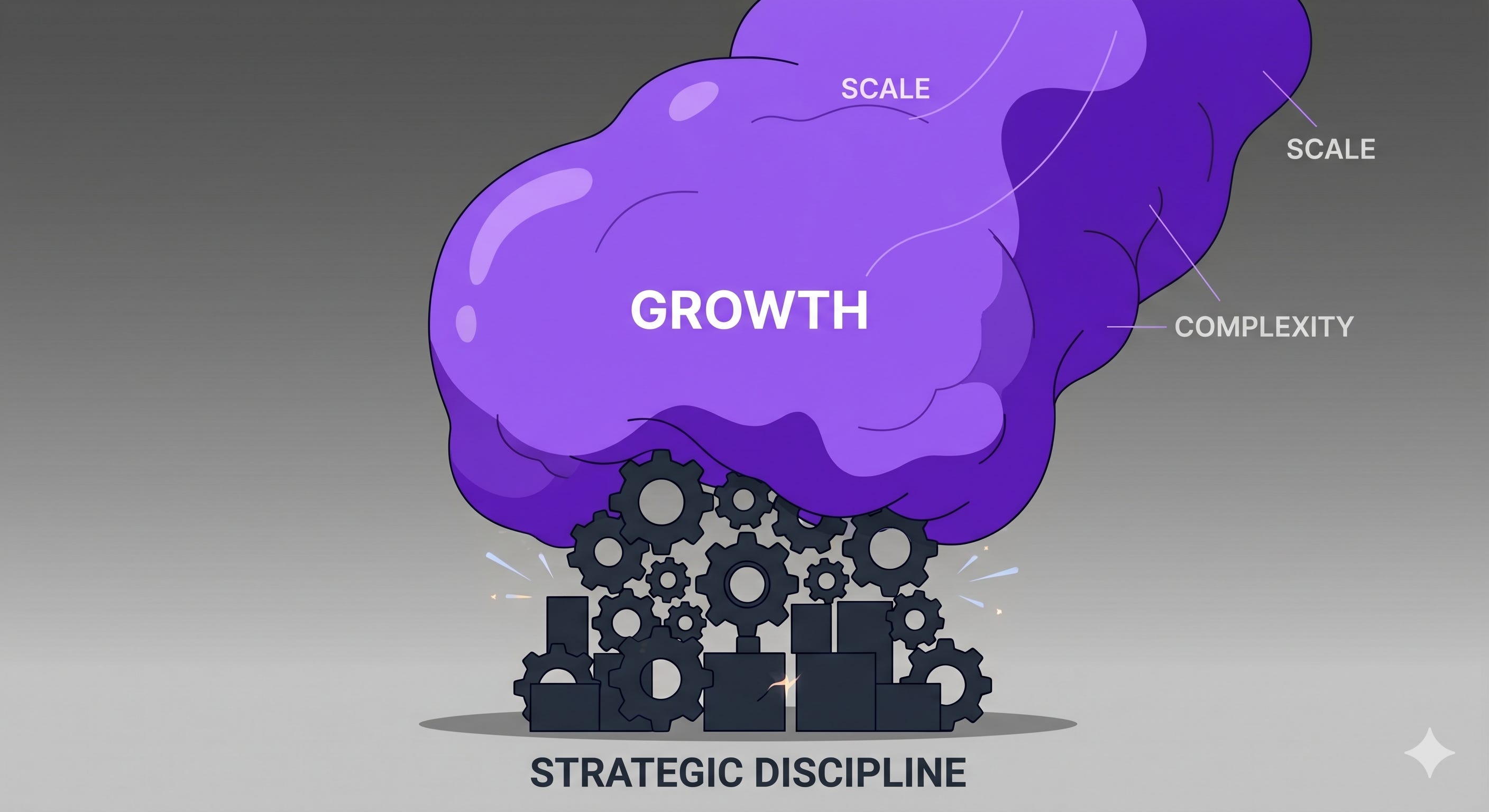
Why? The data doesn’t tell us directly, but the behavioral scores suggest a hypothesis. Large organizations score worst on exactly the disciplines that require saying no: prioritization, willingness to sunset programs, and reviewing leading indicators that might force uncomfortable conversations. They score better on the outward-facing, additive behaviors like stakeholder anticipation and environmental sensing that let them respond to new opportunities without subtracting old commitments. In other words, they’ve gotten good at adding, but they’ve lost the ability to subtract. Every new grant, every new Board priority, and every new political moment layers on top of what already exists, and no one has the mandate or the mechanism to take anything off the pile.
The smallest organizations, operating without this accumulated sediment, can still turn. They haven’t yet built the institutional inertia that makes strategic discipline so hard to maintain at scale. The question for growing organizations—the ones moving from $1M to $5M, from $5M to $10M—isn’t whether growth will test their strategic infrastructure. It will. The question is whether they’ll notice the erosion before it becomes the culture.
The pattern also shows up across mission areas. Environment and climate organizations score lower than any other mission area on nearly every dimension: behavioral composite of 2.6, outcomes average of 2.6, overall fitness of 4.2. Civic engagement and advocacy organizations score meaningfully higher: 3.2 behavioral composite, 3.3 outcomes, 5.8 overall fitness. The difference is infrastructure.
4. Below the Director Level, Governance Is a Black Box
When staff experience strategy as something done to them rather than something they shape, strategic execution becomes brittle at best, and when the pressure hits, strategic coherence is the first thing lost.
The survey includes a seven-item governance section: questions about whether Board meetings address long-term direction, whether decision authority is clear, whether leading indicators get reviewed, and whether there’s a regular strategy cadence.
The single non-leadership staff member in our sample—someone who identified as “Other role,” working at a $10M–$25M civic engagement organization—couldn’t answer any of them. Every governance question came back “Unanswerable.”
One person is an anecdote, not a finding, and we know that. But as a signal, it’s worth sitting with, because it’s consistent with everything else in the data. The further you move from the C-suite, the less visible governance becomes. Senior leaders (VPs and Directors) could answer the governance questions, but their scores were low: 2.6 on whether Board meetings spend enough time on long-term direction, 2.2 on reviewing leading indicators, and 2.0 on decisions being clearly communicated afterward. They know enough to know it’s broken. The person one tier below them couldn’t even tell you whether it exists.
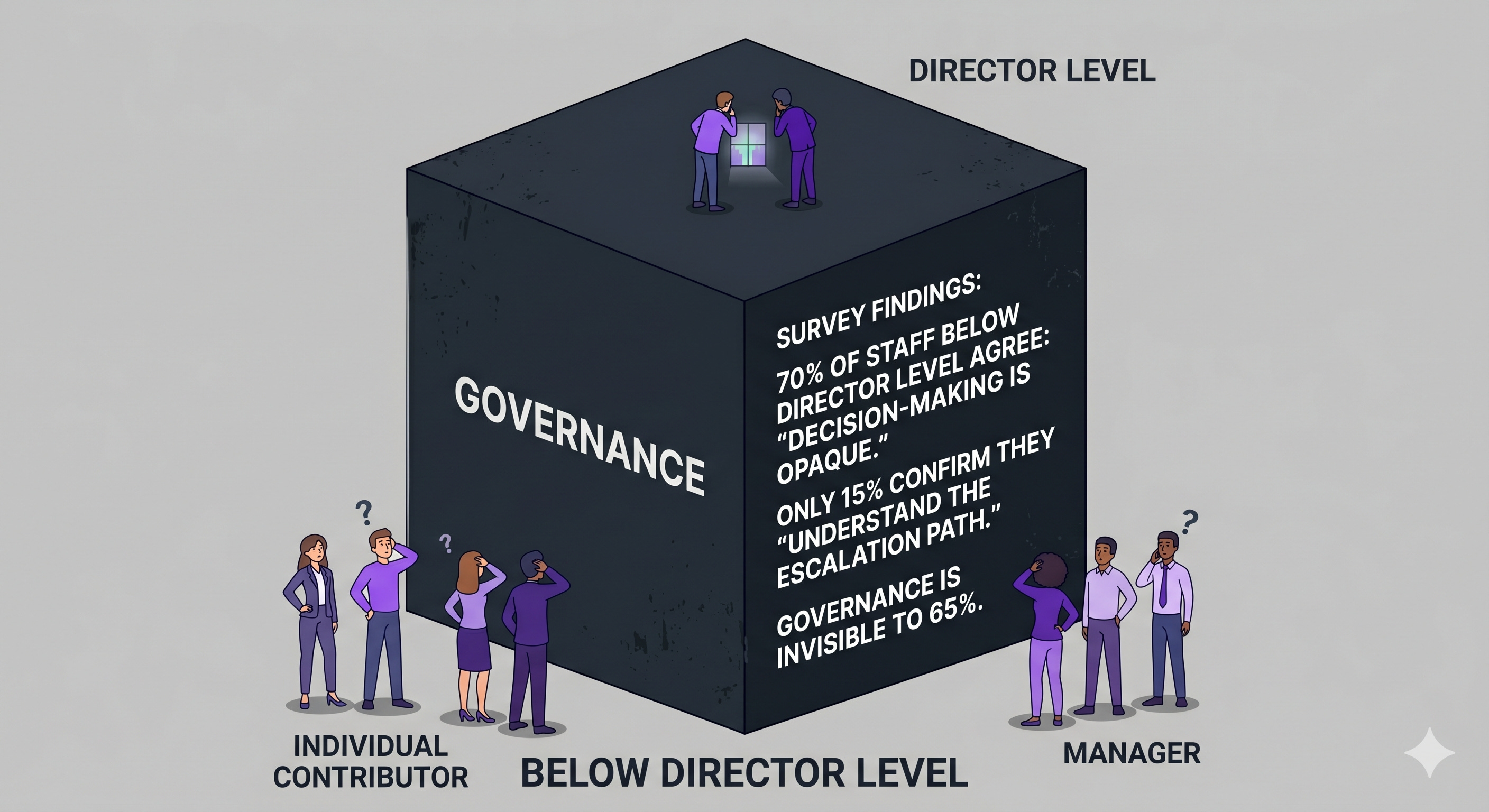
This reframes the perception gap in an important way. The information architecture of most nonprofit organizations does not carry strategic context downward. Strategy gets decided in a room. It may or may not get communicated in a meeting. By the time it reaches the people actually executing the work, it has become a directive without a rationale, a priority without a framework, or a change without a story. Staff experience strategy as something that happens to them, not something they’re part of shaping. Sixty percent of respondents disagreed that staff feel meaningfully involved in setting direction, and only ten percent agreed.
The compounding problem is leaders often hesitate to bring staff into strategic conversations precisely because staff aren’t equipped to engage strategically. They’ve never been given the context, the data, or the decision frameworks to do so. It’s a self-sealing loop: the less you share, the less people can contribute. The less people contribute, the more you believe they can’t.
What These Four Findings Mean Together
Taken individually, each finding has its own implications. Taken together, they describe a system.
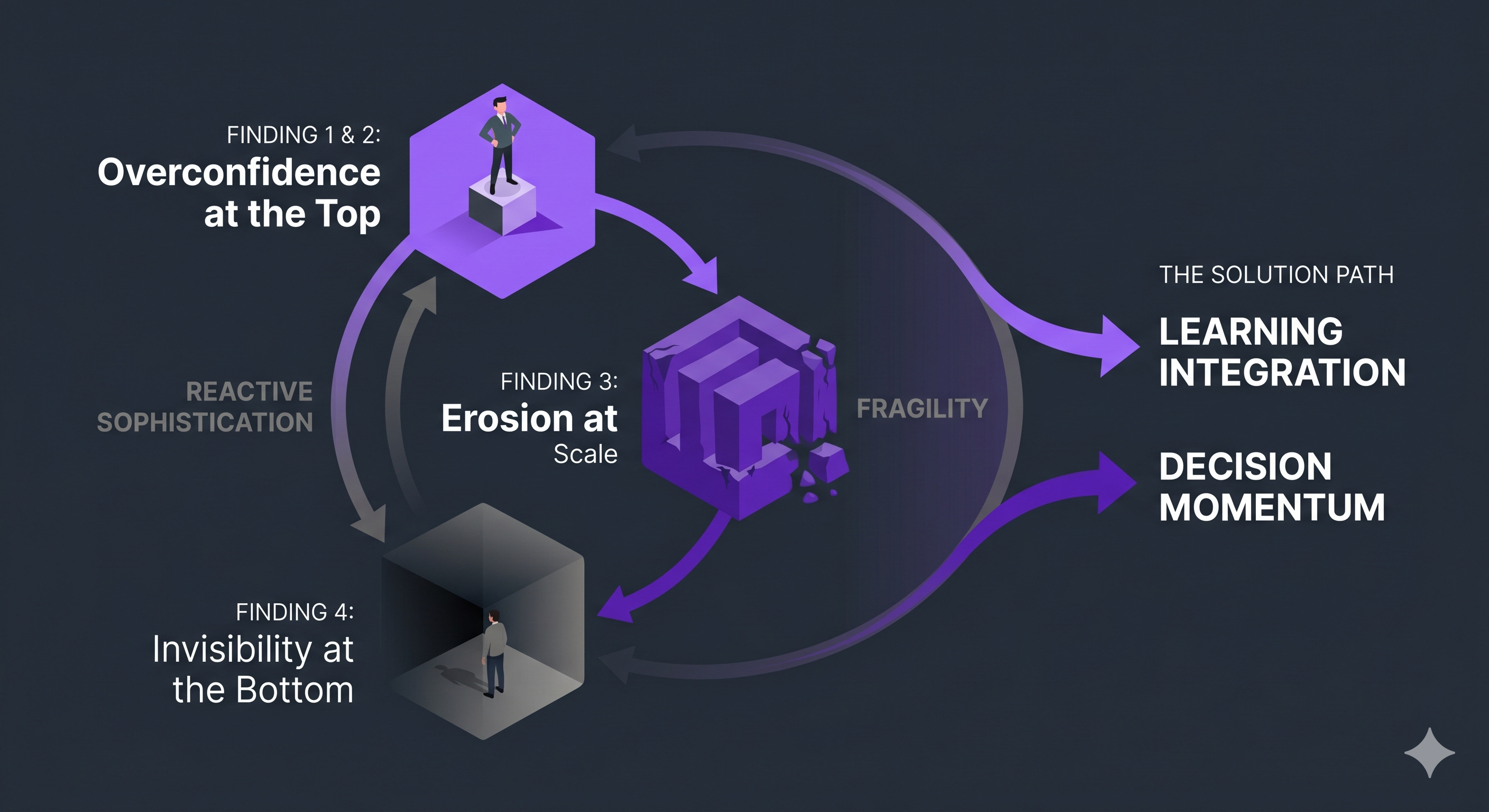
The CEO or Executive Director thinks the organization is healthy (Finding 1). That confidence is reinforced by item-level self-assessments that diverge sharply from everyone else’s experience (Finding 2). The organization grows, and growth erodes the very disciplines—prioritization, subtraction, governance rigor—that would surface the problem (Finding 3). Meanwhile, the further people sit from the leadership table, the less they can see of how strategy actually works, which means the signals that might correct the Executive Director’s overconfidence never reach them (Finding 4).
Confidence at the top. Erosion at scale. Invisibility at the bottom. And no feedback mechanism connecting them.
The overall fitness average across the full sample was 5.2 out of 10. The behavioral composite was 3.07 out of 5. In a stable operating environment, that might be survivable: adequate if unimpressive, the organizational equivalent of a C+. But the organizations in this sample are advocacy groups, climate organizations, civic engagement operations, and more. They work in volatile political and funding contexts where the ground shifts fast and often. Mid-functioning isn’t a stable state for them; it’s fragile. One significant external disruption—a funding shock, a political reversal, a leadership transition—and the infrastructure that was “good enough” yesterday becomes the thing that breaks today.
The strongest behavioral predictors of better outcomes in this sample were Learning Integration (r=0.78) and Decision Momentum (r=0.66). Organizations that examine what’s working mid-effort and act visibly on what they learn—and that keep decisions moving rather than letting them stall in consensus limbo—report markedly better results. The fact that they’re the strongest differentiators in the dataset says less about their inherent power than about how rarely they’re practiced.
The gap between high-fitness and low-fitness organizations bears that out. The largest differences show up on Decision Momentum (+1.62), Scenario Consideration (+1.55), Leadership Modeling (+1.49), and Learning Integration (+1.42). High-fitness organizations move faster and learn more. Low-fitness organizations are stuck and, critically, are not learning their way out of being stuck.
What the sector has, in abundance, is strategic awareness. The two highest-scoring behaviors across the full sample are Stakeholder Anticipation (3.71) and Environmental Sensing (3.35). These are the outward-looking muscles, the ability to read the room and anticipate reactions.
What the sector lacks is strategic discipline: the internal systems that translate awareness into prioritization, learning, and subtraction. These organizations are sophisticated scanners of their environment. They are not, by and large, disciplined governors of themselves.
We can call this pattern Reactive Sophistication: externally perceptive but internally undisciplined. High responsiveness plus low structural discipline equals strategic drift. The organization responds to everything, subtracts nothing, and gradually loses the thread of what it was actually trying to do, because no one made the decision not to do something.
What Comes Next
We want to end where we started on Tuesday: with that 3.17-point gap.
Because the most dangerous finding in this dataset is that the people with the most power to fix these problems believe, sincerely and with conviction, that they don’t exist.
If you’re reading this as a CEO or Executive Director, the data’s invitation is not to feel defensive. It’s to get curious about whether your team’s experience of the organization matches yours. Ask them, not in a town hall or a survey with your name on it, but in a way that makes honesty costless.
What you hear might close the gap, or it might widen it in useful ways. Either outcome is better than the alternative, which is leading an organization you don’t fully see.
We’re building something to help.
The findings in this report describe a structural problem: leaders operating inside systems that limit their visibility, reward addition over subtraction, and don’t carry strategic context to the people who need it most. You don’t solve structural problems by working harder or reshuffling priorities. You solve them by building the infrastructure that makes visibility and discipline possible.
We’re assembling a small design cohort—ten to fifteen senior leaders with direct authority over how their organizations operate—to do exactly that. This won’t be a training or webinar series, but rather a working group that pressure-tests frameworks against live organizational challenges, builds the tools the sector is missing, and shapes resources for wider distribution. The kind of room where an ED can say “my team doesn’t experience my organization the way I do” and get help figuring out why.
If that’s a conversation you want to be part of, let us know here.
If you’d rather follow the work as it develops, make sure to subscribe to the Strategic Agility Reboot series.
Methodology Note
This survey was administered in Q1 2026 with nearly a 50-50 split of respondents between independent consultants assessing client organizations and nonprofit staff and leaders assessing their own. Respondents rated organizations on twelve strategic behaviors (1–5 frequency scale), seven governance items (1–5 agreement scale), eight outcome items (1–5 agreement scale), and one overall fitness rating (1–10). The sample skews toward environment/climate and civic engagement/advocacy organizations. Budget bands range from under $500K to above $25M. All correlations reported are Pearson’s r on the full sample. Given the sample size, all findings should be understood as directional signals warranting further investigation, not definitive conclusions.