


Before jumping down to the newsletter, please contribute to our survey! It closes in 2 weeks, and we’d love to get your input on how strategic the nonprofit community is and where we can improve.
It takes less than 10 minutes to complete, and we invite nonprofit staff, leaders, board members, and consultants to share their experiences. Your participation will help build a comprehensive picture of strategic practices across the sector, with findings to be published in early 2026. Please take the survey and share it with your network to help us gather diverse perspectives.
Now, back to the newsletter.
Is Your Hiring Process Screening Out Strategic Thinkers?
Building Your Strategic Operating System, Part 1
We’ve named the need to build a strategic operating system—the structures, rhythms, and decision-making infrastructure that make it possible to think long-term while executing in the short-term—but haven’t dug in much. Today, we begin the dig.
To start: operating systems aren’t just processes, they’re people.
A strategic operating system runs on strategic operators—people who default to thinking about context, tradeoffs, and second-order effects. People who naturally ask “why” before “how.”
Strategic thinking is more innate in some than others. It’s also trainable, but not quick.
I’ll save the science for a different article, but short story: strategic thinking involves complex brain networks and depends on the ability to engage both logical (left-brain) and intuitive (right-brain) processes to see patterns, anticipate outcomes, and plan for the future. Again, trainable, but the work of rewiring brains is not so quick.
The very best thing you can do for your strategic operating system is to add more of these “whole-brained” people who have been moving in the world as strategic operators long before you met them and will have an almost immediately outsized impact by just using their brains to do their job.
The problem is that most hiring processes are designed to screen these people out.
Below you’ll find:
Specific examples of how our hiring processes might be keeping us from getting what we need the most.
A list of indicators we refer to as the “How to Spot a Strategic Brain When It’s Right In Front Of You, and never let another one get away” list.
And then, to end on a high note, we’ll review a set of red-flags that when (commonly) misread as impressive answers lead us to that dreaded place of eery confusion months later where we find ourselves trying to square the two following facts: 1. You did successfully recruit and hire that whole new batch of senior leaders 2. Absolutely zero has changed.
After you’re done reading:
Check out our set of sample Interview Questions for Identifying Strategic Thinkers
Go look through your hiring process documents and determine and then take the next appropriate action. Direct communication is the gold standard but if forwarding this article to a handful of your colleagues with just a note at the top that says “Interesting, what do you think?” is the most strategic option given the landscape within which you operate, then just hit send now, get on with your day, and reassess later.
The pitfalls in most hiring processes (how we are getting it plain wrong):
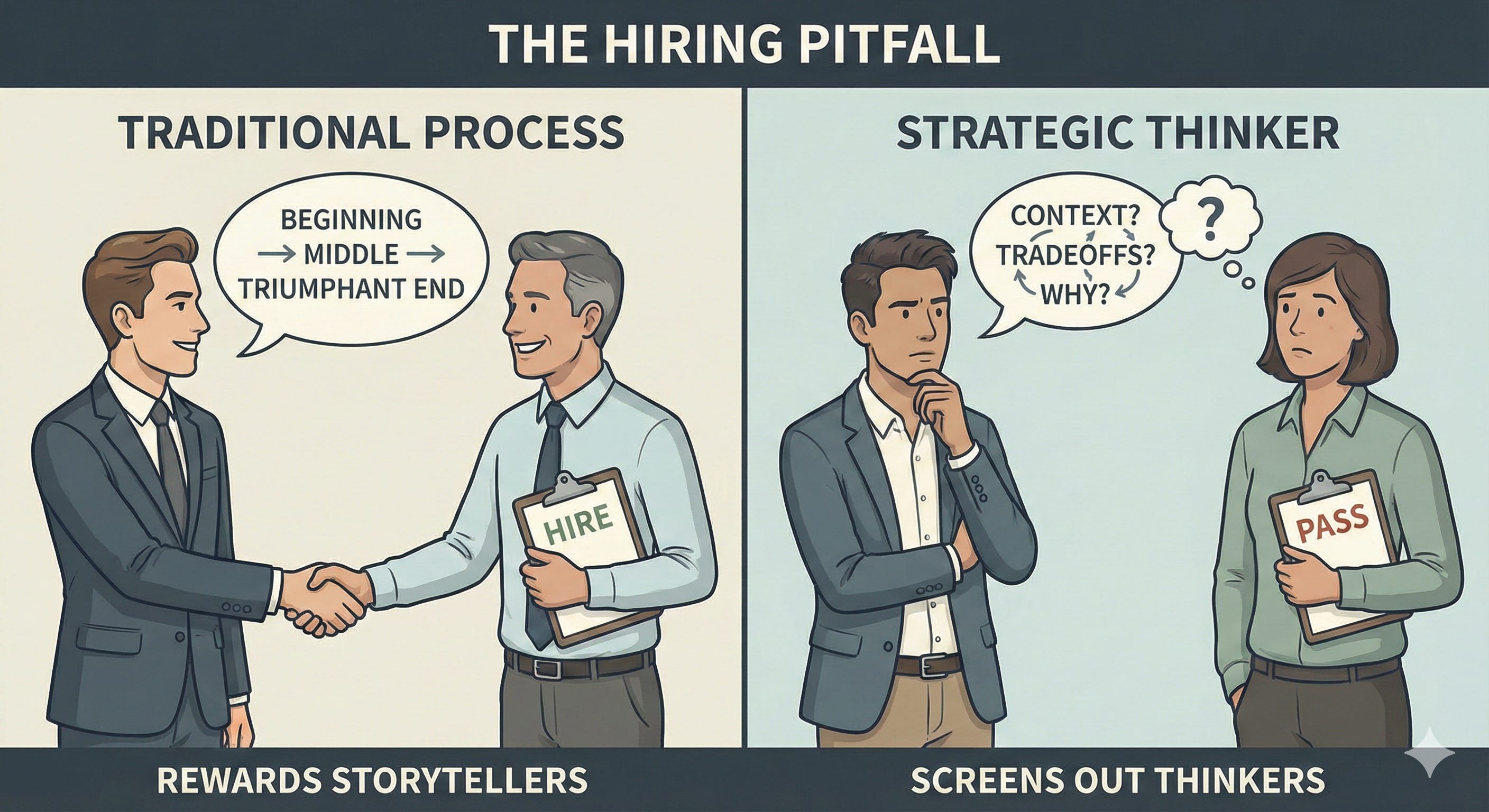
We reward storytellers, not thinkers. “Tell me about a time when...” is the backbone of behavioral interviewing, and it’s terrible for identifying strategic thinkers. It favors people who’ve rehearsed polished narratives about their accomplishments. Strategic thinkers often give messier answers—they want to talk about context, tradeoffs, what they’d do differently now. Unless you are hiring for an in-front-of-the-camera position, listen to the strategic thinker, ask follow up questions and don’t default to the smooth talker with the tight story.
We screen for confidence and not insight. Strategic thinkers often hedge. They ask clarifying questions. They say "it depends." It's easy to mistake this for indecision or even insecurity, when it’s really critical nuance. Be careful not to reward performative certainty over real-time evidence of a disciplined, thorough, and adaptive strategic operator.
We mistake seniority for strategic capacity. Big assumption: if they’ve held senior roles, they must think strategically. Plenty of people get promoted for all manner of reasons; title is not any kind of proxy for how someone thinks.
We focus on what they’ve done, not how they would go about doing it. Most interviews focus on what someone has done and skip the questions that tell you how they did it or how they would do it. Try this prompt: “Here’s a problem you haven’t seen before—how would you think about it?” Listen and then probe. Get clear on what they can do by focusing on how they go about doing it.
Standard reference check questions don’t help. “Would you hire them again?” “What are their weaknesses?” These questions reveal nothing about how someone thinks. Ask about a project that didn’t go as planned and how the candidate handled it. Focus on how they responded and pivoted.
“Culture fit” can screen out the people you need the most. Strategic thinkers challenge assumptions. They ask uncomfortable questions. They push back. This often reads as “not a fit” or “difficult.” We hire easy joiners and then wonder why everything is basically the same 9 months later?
How to spot a strategic brain when it’s right in front of you, and never let another one get away:
Strategic thinkers leave signals all over interviews, because when someone’s default mode is to think before acting, it shows up in nearly every question they are asked.
Here are some of the ways you can spot a strategic operator:
They ask questions, a lot. About the role. About the organization. About your strategy. About the problem you’re trying to solve. About why you joined the team. About what you see as the hardest part of the work and the key strengths and weaknesses of the organization. And they will bring vigor to this because every answer is a set of data points that will help complicate their thinking in order to sharpen it. If you listen, you’ll often hear your answer come back to you by way of a surprising series of connected dots.
They ask clarifying questions or for specific examples before giving an answer. Instead of launching into a response, they will probe the question. “In this scenario when you refer to ‘leadership challenge,’ do you mean managing people or influencing without authority… or something else?” This isn’t avoidance or buying time, this is their discomfort in jumping to a conclusion or solving a problem before understanding it and their confidence in being able to really answer a question when they do.
They tell you about the win and the cost (and without hesitation, they will undercut their own win in service to a fully strategic assessment). They don’t just name the outcome or describe what happened, they talk about tradeoffs and context; they situate it in a broader frame. “We hit our number, but we burned out the team doing it—I wouldn’t run it the same way again.” Or: “We launched on time, but we cut scope in ways we’re still paying for.” Strategic operators evaluate outcomes while holding multiple variables and no strategic evaluation ever reveals just the upside.
This matters to you because strategic work is tradeoffs. If they can’t name the tradeoffs in their past work, they won’t see them in yours.

They say “it depends” and they mean it. Not as a dodge, but as a genuine reflection that context matters and that no thinking is does in a vacuum. Ask them what it depends on, and they will walk you through that with ease.
They self-reflect without being asked. Strategic thinkers did the post-mortem long before they walked into your interview. And it will always include a more than healthy does of feedback that have for themselves.
They volunteer what didn’t work without being prompted. Not in a self-flagellating way, but with the ease of someone who’s processed it and has an unflappable practice of strategic humility. They’re not defensive about failure because that would get in the way of what they want the most —another opportunity to extract learning.
They really do want your feedback. Strategic thinkers seek out feedback; they depend on it to refine their thinking now and moving forward.
Test this: give them real-time feedback on something during the hiring process and watch the reaction. Do they get curious or defensive? Were they grateful or annoyed? Did they immediately process it and then begin sharing their pivoted thinking without you having to ask? Or did they just kinda shut down?
They push back and challenge the premise. Not to be contrary, but because they’re actually engaging with the problem. “I’m not sure that’s the right framing—have you considered...?” This takes confidence, and it shows you how they’ll operate once they’re in the role. Neither you nor they want to keep doing things that don’t make sense.
They often take a beat to think before responding. Silence in an interview can feel awkward, but if you are interviewing a strategic thinker, silence is thinking. And you want thinking.
They will be deeply curious about things that appear to have nothing to do with their role or anything you have discussed.That’s not an indicator that they lack enthusiasm for the position they are being interviewed for. The opposite. When they are excited about the role, they will then seek to understand the system and context around it. They need to build a clean enough picture of the entire organization and the system they would operate in, in order to complete their assessment about the role. They get the thing we need everyone to get, that the work of an individual matters in so far as it connects to the work of others to drive a shared strategy toward progress.
Red-flags we misread as impressive:
What might make a candidate feel impressive to you might actually be an indicator that they fundamentally lack the ability to think strategically.
Overly polished stories with clean arcs. Real strategic work is messy. If every story has a tidy beginning-middle-end and a triumphant conclusion, they’re performing, not reflecting. People are trained to interview in this manner, so you as the interviewer might need to push them out of this model.
Every outcome was a win. No real reflection on mistakes. Either they haven’t done hard things, or they haven’t processed them honestly.
Confidence without nuance. Strong opinions, loosely held is a cliché—but confidence with nuance is the real signal. Beware the candidate who has answers for everything.
No questions about the bigger picture. If they’re not curious about where the organization is going, they’re probably not going to think strategically about their role in it.
They describe what they did, but not why. Execution without reasoning. They may have delivered results, but did they understand the strategy behind them?
“Learnings” that sound rehearsed. “I learned to communicate better” is not a learning. It’s a platitude. Push for specifics.
The Caveat
Hiring is only half the equation. Even if you hire a strategic thinker, they won’t stay strategic in a reactive environment. They will come in strong, try absolutely everything to make the system a strategic one, but when the system doesn’t change, they will get frustrated and ultimately burn out from the disconnect between the vision and the everyday work and the experience of working within a system that keeps them from utilizing their key strength.

That’s a topic for another article. But it’s worth naming here: if you keep hiring strong strategic thinkers and watching them become reactive operators within six months, the problem isn’t the people. It’s the system.
—----
Next Steps:
Download the Interview Questions for Identifying Strategic Thinkers
Now go look through your hiring process document and then do whatever is the next right strategic operator thing to do. You know best.
And we want to hear from you. Really we do.
If any of this landed with you—whether you’re in the thick of these challenges or you’ve developed strategies that work—we want to hear about it. We’re scheduling 20 minute conversations with leaders to understand what’s helping you stay grounded as a strategic operator and where you’re struggling. Your insights will shape how we build this series and similar future projects. Send us an email at Susannah@hookrodgersconsulting.com to get on the books.