


Most people who dream about independent consulting imagine freedom: no difficult managers, no pointless meetings, no workplace politics. You get to set your own schedule, pick your clients, and be your own boss.
Jen Job didn’t get into consulting because she was running from a bad manager. But she learned something that messes with the whole “no boss” fantasy:
People think, “If I’m just my own boss, it’ll be fine.” But you don’t have one boss anymore—you have six. And you don’t have the protections of a workplace. Your clients can drop you in 30 days. You’re the first expense they’ll cut.
Independent consulting at its best can be an escape from some of the slog of workplace dynamics. But as my conversation with Jen revealed, it’s also a test of whether you can navigate those dynamics in a different form, and without institutional support!
First, Meet Jen
I’ve known Jen for a few years, and she’s one of those rare people who combines real strategic range with the kind of steadiness that makes everyone around her better. She’s the principal of BreakGlass Strategies, where she helps progressive organizations with digital strategy that’s both fast and high-quality. She’s been doing this work for over a decade, spanning fundraising, list growth, message testing, and cross-channel execution (email, paid media, and more). She’s the person you want in the room when the plan needs to be both principled and practical.

But Jen isn’t just “good at digital.” She’s unusually good at the human part: clear boundaries, sharp instincts about what’s actually needed, and a bias toward getting the work done without drama. She’s built a reputation as a strategic force behind the scenes—long-term, not just in bursts—which you can feel in the way clients talk about her impact.
All of that is why I took her “six bosses” line seriously. It’s not a cute comment. It’s wisdom earned the hard way, from someone who’s lived the real tradeoffs of going independent and still chose it anyway.
Boss #0: The Myth of “No Boss”
Jen didn’t literally hand me a numbered list, but her point is dead-on: independence doesn’t remove bosses. It actually multiplies them!
Here’s what “six bosses” usually looks like:
Your client contact (The person who assigns your work and makes the call about whether you stay or go.)
Your client’s internal stakeholders (Those are the campaigners, the Comms team – anyone who comes with the “quick question” that ends up doubling your work)
The budget owner (The guy who cuts vendors first when things tighten)
Your pipeline (The need to always be looking to the next contract,whether you feel like it or not)
Your capacity and health (This is he constraint you can’t outsource – or if you do, you become someone else’s boss, which comes with its own pitfalls)
The admin state (This is the administrivia you don’t really care about but can make or break you – invoicing, taxes, insurance, tools, licenses)
Multiply that by the number of clients you have, and it gets bigger than six fast. And unlike a traditional job, there’s no HR buffer and no putting you on a Performance Improvement Plan. If things get awkward, you can be gone in a month.
That risk hits differently for Jen, because she’s a single mom: no second income, no partner’s insurance safety net. She’s doing this on hard mode.
Boss #6 (First): The Admin State Chooses You Every Day
If you’ve never been independent, it’s hard to appreciate how much “work” isn’t the work. Contracts. Invoicing. Tooling. Taxes. Insurance. The little frictions that don’t feel like a job until they’re your job. For instance, Jen found out when she started that anyone who writes fundraising emails in her state requires a license that must be renewed annually – even if her clients are out of state.
One reason Jen’s story is useful is that she doesn’t romanticize independence. She’s honest about the tradeoffs: when you don’t have institutional protection, you build your own systems, and you pay for them in time, attention, and stress.

Boss #5: Your Capacity Is the Real Ceiling
There’s no manager to tell you to stop. There’s no team to soak up overflow. There’s just your calendar, your brain, your energy, and the fact that if you burn out you don’t get sick leave. In fact, you just fall behind and potentially lose out on income.
Jen’s “six bosses” framing forces the hard question: Can you protect your capacity while still saying yes enough to make the business work?
Her answer is refreshingly simple: it’s less about tools and more about people skills.

Boss #1 and #2: The Human Bosses (Clients + Stakeholders)
When I asked Jen about her strengths, she didn’t start with technical chops. She started with people:
I can read people pretty well and tell what they need and what type of communication works with them. I know how to set boundaries without making it seem like I’m saying no.
That’s an underrated consulting superpower: delivering what clients want without getting trapped by how they asked for it, especially when there are multiple stakeholders pulling you in different directions.
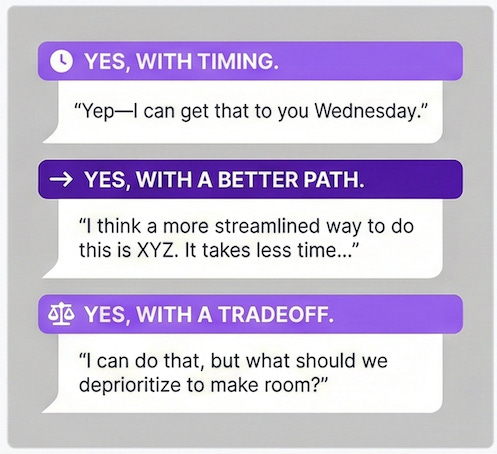
Three ways to say “no” without saying “no”
If you can do this well, you manage expectations, keep relationships intact, and protect your time without turning every boundary into a fight.
Boss #1’s Favorite Test: Can You Be Boringly Dependable?
Jen’s other critical strength is less glamorous but more rare: dependability.
Clients don’t have to chase her or ask twice. In a world where follow-through is inconsistent, “this will happen without reminders” becomes a differentiator.
It’s also a hedge against the “30-day drop” reality. When budgets tighten, it’s easier to cut the vendor who creates friction than the one who quietly makes things work.
Boss #4: The Pipeline Doesn’t Care That You’re Busy
Jen made two mistakes early on that are common. The first was underinvesting in business development.
She focused on doing great work for existing clients, but didn’t consistently carve out time for networking and building a pipeline. The problem is obvious: if you rely on a small number of clients and one drops, you’re suddenly in a hole.
This is where the “six bosses” framework is brutal: your pipeline is a boss. It wants time every week, even when you’re slammed, even when you’re tired, even when you’d rather tell yourself you’ll get to it later.
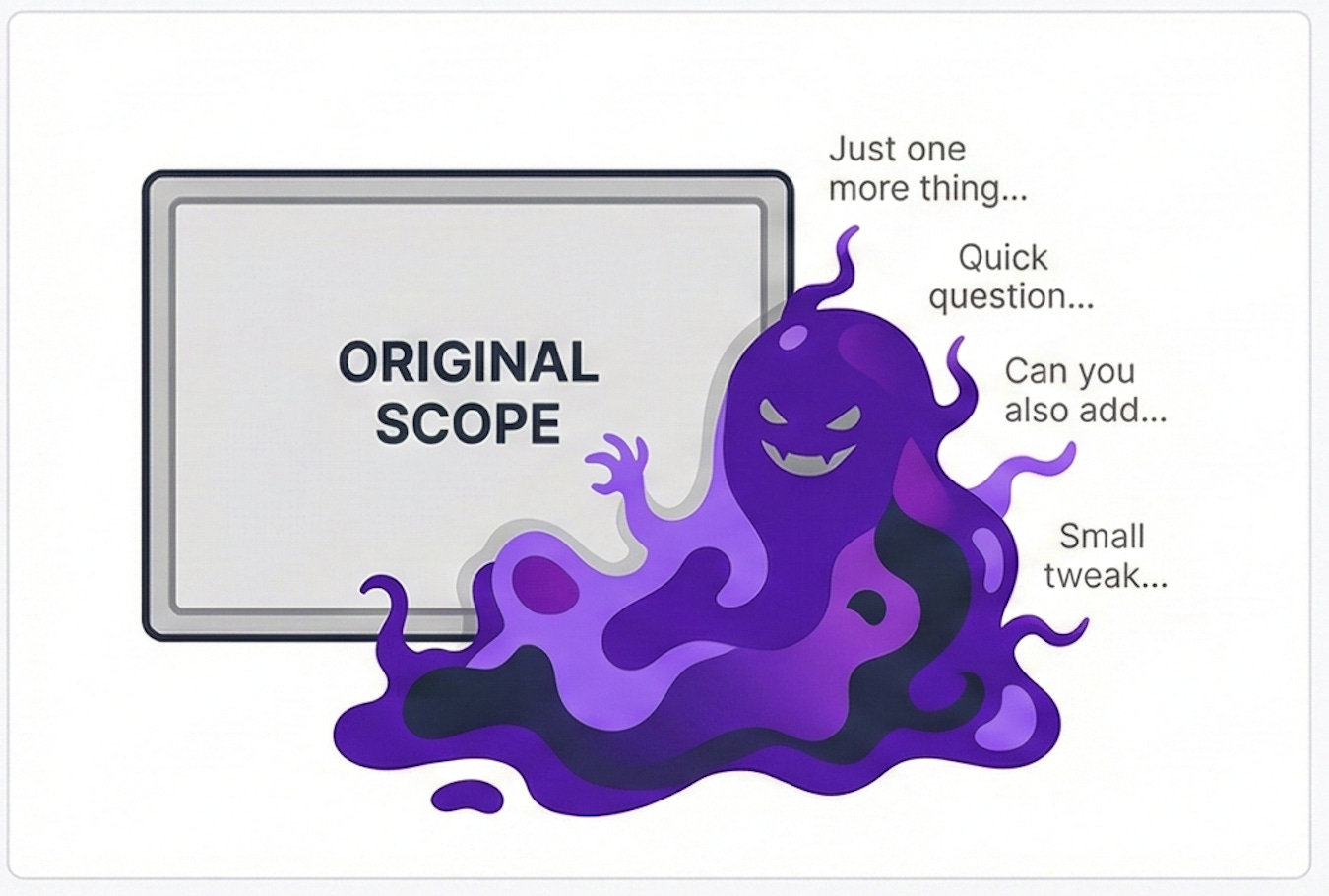
Boss #2: Scope Creep Is a Stakeholder With Teeth
The second mistake was letting scope creep become the norm.
Jen prefers value-based or work-product-based pricing: get paid for delivering outcomes and things she produces, not for hours worked. One client pushed hard for hourly billing. Jen refused, but they still asked for “just one more thing” beyond the agreed deliverables. And because she didn’t like saying no, she kept doing it.
Eventually, they were getting two consultants for the price of one.
Jen ended the relationship, and the lesson stuck: once scope creep becomes normal, it’s painful to claw back. Hourly billing also punishes efficiency. If Jen can do in two hours what someone else takes four hours to do, she shouldn’t earn less for being faster!
Don’t mistake scope creep for misunderstanding. It’s a negotiation. And if you don’t negotiate, you’ll still get negotiated with. Better to grit your teeth and dive in.
Boss #3: The Budget Owner Wants Fewer Vendors
Conventional wisdom says: specialize narrowly. Pick one thing and become known for it.
Jen’s experience is a little different, and the reason comes down to the budget boss.
She started in email, but expanded into SMS, social ads, and even direct mail. On the other side, organizations increasingly want fewer vendors. Budget pressure means fewer internal staff to manage multiple consultants. So if you can cover multiple channels, you become easier to keep.
Jen has even seen consultants lose clients because the “ad people” a client used started offering email, too. The client would rather pay one shop than coordinate four.
Jen isn’t saying to be a generalist at everything. She’s saying that you should be broad across channels, but not scattered across too many organizations. The breadth works because she’s a solo consultant and the offering is her.
Boss #5 (Again): Benefits, Security, and the Reality of Risk
Jen still loves consulting, even with all of this, but she’s also practical about risk.
She recently took a role that was a pay cut compared to pure independent work, butcame with health insurance and a 401(k). That mattered because her Affordable Care Act premium was about to jump.
Jen still consults on the side because she likes having multiple things going. Variety keeps her sharp and keeps options open.
Boss #0 (Again)
Jen’s path, from high school English teacher to digital strategist, wasn’t planned. She followed what interested her and what clients needed. She learned SMS tools because a client required it. She got into ads because a friend needed QA help. She took on direct mail because someone said it wasn’t that different from email.
What made it work wasn’t being the world’s best at a single platform.
It was:
reading people,
delivering consistently,
and setting boundaries without turning every boundary into a fight.
Which brings us back to the real punchline: you don’t lose bosses when you go independent. You just trade one boss for six, and find out whether you can manage all of them at once.