


Over the past year, we’ve published two pieces of research about how independent consultants in the social impact sector actually find clients, and what gets in the way.
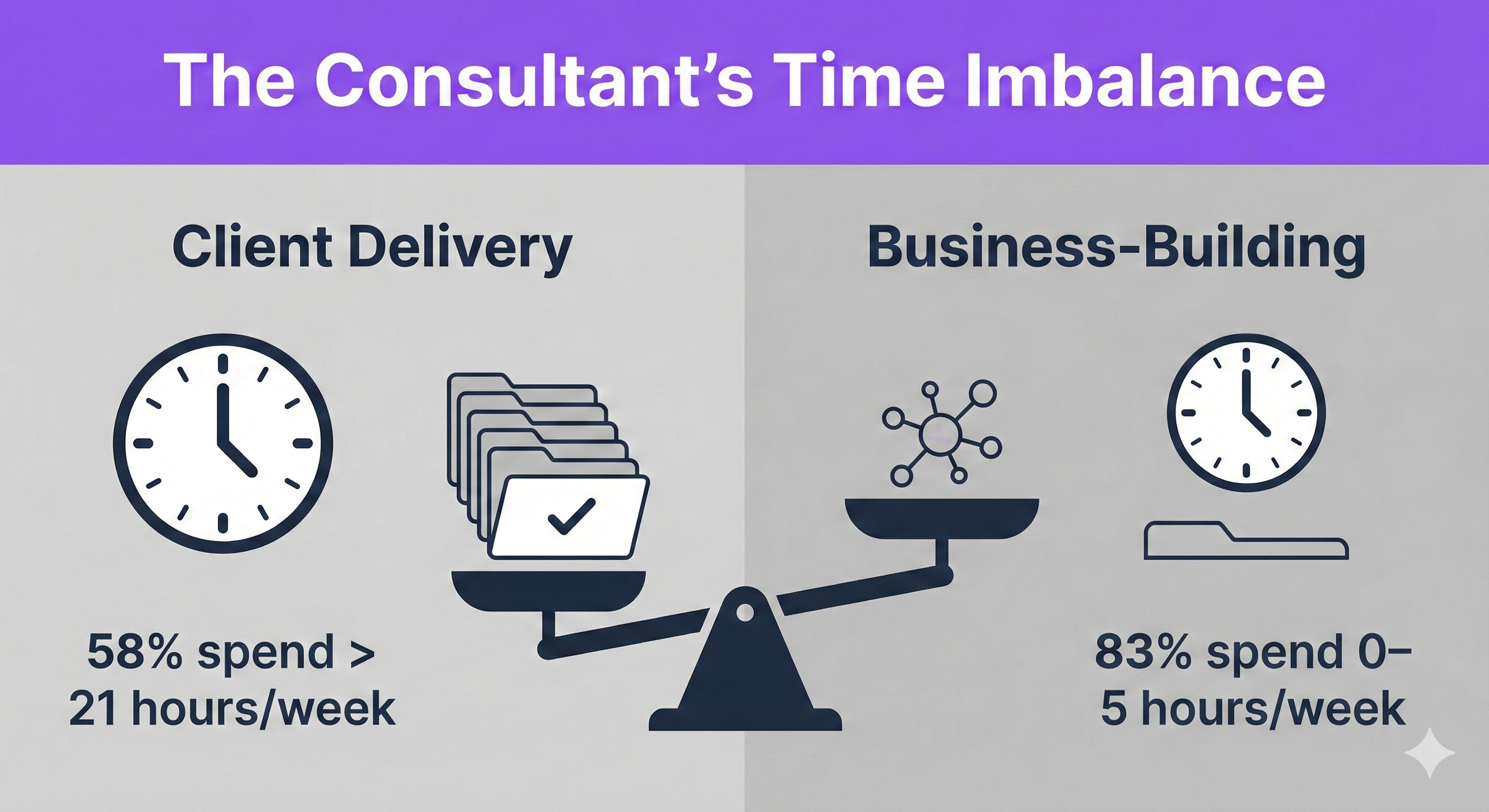
Report #1 (on time and resources) surfaced a stark imbalance: most of you are fully booked with delivery, while business-building gets squeezed into scraps of time.
58% spend more than 21 hours/week on client work.
83% spend only 0–5 hours/week on business-building.
Report #2 (on finding clients) confirmed what we feel in our bones: relationships and word-of-mouth are the most effective channels. Cold outreach ranked lowest.

Put those together and you get a situation that is both comforting and fragile.
Comforting, because you don’t need to become a LinkedIn influencer or a cold-email machine to succeed. Relationships work.
Fragile, because “relationships” as a strategy collapses if you don’t have time to nurture them, and our data says most of you don’t.
That’s where the feast-or-famine cycle comes from. You know how to win new clients, but you are running a relationship-driven business without a relationship-driven system.
If you have less than 5 hours a week for business development, you can’t afford to guess. Here is a lightweight “Research Before Reach” loop to turn your network into a reliable engine.
The Problem: Referral Dependency vs. Strategy
The “Surprising Truth” report makes a strong claim: most work comes through personal networks. But if you’re spending nearly all your week on delivery, you’re essentially hoping your network will produce opportunities on demand.
That’s dependence, and it WILL dry up one day!
It creates inconsistent lead flow, under-qualified leads (nice conversations that go nowhere), and a massive invisible emotional load.
The fix isn’t “more marketing.” It’s tightening your narrative using evidence, not vibes.
A 6-Step Loop for Consultants With No Time
Don’t write a 30-page market landscape you’ll never open again. Do try out this compact system that answers three questions fast: Who buys? Why now? What language do they use?
Here is how to run this loop in a couple hours/week.
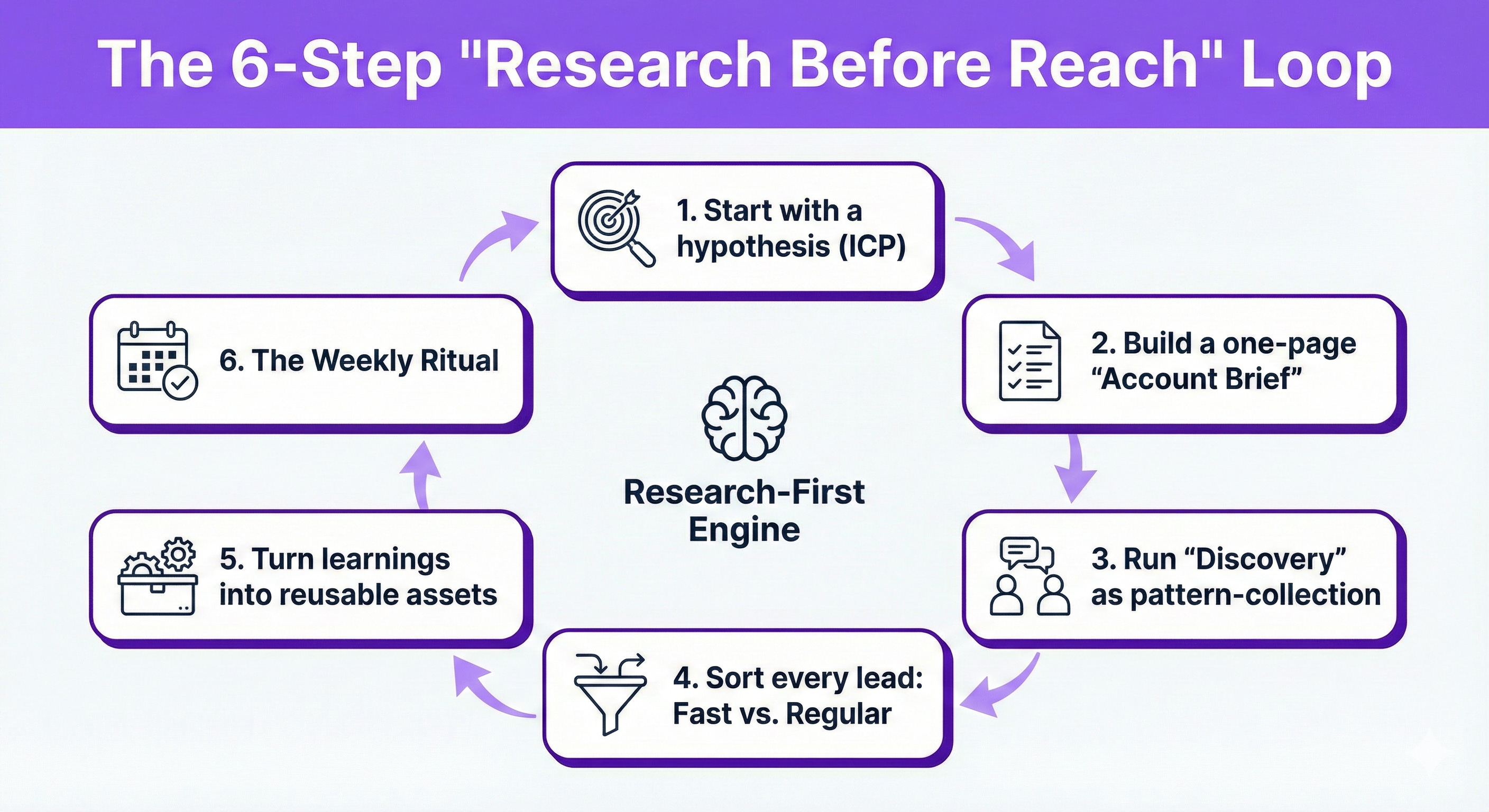
1. Start with a hypothesis you can disprove
Most consultants target broad categories like “nonprofits” or “foundations.” That is a mission category, not a buying category.
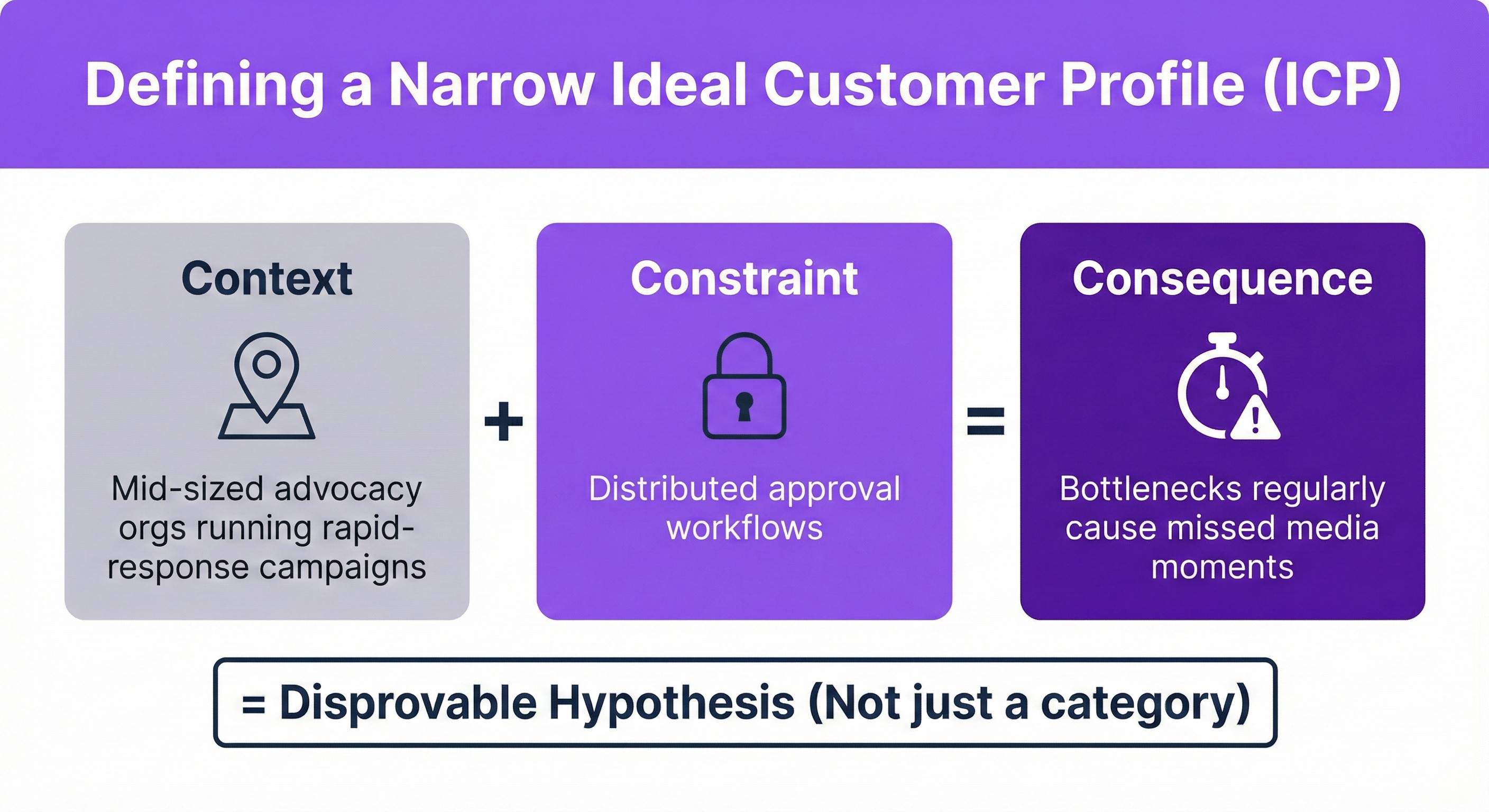
Instead, define a narrow Ideal Customer Profile (ICP) using this formula: Context + Constraint + Consequence.
Bad: “I help nonprofits with comms.”
Good: “Mid-sized advocacy orgs running rapid-response campaigns (Context), with distributed approval workflows (Constraint), where bottlenecks regularly cause missed media moments (Consequence).”
This is disprovable. If you have 10 conversations and learn the real bottleneck is list growth, not approvals, then you revise. That revision is progress.
2. Build a one-page “Account Brief”
This solves the “no time” constraint. Don’t try to know everything about a prospect. For each target organization, capture just five fields based on observable signals:
Year goal: What are they trying to win this year? (Check strategic plans or executives’ messaging).
Forcing event: Is there a deadline, funding shift, reorg, or compliance requirement?
Constraint: Capacity, politics, procurement, or board dynamics.
Pain-holder: Who feels the problem day-to-day?
Budget path: Who can plausibly pay?
Now you are showing up with an informed hypothesis.
3. Run “Discovery” as pattern-collection
Discovery is a structured conversation designed to learn the prospect’s world without rushing to pitch.
In our second report, we talked about the referral multiplier effect: one successful engagement leads to others. Discovery is how you earn that multiplier because it helps you identify the work that actually matters to them.
Listen for the difference between a symptom and a deal:
“We’re behind on outcomes reporting” (Symptom)
“I’m spending Sundays stitching spreadsheets” (Pain intensity)
“If we miss this, our renewal is at risk” (Stakes)
Only the last two predict a deal.
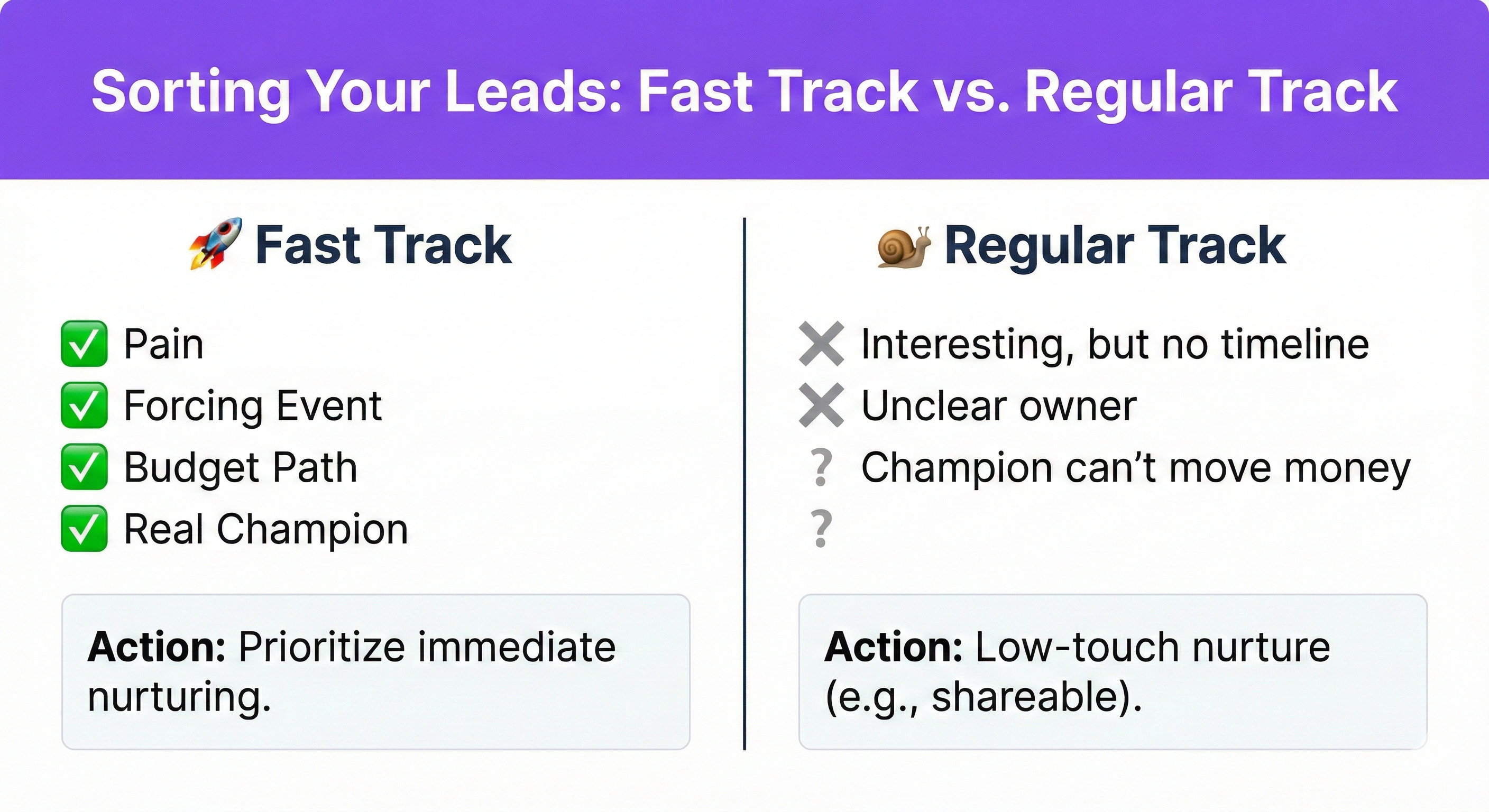
4. Sort every lead: Fast Track vs. Regular
If you only have 5 hours a week for business building, you cannot afford to treat all leads equally. Sorting protects your time.
Fast Track = Pain + Forcing Event + Budget Path + Real Champion.
Regular Track = “Interesting,” but no timeline, unclear owner, or the person who loves you can’t move money.
5. Turn learnings into reusable assets
If relationships drive your work, your job is to make relationship-led growth less labor-intensive. After every 5-10 discovery calls, update three assets:
Positioning sentence: “I help X do Y when Z” (using the buyer’s actual words).
Proof snippets: 3-5 mini-stories with measurable before/afters.
A nurture shareable: A one-pager or checklist you can share that helps your “Regular Track” leads without turning into unpaid consulting.
This makes your referrals easier to activate because you are speaking to an acute, defined pain.
6. The Weekly Ritual
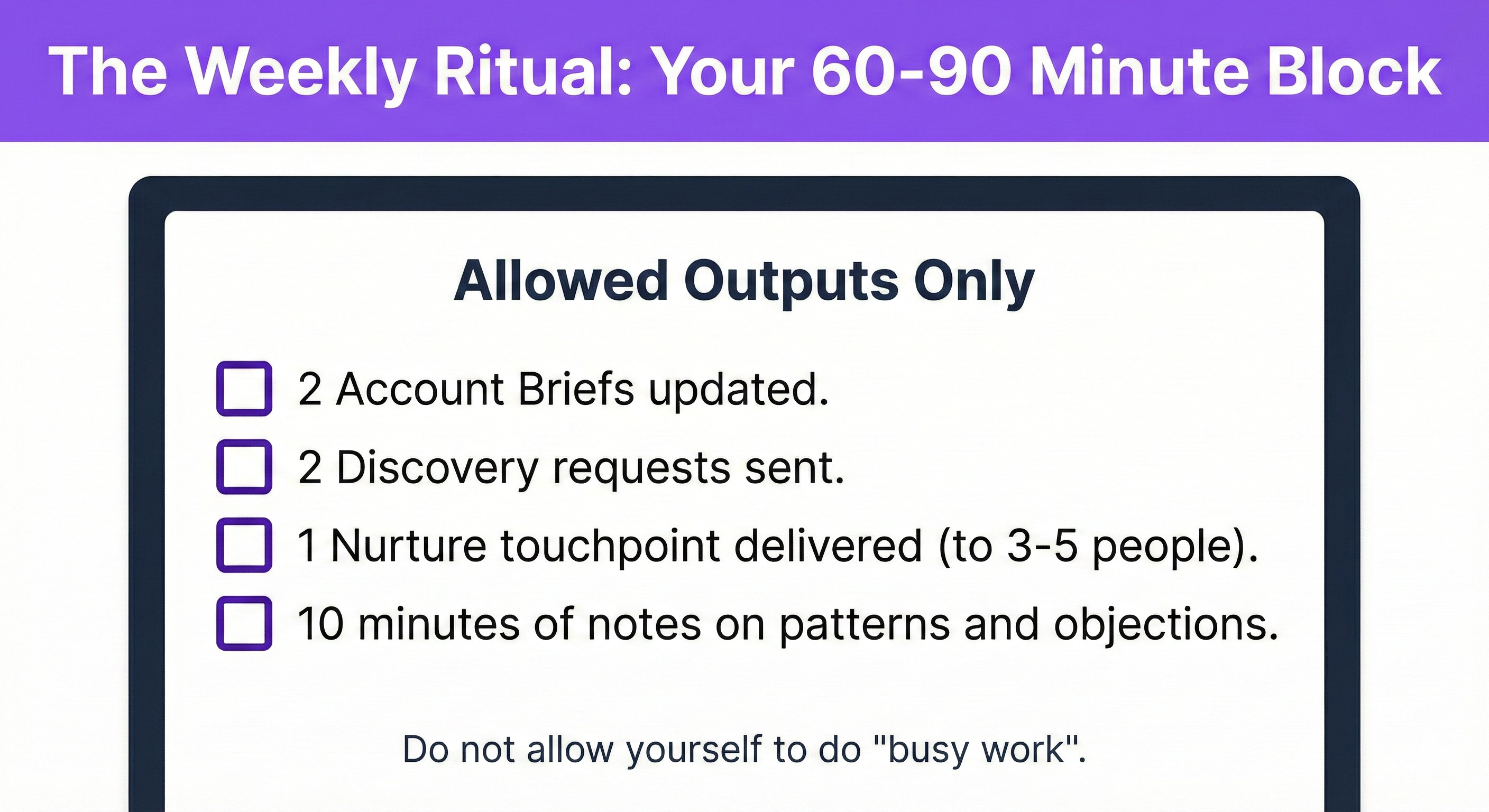
Pick one 60–90 minute block each week. Do not allow yourself to do “busy work.” The only allowed outputs are:
2 Account Briefs updated.
2 Discovery requests sent.
1 Nurture touchpoint delivered (to 3-5 people).
10 minutes of notes on patterns and objections.
Relationships require maintenance
Our findings don’t say “consultants should stop relying on relationships.” They say: relationships are the dominant engine, but the engine is under-maintained.
A research-first loop turns that engine into something steadier. You spend fewer hours chasing low-probability leads, and you give your network clearer reasons to refer you (”Send me people with this specific problem“).
Questions to ponder once you’ve got the basics down:
What are the most common “forcing events” in social impact buying right now?
What is the best proxy for willingness-to-pay among relationship-led leads?
How do high-earning consultants operationalize “nurture” without it turning into unpaid labor?
If you have thoughts on these, hit reply. I’d love to hear what patterns you’re seeing.