


Hi everyone,
We started this series talking about the foundational muscle of a strategic operator: your ability to create space for intentional choice. This is where strategic operating begins, but it’s not enough. You need infrastructure for what comes next; infrastructure that supports a sound strategic operating system. Without this, the best strategic thinkers will still default to sophisticated reactivity, making smart tactical moves that don’t add up to strategic momentum.
This article breaks down that cognitive infrastructure into two toolkits: the Anticipation Toolkit for seeing what’s coming before it arrives, and the Navigation Toolkit for steering through uncertainty without losing your strategic thread. These are specific, learnable skills that change how you process complexity, map implications, and navigate uncertainty in real time. And what’s really cool is we’ll do it through scenarios.
We’ll tackle execution infrastructure — the systems that translate strategic decisions into operational reality — in a later article. For now, we’re focused on the thinking and decision-making skills that separate strategic operators from everyone else who’s just working really hard and hoping it adds up to something.
When Instinct Isn’t Enough
The airport book version of my tagline speaks to the 20+ years I’ve spent in executive and management positions. But the real tagline is about the strategic boot camp I’ve been in for the past 6 years: milestones marked by deafening hammer blows of parenting.
The contexts look different — one involves quarterly projections and stakeholder management, the other involves bedtimes and screen time negotiations — but the emotional experience is identical.
You’re making consequential choices with incomplete information, watching for signals that might mean everything or nothing, second-guessing yourself at 2am, and wondering if the path you chose today will reveal itself as wise or foolish five years from now. Whether you’re deciding to restructure a department or whether to let your kid quit piano, the gnawing question is the same.
How do I know I’m getting this right?
The answer, unfortunately, is also the same: you don’t, you won’t, but you can make the best possible decision, most of the time.
What we all really want is to feel confident that we are making the right decisions, or at least the best decisions possible given what we know, most of the time. Not perfect decisions. Not decisions that never need adjustment. Just the consistent ability to look at complex situations and choose paths that actually advance your objectives instead of creating new problems you’ll spend months (or years) untangling, paying for, or, in the case of your child, a lifetime hearing about.

Wheel-spinning at work (or with kids) is frustrating, exhausting and demoralizing, but it’s unsound decision-making that we are (and should be) most scared of. And the real pain is that most bad decisions don’t feel bad at the moment. They feel necessary, urgent, obvious — until the downstream effects start showing up, you realize what you missed, and then you look for the closest wall to bang your head on or the nearest window to throw your computer out of.
The Need For Infrastructure
The difference between leaders who consistently make sound decisions under pressure and those who don’t isn’t intelligence or experience. It’s infrastructure.
Strategic operators rely on a cognitive operating system — systematic ways to anticipate what’s coming and navigate uncertainty — that works at speed and scale. Without this infrastructure, you can’t maintain strategic perspective when decisions are coming fast or when you’re managing complexity across multiple initiatives simultaneously.
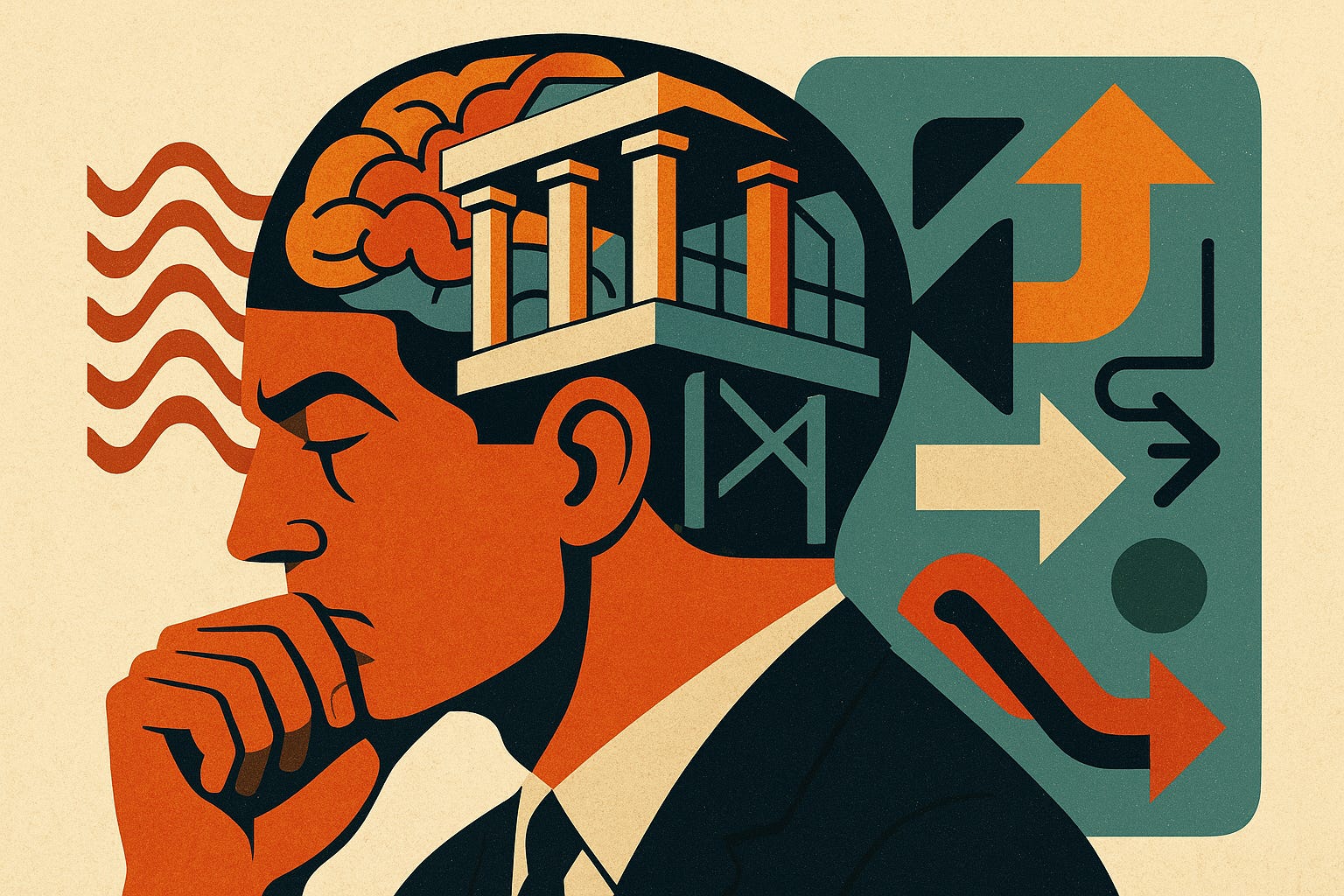
You revert to pattern-matching and instinct. And while pattern-matching and instinct can serve you well — even the best leaders rely on them — they only get you so far. Pattern-matching works until you encounter a situation that doesn’t match your previous patterns.
Instinct serves you until the context shifts in ways your gut hasn’t calibrated for. Strategic operating requires more than good instincts. It requires systematic thinking that helps you see what instinct alone will miss.
The Anticipation Toolkit: Skills for Seeing Around Corners
These skills help you map what’s coming before it arrives — not through prediction, but through systematic thinking about implications, vulnerabilities, and how systems respond to change.
For each skill, we’ve linked a scenario for how this plays out in your work-life.
Trade-offs and downstream effects is really three interconnected skills that teach you to map decision space in three dimensions. Risks show you what you’re vulnerable to. Trade-offs surface what you’re giving up with each choice. Downstream effects trace how your decision ripples through the system over time. Together, they keep you from making choices based only on what’s visible in the immediate moment.
Check out the scenario here.
Inversion is the practice of approaching problems backward—instead of asking “how do we succeed?”, asking “how would we definitely fail?” This skill reveals blind spots and unstated assumptions that forward-thinking misses entirely. Strategic operators use inversion to stress-test their plans by identifying all the ways things could go wrong, then working backward to prevent those failures.
Second and third order thinking takes you beyond the immediate consequence of a decision to map what happens next, and what happens after that. First-order thinking stops at “if we do X, Y will happen.” Strategic operators push further: “and when Y happens, what does that trigger? And when that triggers, what systemic shift does it create?” This skill keeps you from winning battles that lose you the war.
Check out the scenario here.
Root cause thinking is what separates people who solve symptoms from people who solve problems. It’s the discipline of asking “why” until you get to the structural issue creating the pattern you’re trying to change. In anticipation mode, root cause thinking helps you see what’s actually driving the dynamics you’re responding to—so you’re not building strategy on top of misdiagnosed problems.
Check out the scenario here.
The Navigation Toolkit: Skills for Moving Through Uncertainty
These skills help you steer when circumstances shift—making deliberate choices about what to preserve, what to abandon, and how to maintain strategic momentum when your original plan meets reality.

Backup plans and contingency strategies separate hope from strategy. Strategic operators don’t just have a plan A—they’ve identified the specific triggers that would signal plan A isn’t working, and they’ve pre-built the pivots they’d execute in response. This isn’t about pessimism; it’s about not being caught flat-footed when circumstances shift.
Check out the scenario here.
Sustainable success versus short-term wins is about distinguishing between outcomes that build capacity and outcomes that just look good on this quarter’s scorecard. Strategic operators know the difference between a win that creates momentum and a win that depletes resources. This skill keeps you from optimizing yourself into a corner.
Check out the scenario here.
Root cause thinking also serves navigation by ensuring you’re solving actual problems instead of managing symptoms. Without this skill, you’re constantly busy, constantly firefighting, and never actually fixing anything. In navigation mode, root cause thinking keeps you from repeatedly pivoting away from surface-level issues while the structural problem continues generating crises.
Check out the scenario here.
What This Looks Like in Practice
When you’ve developed these skills, your decision-making process changes fundamentally. You don’t need perfect information because you’re not trying to predict the future. You’re choosing the path that gives you the most strategic flexibility across multiple possible futures. You’re naming what you’re willing to risk, what you’re choosing not to do, and what chain reactions you’re setting in motion.
You’ve already inverted the problem to identify failure modes. You’ve traced second and third order effects to see where the decision leads three moves out. You’ve built contingencies for the scenarios that would actually threaten your objectives. You’ve diagnosed what’s actually causing the pattern you’re trying to change.
You stop being surprised by consequences you could have anticipated. You stop optimizing for metrics that don’t actually advance your goals. You stop solving the same problems repeatedly because you never addressed what was causing them. You stop getting caught without options when your initial plan hits reality.
You become someone who sees around corners—not because you’re clairvoyant, but because you’ve built the infrastructure to systematically think through implications before they become emergencies.
What’s Coming
Over the next several articles, we’ll do deep dives into each skill in the Anticipation and Navigation toolkits—what they are, how they connect, and how to use them to make better decisions under uncertainty.
Each article will give you specific frameworks and tools you can apply immediately and show you the common traps that keep strategic operators from seeing these elements clearly.
Once we’ve built out your anticipation and navigation capabilities, we’ll tackle the execution toolkit—the infrastructure that translates strategic decisions into operational reality. Because even the most brilliant strategic thinking means nothing if you can’t actually make it happen.
We want to hear from you!
If any of this landed with you—whether you’re in the thick of these challenges or you’ve developed strategies that work—we want to hear about it. We’re scheduling 20 minute conversations with leaders to understand what’s helping you stay grounded as a strategic operator and where you’re struggling. Your insights will shape how we build this series and similar future projects. Send us an email at info@hookrodgersconsulting.com if you want to schedule a conversation.