
In early 2025, we surveyed independent consultants working in the social impact space about how they price their work. What follows is a summary of what they told us — about their fee structures, their rate-setting logic, and the gaps in their confidence.
Who Responded
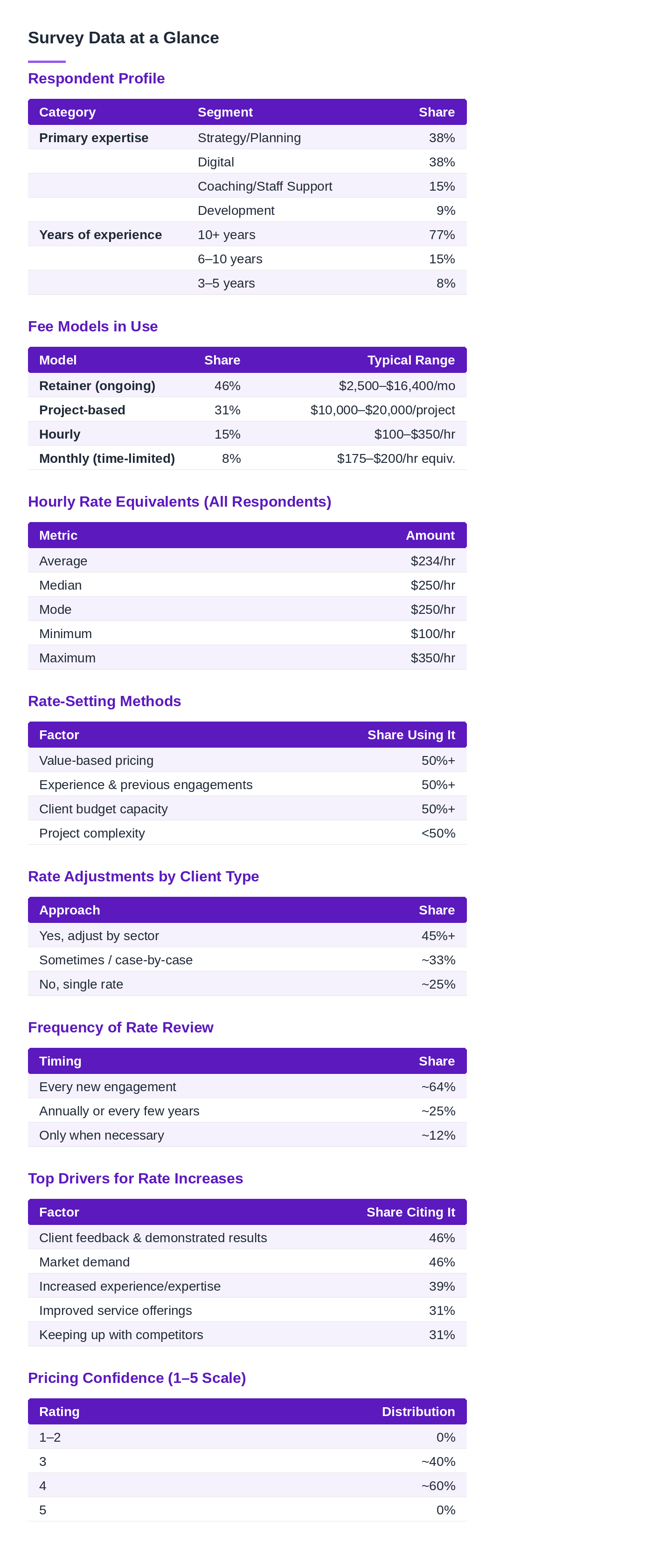
The group skews experienced. More than three-quarters have been consulting for 10+ years, with another 15% in the 6–10 year range. Only 8% have been at it for fewer than five years. Primary areas of expertise split almost evenly between strategy/planning and digital work (38% each), with coaching/staff support at 15% and development at 9%.
How They Charge
Retainers are the most common fee model, used by 46% of respondents. Monthly retainer rates range from about $2,500 to $16,400, with most consultants targeting an hourly equivalent somewhere between $150 and $350. Project-based fees come next at 31%, with project rates typically landing between $10,000 and $20,000 (or $1,500–$2,500 per day for those who think in daily terms). About 15% bill hourly, ranging from $100 to $350 per hour. The remaining 8% use short-term monthly arrangements, usually targeting $175–$200 per hour equivalent.
Most consultants don’t stick rigidly to one model. They shift depending on the client, the scope, and the relationship.
What They Earn
Compressing all the responses into hourly equivalents, the average rate works out to $234 per hour. The median and mode both sit at $250. The floor is $100; the ceiling is $350. Most consultants aim for or exceed a $150–$200 benchmark in practice, though they’ll flex in either direction depending on the engagement.
How They Decide What to Charge
More than half the respondents use value-based pricing — pegging their rate to the perceived impact for the client rather than simply counting hours. An equal share relies on experience and previous engagements as their primary benchmark. Client budget capacity is just as common a factor: consultants adjust within a range depending on what the organization can bear. Project complexity matters too, though fewer than half cited it as a primary driver.
Nobody’s using just one of these inputs. Everyone is triangulating.
Do They Charge Nonprofits Differently?
Yes, mostly. Over 45% adjust their rates based on client type, typically discounting for nonprofits or organizations whose mission they believe in. About a third keep rates consistent in principle but negotiate in special cases. Roughly a quarter charge a single rate regardless of sector, guided by project factors rather than client type.
Do They Publish Their Rates?
Almost universally, no. Only one respondent makes rates publicly visible. The rest prefer the flexibility to tailor proposals to each engagement — which makes sense given how many variables they’re already juggling.
How Often They Revisit Pricing
Almost two-thirds reevaluate their rates with every new engagement. About a quarter review annually or every few years. The rest change rates only when forced to by rising costs or new market information. This is a group that thinks about pricing frequently, even if they don’t always act on it.
What Pushes Rates Up
The top drivers for rate increases: client feedback and demonstrated results, tied with market demand (both at 46%). Increased experience and expertise came next at 39%. Improved service offerings and competitive positioning tied at 31%.
How Confident They Feel
On a 1–5 scale, nobody picked 1 or 2 — but nobody picked 5, either. Everyone clustered at 3 or 4, with 4 getting roughly 50% more votes than 3. This is a group that feels competent but not fully calibrated. They know they’re in the right neighborhood; they’re less sure they’re in the right house.
What They Want Next
The recurring requests: examples of what competitors charge, case studies comparing retainer versus project-based versus hourly models, strategies for pitching retainer arrangements to clients, simple negotiation frameworks, and guidance on billing for travel, site visits, and other add-ons. The theme across all of it is that consultants want more comparative data. Pricing in this sector is a private conversation by default, and most people have a nagging suspicion that they’re operating with incomplete information.
They’re probably right.
What This Tells Us
There’s no standard rate for independent consulting in the social impact space — and there probably shouldn’t be. The range is too wide, the variables too numerous, and the client relationships too varied for a single number to mean much. But a few patterns are clear: experienced consultants gravitate toward retainers, most calibrate rates against multiple factors simultaneously, and nearly everyone wants more transparency from their peers about how pricing actually works.
We’re planning an updated version of this survey later this year. If you’d like to participate or have suggestions for questions we should add, let us know.
Appendix