


The Discovery Call
The first discovery call I ever took as an independent consultant, I talked for most of it. I described my background, explained my approach, and walked through examples of past work. The potential client was polite and asked a few questions. We scheduled a follow-up.
I never heard from them again.
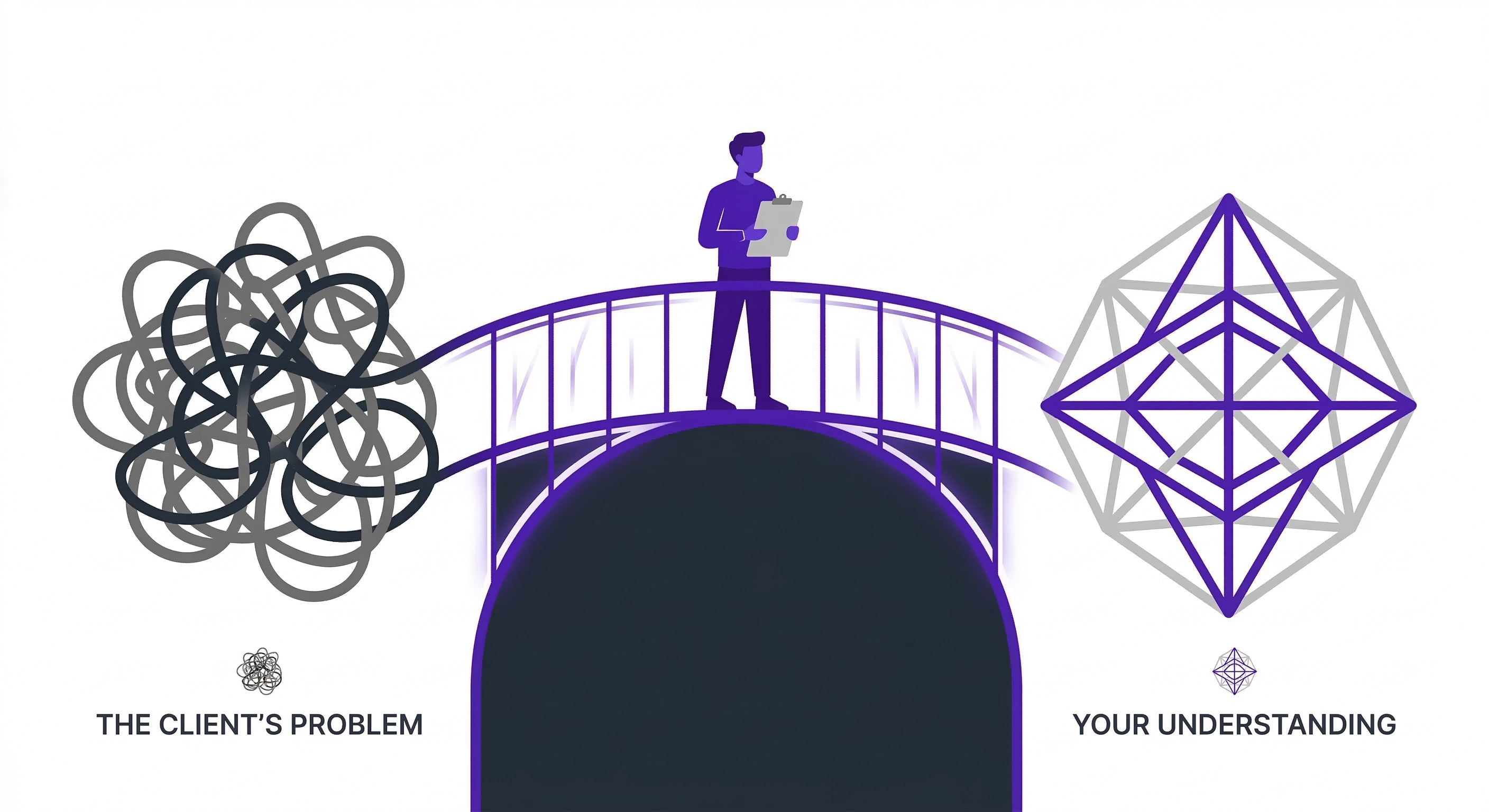
What I understand now is that I had it backwards. A discovery call isn’t a pitch, so your job is not to demonstrate that you’re impressive. The point to understand the problem well enough that you can describe it back to the client better than they can describe it themselves. When you can do that, the proposal almost writes itself.
What are we talking about?
A discovery call is a structured first conversation with a potential client — typically thirty to sixty minutes — where your goal is to understand their problem, their context, and whether there’s a genuine fit before either of you commits to anything. It usually happens after an initial introduction or referral, once someone has expressed enough interest to warrant a real conversation, but before you’ve written a single word of a proposal. Think of it as the difference between a first date and an application: you’re not trying to close anything, you’re trying to find out if there’s something worth closing.
Here’s how I structure them.
Before you dial in
Do thirty minutes of research. Look at recent board decks, annual reports, press, and their job postings. Job postings are underrated. They tell you where the organization is investing and what they can’t get done internally.
Your goal is to come in knowing something specific. It signals that you take the engagement seriously before it’s even an engagement.
The opening (two minutes)
I always start by resetting the purpose of the call. Something like:
I want to spend most of our time understanding what you’re dealing with. I have some questions prepared, but treat this as a conversation. I’m less interested in presenting myself than in understanding whether there’s a real fit here.
This does two things. It gives the client permission to talk, which most people want to do. And it signals that you’re not desperate, which changes the power dynamic in ways that matter later when you’re negotiating scope and rates.

Understand the problem (ten to twelve minutes)
Start broad, then go deep. The opening question I almost always use is some version of:
Walk me through what’s going on and what made you reach out now.
The word now is doing real work in that sentence. Organizations often live with problems for years before hiring someone to address them. Something has changed: a new ED, a funder pushing for evaluation, a grant that came through, or (hopefully not, but sometimes!) a crisis. Understanding the triggering event tells you a lot about the urgency of the problem and the political dynamics around it.
After they answer, I go deeper with:
How long has this been an issue? What have you already tried?
What they’ve tried (and why it didn’t work) is often the most useful intelligence you’ll gather on the whole call. It tells you about the constraints they’re operating under, the internal politics, and what a realistic solution actually needs to account for.
The follow-up I use most often:
Can you give me a specific example of where this showed up recently?
Abstract problem descriptions are hard to scope, but a concrete recent example is something you can actually work with.
Understand what success looks like (five minutes)
This is where most consultants don’t push hard enough. What does good look like a year from now? is fine, but it’s not specific enough. I push further:
If you looked back six months from now and said ‘that was exactly what we needed,’ what would have happened? What would be different?
Sometimes clients have very clear answers. Sometimes they don’t, and the vagueness is informative. An organization that can’t articulate what success looks like is going to have a hard time evaluating your work, which can create problems downstream.
I also ask:
Who else will have a view on whether this went well?
This surfaces the political landscape — funders, board members, program staff, whoever’s affected — and helps you understand whether the person you’re talking to actually has the authority to define success.
Qualify (five minutes)
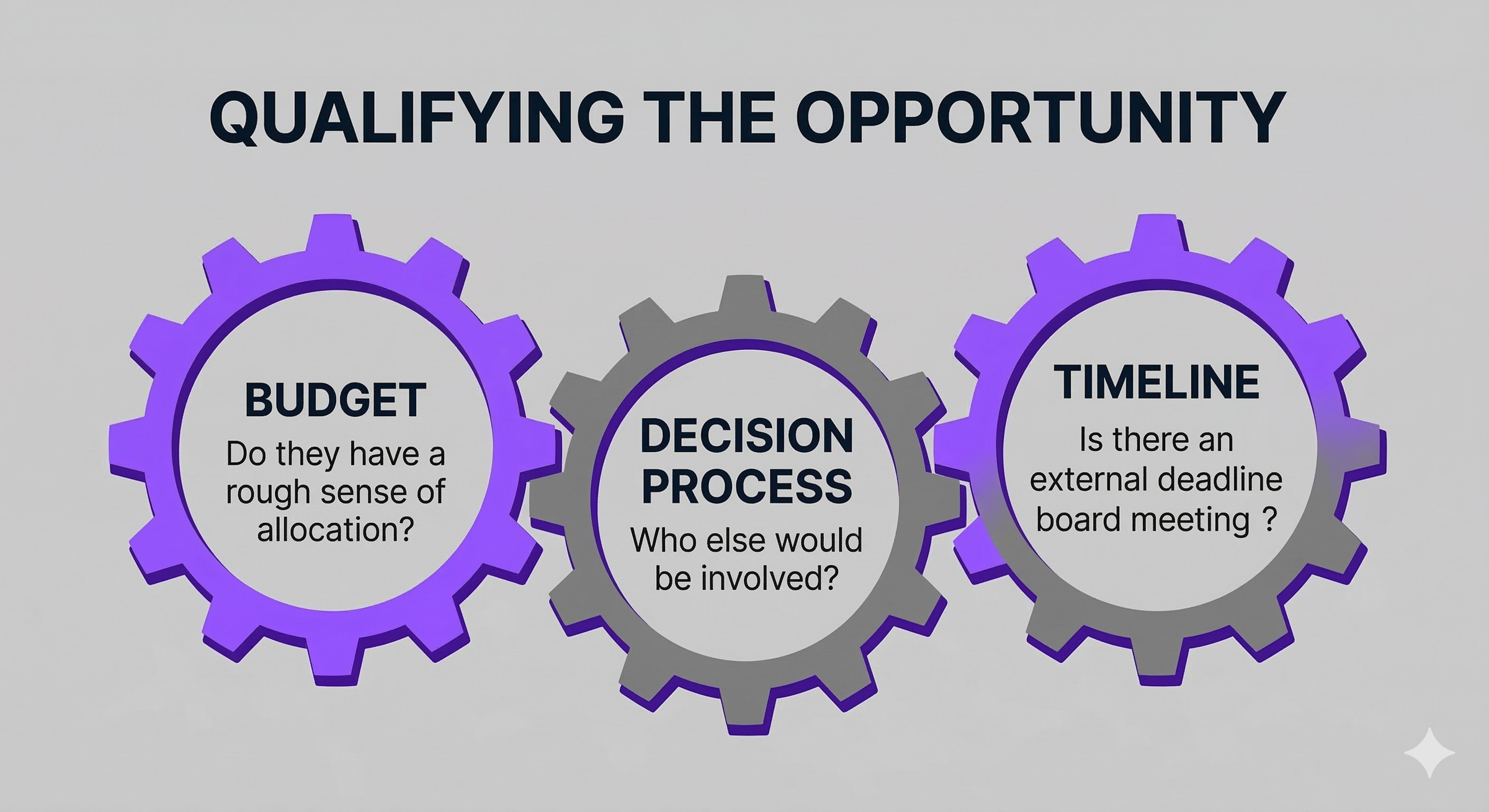
You need to know three things before you’ll be able to close any new engagement: budget, decision process, and timeline. A potential client who checks all three boxes is “qualified.”
On budget:
I want to make sure we’re in the same ballpark before we go further. Do you have a rough sense of what’s allocated for this?
Most clients expect this question. If they deflect completely, that’s a signal worth noting.
On decision process:
Walk me through what happens after this call on your end. Who else would be involved in a decision like this?
This tells you whether you’re talking to the actual decision-maker, whether there’s a committee, whether there’s a procurement process you’re not expecting.
On timeline:
Is there a point by which you’d need something in place like a board meeting, a grant deadline, something else?
Timeline pressure is often what separates a real engagement from an exploratory conversation that goes nowhere.
Listen for the emotional charge
This is the part that matters most. As the client is talking, pay attention to which problems they describe with urgency and which ones they describe flatly. Both matter, but the felt ones are what will actually motivate action.
When something comes up that seems emotionally loaded — frustration, embarrassment, real urgency — go deeper. Don’t move on. Ask them to say more. Ask what it costs them when it doesn’t get addressed. That’s where the real scope is.
Close the call (two minutes)
I don’t try to book the next meeting at the end of a discovery call. I say something like:
This has been really helpful. I want to think about what I’m hearing and come back to you with a sense of how I’d approach this. Does that work?
This gives you time to actually think, which means you’ll write a better proposal. It also signals that you’re not going to immediately paper over their problem with a scope of work you wrote in an hour. Most clients find that reassuring.
Then I send a follow-up the same day that reflects back what I heard: the problem, the stakes, what success looks like. Two things could happen. If I got it right, the client feels understood, which builds trust. If I got something wrong, they’ll tell me, and I’ve learned something important before I write anything.

The hidden purpose of a discovery call
The discovery call is also the moment you decide if you want the work. You’re evaluating them as much as they’re evaluating you. Is the problem real? Is the organization positioned to act on your recommendations? Is the person you’re talking to actually going to be a reasonable client?
I’ve left discovery calls knowing the work was real but the engagement would be painful. Taking those projects anyway is almost always a mistake. The call is information. Use it.