



The day Michaela Howard passed her coaching exam, she celebrated by… putting diesel in her car. Not because she meant to! Because she was excited, distracted, and doing too many things at once.
That’s a pretty good snapshot of independent consulting. You’re capable and committed. You’re also juggling a dozen invisible balls, and that’s exactly why most business development advice doesn’t stick. It assumes you have spare afternoons, boundless energy, and a personality built for relentless outreach.
In our research with social impact consultants, 89% spend less than five hours per week on business development even though most say it’s critical to their success. Meanwhile, 67% report being regularly overcommitted when work does come in, trapped in the feast-or-famine cycle that defines so much of independent consulting.
Michaela’s first year as an independent consultant looked like what many of us quietly experience: lots of capability, not enough clarity, and a persistent sense that “I should be doing more.” As she put it, “I don’t think people knew what to hire me for.” She had coaching expertise, consulting experience, and a background in organizing and nonprofit work. She could do almost anything, which meant potential clients couldn’t picture her doing any specific thing.
Then something shifted. Michaela built a business development practice small enough to actually keep. Within three months, she went from her slowest period to her busiest ever.
I have long admired Michaela’s approach. I’ve seen her deliberate LinkedIn posts and creative lead generation strategy. So I asked her to chat with me about what she’s tried, learned, and can share with others.
The Mistake of Waiting for the Perfect Afternoon
Michaela’s early attempts at systematic business development followed a familiar pattern.
“I thought I needed a big chunk of time,” she explained. “I would say to myself,I need to devote an afternoon to business development. And because of that, I need a whole long list of people that I’m going to reach out to.”
She would block the time on her calendar, but when the time came, she didn’t have the momentum. She would do other things and the list never got built. Business development kept getting pushed to tomorrow.

Everything changed when she started working with Rebecca Van Damm, a marketing advisor who defines herself as a “thought partner for thought leaders”. Rebecca asked a great question.
“What if it doesn’t have to be an hour? What if it was just a little bit every day?”
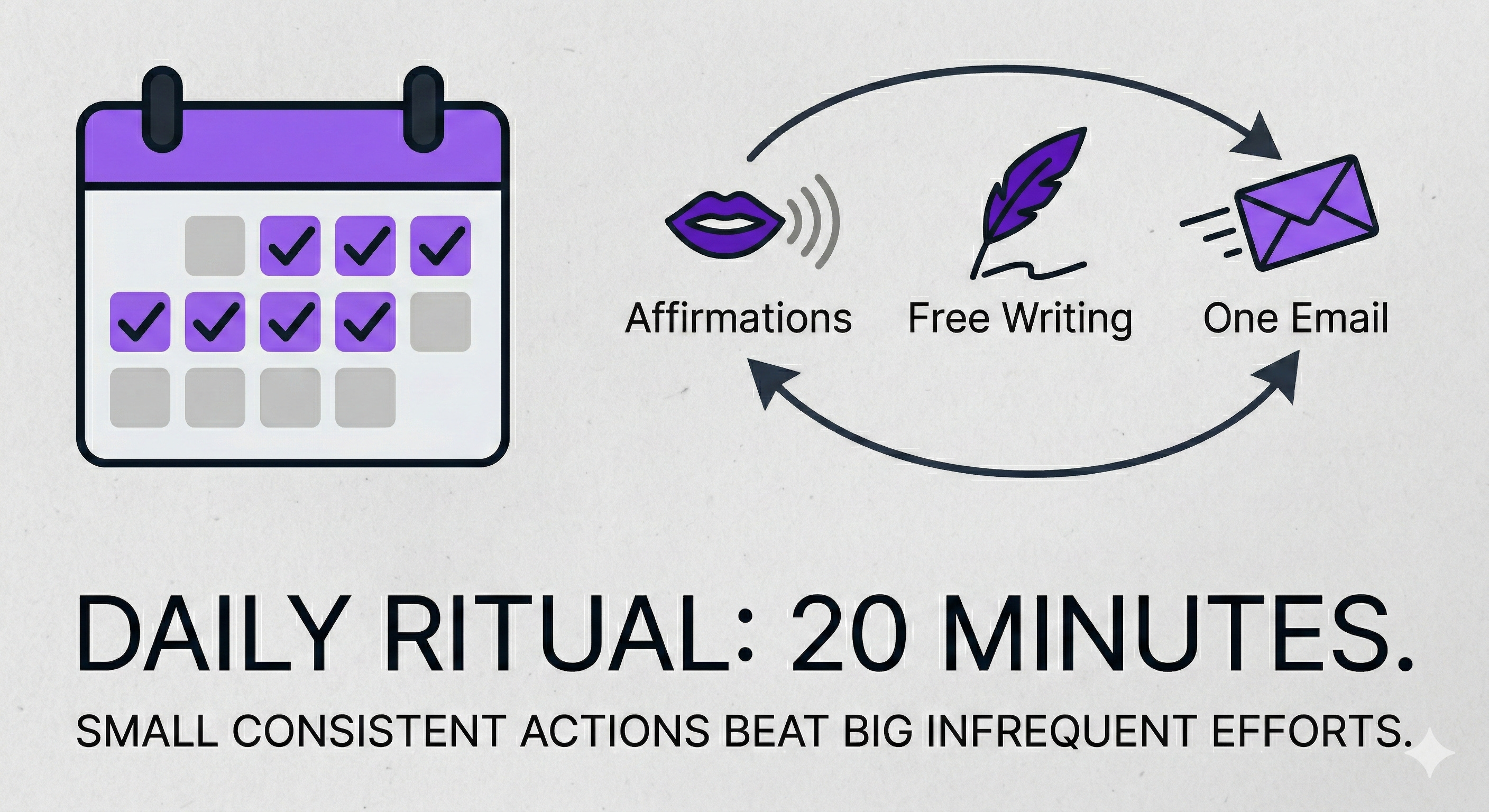
Together, they created a daily morning ritual. Michaela committed to three actions: positive affirmations to address all her business fears, ten minutes of free writing, and three business development emails per day. After two weeks, three emails felt like too many, so she adjusted to one email per day.
That flexibility is part of why it works.
The Minimum Viable Business Development (BD) Practice
By “business development,” Michaela means any outreach or connection that keeps her network active and aware of her work: reconnecting with former colleagues, following up on past conversations, reaching out to potential collaborators, or staying in touch with people she genuinely values.
The core of Michaela’s approach isn’t “networking” in the cringe sense or cold outreach to strangers. It’s a small daily habit that keeps her relationships warm and her thinking sharp.
Michaela’s Minimum Viable BD Practice (20 minutes/day)
Affirmations (2–3 minutes): out loud, positive, and addressing her loudest fears at the moment
Free writing (10 minutes): brain dump, polishing drafts, or scheduling a post
One email (5–10 minutes): any outreach that maintains connection: a check-in, a follow-up, a response, or a quick reconnection.
The key is consistency.
Direct BD vs. Ambient Credibility: The Two-Speed System
This is where Michaela gets especially practical.
The email is direct business development: it creates conversations, reopens relationships, and surfaces opportunities.
The writing is ambient credibility: it’s how people remember what she does, how she thinks, and why they should reach out.
Some days her ten minutes of writing is a pure brain dump. Other days it becomes a LinkedIn post. Over time, that practice helped her develop a consistent LinkedIn presence, first posting weekly then twice per week.
Michaela doesn’t see LinkedIn as business development exactly, though a few clients have found her there.
“To me, Linkedin is about developing my thought leadership on what’s important to me and staying visible” she said. “And maybe it’s a validator. I hope people see my posts and think, oh right, I need to email Michaela about that thing.”
She started this daily practice in July during a slow period. By the fall, Michaela’s calendar had filled up.
Three Copy/Paste Templates You Can Use Today
If your brain locks up when you try to “do Business Development,” steal these ones from Michaela. They’re intentionally simple, warm, and not sales-y.
1) The low-pressure check-in (warm contact)
Subject: Quick catch-up?
Hey [Name],I realized it’s been a while since we connected, and I’d genuinely love to hear how things are going with [work/project].
No agenda on my side, I just thought of you and wanted to say hi. If you’re up for it, want to grab 20 minutes sometime in the next couple weeks?
– Michaela
2) The guilt-free follow-up (assume the best)
Subject: Bumping this up (no rush)
Hey [Name]I am following up in case this got buried. I totally understand if the timing is hectic.
If it is a no or “not now,” feel free to tell me, no worries either way. I appreciate you keeping me in the loop.
Warmly,
Michaela
(Michaela’s mindset here is key here. She shared with me that nine times out of ten, they just lost it in their inbox.)
3) The “specific but brief” Slack/listserv post
Hi [community], I recently partnered with a small organization to build a simple, values-aligned competency model that [clarified what skills are essential at every level of the organization, set clear expectations, etc]
We created something they can now use for skills-based performance management, hiring, and leadership development systems.
This is one way I love supporting organizations as they strengthen their leadership development pathways.
If you’re thinking about evolving this work in 2026, especially in ways that support transparency, clarity, and staff growth, I’d love to connect. Schedule time to discuss:[Booking link]
This works because it’s concrete. It names a real deliverable, and it makes the next step easy.
Starting Where Networking Feels Natural
For years, Michaela avoided networking. She had worked as a recruiter, a job that required constant cold calls. The experience turned her off to anything that felt like “prospecting.”
When she started her consulting practice, she realized she’d been defining networking in the narrowest, most unpleasant way.
“There are all these people from my network that I haven’t kept in good touch with that I actually just genuinely want to catch up with,” she said.
That became her starting point: low-stakes conversations with people she actually wanted to talk to. Those conversations built her confidence because she was “practicing sharing what I’m up to on people that I really wanted to talk to.”
She also got more intentional about why she was reaching out.
“Have an objective,” she advised. “And also get clear on what’s important to you to communicate to them about what you’re doing and how they can help.
“What’s more interesting: Focusing on your fear of imposing? Or focusing on your curiosity and desire to reconnect with your network? I choose curiosity and remember that I’m not ‘pitching.’ I’m reconnecting with intention”
One thing that’s helped her feel more comfortable with this kind of connection is to ask everyone how she can support them, too. It demonstrates that these touchpoints are a two-way street.
What Didn’t Work
Not every experiment worked.
Michaela tried offering free webinars and workshops, some solo and some with collaborators. One on “naming and taming your organizational ghosts” drew good attendance and positive feedback. But none of the free offerings turned into business.
Looking back, she sees what was off: the energy was subtly transactional.
“I think I was too focused on what I wanted out of it than what value I was delivering.” Michaela admitted. “ No one wants to go to a workshop and be sold something.”

If she were to do workshops again, she’d change three things:
Choose content based on what she now knows resonates with clients
Charge a small amount so people make a mutual investment and actually show up
Treat it like a gift: deliver genuine value you can stand behind and are genuinely excited to share with more people
Meanwhile, one tactic has worked: occasional promotion in targeted Slack groups and listservs. However, it’s very important to make sure you’re operating within the rules of your group. Many networking Slack groups and listservs have a “no pitches” policy, or a specific channel for promotion. Michaela takes care to follow the rules of the group, and uses this tactic purposefully and infrequently to make sure it will really stick.
The Clarity That Comes From Doing
The daily practice gave Michaela something she didn’t expect: clarity about what she actually offers.
At first, her message to the market was basically “I can do anything.” And she could. But “anything” is almost impossible for a client to buy.
As she got more deliberate about business development—having conversations, following curiosity, noticing patterns—she realized something important: her work had a through-line.
“The through-line for all of my work is leadership development,” she said.
Her consulting (performance management systems, facilitation, training) was leadership development. Her coaching was leadership development. What had long felt like two separate tracks were actually reinforcing each other.
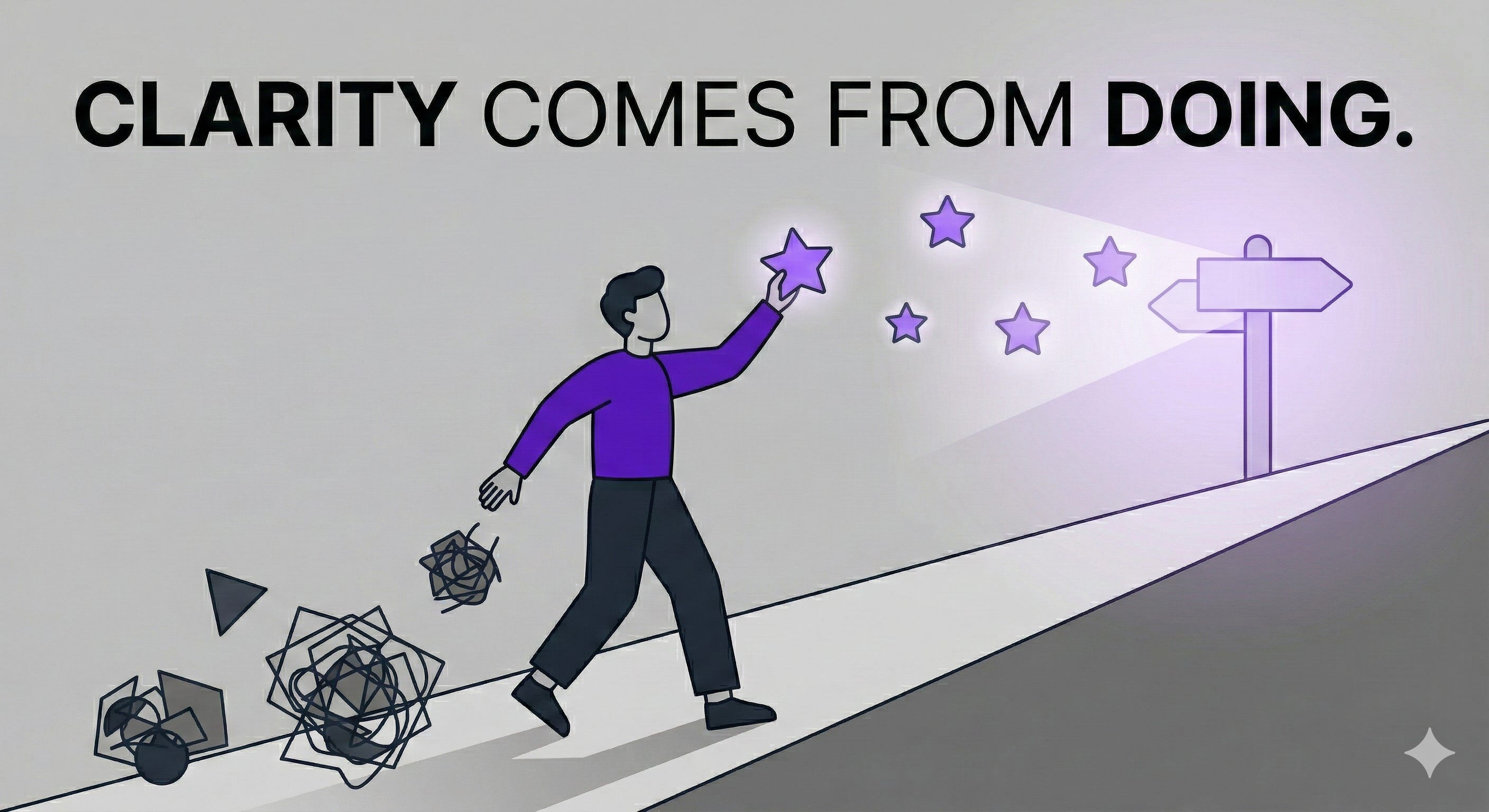
That clarity came from doing the work of staying in motion: sending one email, having one conversation, noticing what resonated, and learning what people actually wanted to hire her for.
Business development isn’t just how you find clients. It’s also how you test whether your “offer” matches what the market can understand and buy.
A Little Bit of Time Goes a Long Way
Near the end of our conversation, Michaela said something that feels almost too simple but is so true.
“A little bit of time goes a long way.”
Her approach works because it’s realistic. It’s built for real life: messy days, inconsistent energy, and the fact that most independent consultants can’t magically summon “a free afternoon” on command.
For Michaela, the practice is affirmations, ten minutes of writing, and one email. For you, it might be different. But the principle holds: consistency beats intensity. Small actions taken regularly beat big efforts that never happen.
Michaela still doesn’t consider herself an expert in business development. But that’s part of what makes this valuable: it’s not theory. It’s a system she’s actually living, adjusting, learning, and keeping.
Michaela Howard is an independent consultant and coach who specializes in leadership development and organizational capacity-building. Grounded in a background in organizing, strategic planning, and nonprofit management, her work centers on developing people, strengthening systems, and cultivating cultures of shared leadership. She writes a monthly newsletter exploring leadership lessons through the lens of organizing principles. Learn more at michaelahoward.com.