



The Bowl of M&Ms
In the early 1980s, Van Halen was the biggest touring rock band in the world—and one of the most technically demanding. They were the first act to bring massive arena-scale lighting and staging rigs into smaller markets: nine eighteen-wheeler trucks of gear rolling into venues that had only ever handled three.
Along with this staggering infrastructure, they gave each hosting venue a 53-page contract rider detailing their specific requirements, and buried between voltage specs and load-bearing requirements was Article 126: “M&M’s (WARNING: ABSOLUTELY NO BROWN ONES).”
The press treated this as rock star excess; spoiled brats demanding candy sorted by color. But it was not a diva move; it was a critical diagnostic.

If Van Halen walked backstage and saw brown M&M’s in the bowl, they knew the venue hadn’t read the rider carefully. And if they hadn’t read the contract carefully, the load-bearing calculations might be wrong. The power specs might be off. The rigging that held ten tons of lighting above the stage—directly above the band—might not hold. With nine trucks of heavy staging and lighting gear, a missed detail could mean a collapsed stage or an electrical fire.
In 1980, Van Halen arrived at a venue in Southern Colorado, hours after the venue had already set up the show’s equipment, and found Brown M&Ms in a bowl. They immediately ordered a full technical check and within minutes a significant structural problem was discovered: the staging had already sunk through the venue’s new flooring.
Had Van Halen taken the stage as it was, with the added weight of the band, crew, and movement during a live performance, the floor would have given way and the rigging, holding nine eighteen-wheelers’ worth of electrical equipment, would have come crashing down in a packed venue.
The Brown M&M diagnostic was not just a warning system, it was a confirmation tool; one small, visible failure that reliably predicted much larger ones.
Your ability to Fire people is your Brown M&M
A real strategic operating system has three non-negotiable capabilities: bring the right people in, manage them effectively once they’re there, and move them out if and when you need to.
Hiring is aspirational—it reveals what you hope for. Managing is intentional—it reveals what you’re willing to invest in. Firing is operationalizing your strategy. And how well you can (or can’t) do it is revelatory.
Your ability to fire someone, at the right time and in the right way, is one of the biggest indicators of organizational health, leadership effectiveness, and strategic fitness.
Firing well (timely, risk-managed, in a thoughtful way) is the one capability that depends on every other part of the strategic operating system working—the same parts that determine whether your organization can set direction, align resources, hold standards, and adapt when things change.
If your organization can fire well, it means:
Roles are defined by outcomes, not activities.
Expectations are communicated, not assumed.
Direct communication is the norm, not the exception.
Feedback is specific, useful, and delivered before it’s too late.
Performance standards exist and are enforced consistently.
Leaders trust that the system will back them when they act.
HR operates as a strategic partner, not an obstacle to overcome.
The accountability chain runs unbroken from Purpose to daily operations.
If your organization can’t fire well, those things are broken. Maybe all of them.
The cost of not firing someone who should be let go is enormous—and it compounds.
Time: Hours spent managing around the role instead of leading through it.
Team: Absorbing the underperformance. Scrambling to keep work from dropping or slowed down. A growing belief that expectations, or good work, actually matter. Your stronger performers brushing off their resumes.
Credibility: Standards have bent. Accountability has softened. Commitment to purpose and mission is questioned.
Strategy: Priorities suffering. Opportunities passed by.
Impact: Outcomes compromised. Critical milestones delayed. The toll paid by the people you exist to serve.
Now, Run the Test
You already know if there is someone who isn’t working out.
Now ask yourself honestly: could your organization move that person out—in a timely, defensible and fair way, without it becoming a crisis?
If the answer is yes, and it’s happening tomorrow, then you are the unicorn.
If the answer is no, then you’ve found your brown M&M. And like Roth walking backstage, your next move isn’t to fix the candy bowl. It’s to line-check the entire production.
Here’s where to look.
Line-Check #1: Role Clarity
The first place most systems break is at the beginning: what the role actually requires was never made explicit.
When expectations are vague, accountability is impossible. You can’t hold someone to a standard that was never communicated. And you certainly can’t defend a firing when the person can reasonably say, “No one ever told me what success looked like.”
Is there a list of clear goals and expectations for the role? Was that list informed by and aligned on by the key stakeholders? Was it reviewed with the employee? Did you check for understanding? Could the staff person and their manager independently describe what success looks like in this role and arrive at the same answer? And have the staff person’s goals shifted along with any strategic shifts so they reflect your actual current expectations? If not, then this person was set up to fail and it’s your fault. They may very well still need to be let go, but you’ve got to go back and clean up the process from step 1.

Line-Check #2: Feedback Infrastructure
If you can’t fire someone, ask: was this person told—specifically, directly, and in writing—that their performance wasn’t meeting expectations? And were they told on several occasions over time without seeing improvement?
In most organizations, the answer is no. Managers haven’t built muscle around giving effective feedback, or they have but bad culture suffocated good skills and now feedback is vague, euphemistic, or absent entirely. Leaders hint. They soften. They sandwich so hard the meat disappears.
The person in the role receives just enough signal to feel uneasy but never enough clarity to change course or understand the stakes.
Responsible firing requires specific, documented feedback delivered early and often. Without that, firing feels arbitrary and cruel—because it is. You haven’t built the process that makes the decision legible.
Line-Check #3: Discipline Infrastructure
Feedback tells someone where they stand. Discipline infrastructure gives them a structured path to close the gap or confirms that it can’t be closed. Without it, there’s no bridge between “we told them” and “we acted.”
This is where most organizations have the biggest gap. They may deliver some version of feedback, but when the feedback doesn’t produce change, there’s no defined next step. No escalation path. No structured process that moves from verbal conversation to written documentation to formal improvement plan to decision. So the feedback just… repeats. The same conversation, quarter after quarter, with no trajectory and no consequence.
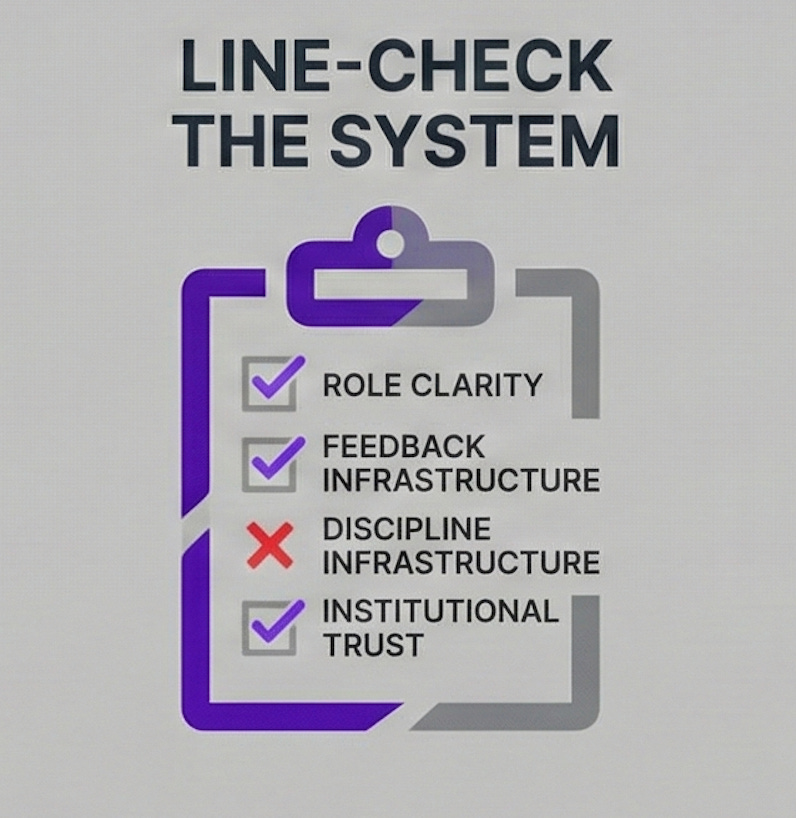
What the infrastructure actually requires:
A codified progressive sequence. Verbal warning, written warning, formal improvement plan, separation. Everyone, from the manager to the employee to HR to senior leadership, should know the steps and what triggers each one.
A real improvement plan template. Not a vague directive to “do better.” A defined gap, measurable milestones, a specific timeline (often 30 days or fewer is enough; reserve longer periods only where it’s truly needed), a clear picture of what success looks like, a plan for what kinds of reasonable supports they’ll get to improve the missing skills, and an explicit statement of what happens if it’s not met.
Honest alignment before the process starts. The manager and anyone else who plays a key role in the process (their manager? HR?) have to be aligned on what the improvement plan is actually for. Is this a genuine chance to course-correct, or a documented path to exit? Both are legitimate. But everyone involved needs to be honest about which one it is.
Clear evaluation criteria. What constitutes “meeting milestones” vs. “showing effort but not getting there” needs to be defined upfront and not adjudicated after the fact. Without this, the evaluation at the end becomes subjective, and subjective evaluations get challenged, reversed, or avoided entirely.
A decision framework for when discipline is and isn’t appropriate. Sometimes the gap is trainable and a structured plan is the right move. Sometimes the misalignment is fundamental: a values mismatch, a role that’s shifted beyond the person’s capacity, or a fit issue that no improvement plan will fix. Leaders need guidance on when to engage the discipline process and when to move directly toward separation, so that performance improvement plans (PIPs) aren’t used to delay the inevitable.
Manager training. Most managers have never been taught how to write an improvement plan that is honest, specific, and legally defensible. They’ve never practiced delivering one. They don’t know how to hold the line through the uncomfortable middle period. This is a skill that has to be built.
And then there’s the cultural layer: the organization has to actually use this infrastructure.
The standard for the organization should be that progressive discipline is a responsibility to the person, not a punishment: we owe you clarity about where you stand and a real chance to close the gap.
Line-Check #4: Institutional Trust
Here’s the one that rarely gets named out loud: leaders don’t trust the organization to stand behind them.
Before they ask “Should this person go?” they ask a quieter, more pragmatic question: What happens to me if I try to do this?
Will HR back the decision—or retreat into risk management the moment things get uncomfortable? Will peers support it—or second-guess it in private meetings after the fact? Will senior leadership hold the line—or flinch and ask for “one more chance” once emotions rise? Will the documentation process protect anyone—or collapse under scrutiny?

When the answer is “I’m not sure,” most leaders stall, which is the rational choice! Firing is one of the few decisions where the consequences are asymmetric: if it goes well, nothing visible happens; if it goes poorly, the leader owns the fallout reputationally, politically, and sometimes legally.
Imagine if Roth found brown M&Ms night after night and nothing happened—the crew shrugged, the promoter pushed back, and the show went on anyway. The diagnostic would still work. It would just stop mattering.
That’s what happens when leaders surface performance problems and the organization doesn’t back them up. Over time, leaders learn to stop pulling the trigger on the diagnostic at all. They soften feedback. They manage around the problem. They stop naming what they see. And the organization learns a devastating lesson: standards exist, but they don’t mean anything.
Line-Check #5: The Accountability Chain
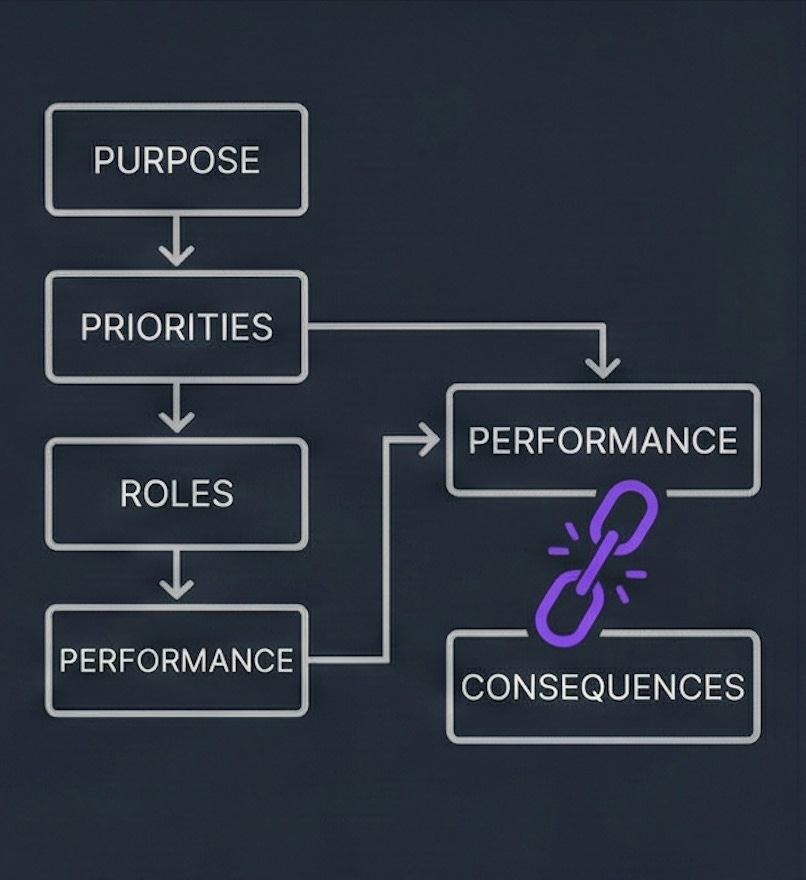
A strategic operating system links purpose to priorities, priorities to roles, roles to performance, and performance to consequences. When the chain is intact, firing is the natural, unsurprising conclusion of a transparent process. When it’s broken, firing feels like an emotional cliff-edge, because there’s nothing connecting the decision to anything that came before it.
Check each link:
Purpose to priorities. Does everyone in the organization know what the current strategic priorities actually are?
Priorities to roles. Is each role explicitly connected to a strategic priority? Can each person articulate how their work advances the strategy? Or are roles defined by activities rather than outcomes?
Roles to performance. Are there real, defined, measurable expectations for each role?
Performance to consequences. When someone doesn’t meet those standards, does anything actually happen? Do they hear directly and clearly from their manager where they missed the mark, and have a chance to improve?
When any link in this chain is broken, the final step—firing someone who is consistently not meeting expectations—becomes impossible. Not because the leader lacks nerve, but because the system never built the connective tissue that makes the decision defensible.
Line-Check #6: The Stories Leaders Tell Themselves
Even when the infrastructure exists, leaders often stall because of narratives that feel like compassion but function as avoidance. These are the rationalizations that surface the moment someone says, “Well, you need to fire that person”:
“We’d lose too much institutional knowledge.”
“No one else could do this role right now.”
“This just isn’t the right moment.”
“They’re not great, but they’re not terrible.”
“Replacing them would be incredibly disruptive.”
“What if we just narrow the scope a bit?”
“I feel responsible for this person’s livelihood.”
Notice what’s missing from all of these: any clear assessment of whether the person is doing the job at the level the strategy requires. These aren’t arguments for keeping someone. They’re confessions that the system can’t tolerate the consequences.
This one: “I feel responsible for this person’s livelihood.” That instinct is human. But it’s misplaced. Your responsibility as a leader is to the mission, the strategy, the stakeholders, and the team executing the work. When you keep someone in a role they’re failing at because you feel bad about what firing means for their life, you are prioritizing one person’s comfort over everyone else’s ability to do their jobs, the mission you were hired to support, and the job you get paid to do. And you’re likely holding them back from finding a role that is truly a good fit for them.
And here’s the part nobody says: keeping someone in a role they’re failing at isn’t protecting them either. They know. They feel the workarounds, the reassigned projects, the conversations that stop when they enter the room. This is a person’s career—finite, non-renewable time—and keeping someone in a role where they cannot succeed is both a strategic and a moral failure. Unless you are prepared to keep them on staff at the same pay grade until they retire, you are not helping them. You are spending their time for them.
Line-Check #7: Union Environments
Everything above applies in union environments, and the stakes are higher, not lower. Collective bargaining agreements do not eliminate the strategic imperative to manage performance. They define the process by which you do it. Leaders who treat the contract as a reason not to act are confusing constraint with exemption.
Union environments require more discipline, not less: clearer roles, tighter documentation, earlier feedback, and strict adherence to progressive discipline. This is infrastructure that protects everyone. The contract governs how you act. Strategy determines when and why you must.
What the Diagnostic Demands
Van Halen didn’t put the M&M clause in the rider because they cared about candy. They put it there because they understood that when the stakes are high, you need a fast, reliable way to know whether the system beneath you is working—before something fails catastrophically.
Firing works the same way in an organization. It’s not the point. It’s the test. And if the test reveals failure, the response is to build the infrastructure that makes firing someone fair, defensible, and unsurprising.
If you find brown M&Ms in the bowl, don’t just pick them out. Line-check the entire production.
Start building.