


I get more done on a three-hour flight than most full days in my Brooklyn apartment.
I have an office slash guest bedroom, a dual-monitor setup, noise-canceling headphones, good coffee within arm’s reach, and a door that closes. I have everything a person could want for focused work, and yet I routinely lose hours to the gravitational pull of Slack, email, finishing a half-read article, the sudden compulsion to check LinkedIn, or whatever else floats across my screen.
None of that exists on an airplane. My phone is in airplane mode. There’s no second screen. Nobody can reach me and I can’t reach anybody. Delta is always gassing up their free wifi, but I find that it rarely works or it works so bad that checking anything feels like punishment. I’m in a metal tube with a laptop, a tray table, and nowhere to be for the next few hours. And every single time, I land having written more, thought more clearly, and accomplished more real work than I would have in a full day at home.
The research backs up what the airplane already taught me
Angela Duckworth, the psychologist behind the concept of grit, published a piece in the New York Times late last year arguing that willpower is overrated (that’s a non-paywalled link, so check it out!). The people who are best at staying disciplined, she wrote, rarely rely on inner fortitude. Instead, they arrange their lives to minimize the need for willpower in the first place. She calls it situational agency.
An Olympic triathlete buys a house near the trails where he trains. A writer keeps off social media by not owning a smartphone. A teacher tells students to put their phones in their lockers, not their backpacks, and suddenly the lunchroom gets louder in the way lunchrooms should be.

Emily Berens and I wrote a few weeks ago about building a self-management system as an independent consultant: structure, prioritization, forcing mechanisms, the whole architecture. That article was about the system, and this piece is the daily-texture companion to that one. This one is about the Tuesday afternoon when you’re supposed to be writing a client memo and you’ve opened your inbox for the fourth time in twenty minutes.
This stuff applies to anyone who works from a computer, but it’s an acute problem for independent consultants specifically. When you worked in an office, the environment did a lot of this for you without anyone noticing. The commute created a transition between home-brain and work-brain. The physical office was a space designed for working, not for living; your novel and your laundry and your kid’s toys weren’t sitting in your peripheral vision. Colleagues provided ambient accountability, by which I mean the social reality that someone might glance at your screen or notice you’d been scrolling for twenty minutes. Meetings happened in a different room, which meant you physically moved between modes of work.
Independent consulting from home strips all of that away. You’re in the same chair, the same room, often the same screen, all day. The transitions that used to happen automatically now have to be built on purpose, and most of us don’t realize that until we’ve spent a year wondering why we can’t concentrate.
The airplane taught me that my focus problem is not a willpower problem, it’s an environment problem. And once I started treating it that way, things changed.
Return to W2, or the plan I didn’t think I needed
When I first went independent, one of the things I celebrated was the end of planning rituals. I was so glad not to have Monday morning check-ins or hourlong planning meetings. I didn’t have to report reporting what I was working on to a supervisor. I was free. I could just do the work.
What I actually did was meander. I’d start Monday with a vague sense of what needed to happen that week, pick up whatever felt most urgent or most interesting, and arrive at Friday wondering where the time went. I was doing stuff every day in the way that felt like productivity — lots of email, lots of tabs open, lots of meetings — but I wasn’t getting the important things done. The compounding work Emily and I wrote about, the work that builds a practice rather than just servicing it, kept sliding into next week.
So I went back to making a weekly plan, because I’d learned the hard way that my brain can’t hold a week in working memory and make good decisions about priority at the same time.
Here’s how it works now. Every Friday morning, I build my plan for the upcoming week. It’s actually a spreadsheet where each column is a day. At the very top, I have my personal things that are the non-negotiables I do every day, like get in some physical activity and play with my three-year old child. Below that, I have my non-recurring personal to-dos, like yesterday I needed to drop off a package at USPS and do the laundry. Then I have my work meetings for the day in order, and finally my work projects that I want to get done that day. I also get specific, so it’s not “work on the client report” but “finish sections 2 and 3 of the client report and send to Maria for review.”
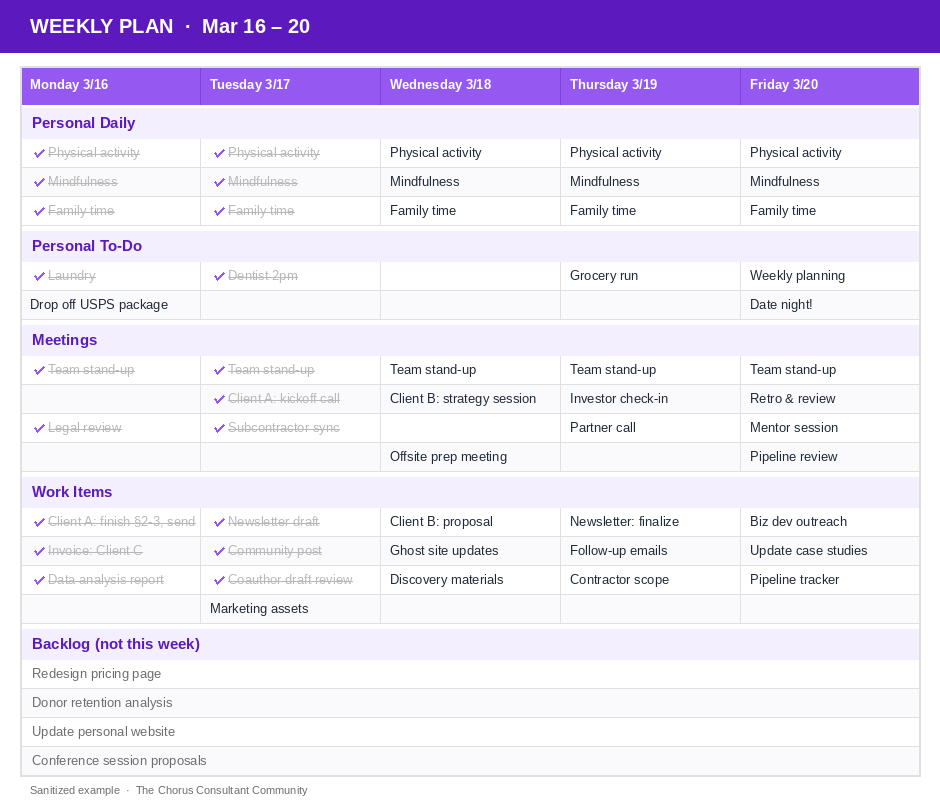
Note this is not a calendar. A calendar is useful because you need to see your day and make sure things don’t overlap. But a calendar is a schedule, not a plan. A plan is a set of decisions about what matters and in what order.
Then I keep that plan open in front of me all day. It’s the first thing I go over in the morning after I make coffee, and I check it frequently as I get through things so I can cross them off. Crossing things off a list is a small pleasure, and everything I said I would do that day, I need to check off. If I don’t finish something, I don’t just let it float. A very important ritual is at the end of the day, I look at the rest of the week and revise my plan: what moves to tomorrow, what gets pushed, and what gets dropped. This five-minute reconciliation is where the real value lives, because it forces me to confront tradeoffs instead of pretending I’ll magically find more time.
The Friday planning session also includes a longer-term view: what do I care about this quarter, what’s the trajectory of my pipeline, and where am I investing in things that compound. That context is what prevents the weekly plan from becoming just a to-do list of whoever yelled loudest for my time.
Move the book
I love reading. I keep a book going at all times, and having it nearby for my late-morning coffee break or for clearing my head between long sessions is one of the genuine pleasures of working from home. But I learned the hard way that “nearby” can be a trap!
If the book is on my desk, it’s in my line of sight. And if it’s in my line of sight, I’m going to pick it up. Not for a full reading session, I tell myself, just to see what’s coming up in the next chapter, or to finish the page I stopped in the middle of. Then fifteen minutes vanish. This is the Duckworth argument: the problem isn’t that I lack the discipline to ignore a book. The problem is that the book is sitting three feet from my keyboard, and asking my brain to override that temptation fifty times a day is a losing strategy. So the book lives in another room until I’m ready for a break.
My general rule of thumb is if I don’t want to do something during my workday, I remove it from the space where I work. This sounds simple, but it works better than other productivity hacks I’ve tried. That also goes for things on my computer or on my phone.
Change the scenery
I don’t fully understand why this works, but when I’m stuck — when the deliverable isn’t coming together or my attention keeps fragmenting — moving to a different physical space often unlocks something. From my desk to the couch, from my apartment to a coffee shop, or from the coffee shop to a library.
It’s not about finding a “better” workspace. The couch isn’t objectively more conducive to writing than my desk. But the act of moving resets something in my brain. Maybe it’s that the new environment doesn’t carry the associations of the old one: the half-finished email I was going to get back to, the tab I left open, the mental residue of whatever I was doing before. I sit down somewhere new, and for a little while, the only thing in front of me is the thing I moved to do.
I think this is also why the airplane works. It’s not just the absence of distractions. It’s that I am in a completely different physical context, and my brain responds to the novelty by actually paying attention to what’s in front of it.
Unplug the second screen
This is another way to reverse-engineer the airplane.
I have a second monitor at my desk, and it’s essential for anything involving spreadsheets, comparing documents side by side, or building out a complex deliverable with lots of source material. But when I’m writing or thinking through a strategy or doing any kind of work that requires sustained attention, that second screen is trouble. It’s showing me something: my Gmail inbox, a Slack channel, or a browser with tabs open with interesting articles I saved to read later. Even if I’ve minimized everything, the screen is there, glowing in my peripheral vision, pulling a tiny thread of attention away from the main task all day long.
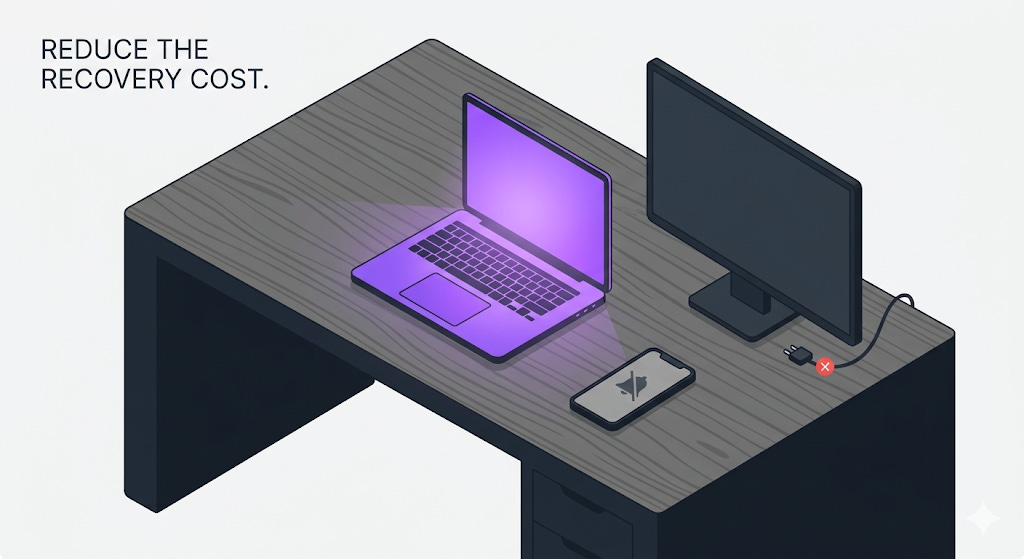
So when I need to focus, I unplug the monitor and move to a different spot. I take my laptop to the kitchen table or the couch or the coffee shop down the street. One screen, one task, and no ambient noise from the digital world. This is the airplane, minus the Biscoffs and the person reclining into my knees (I’m 6’3” tall, so it’s tough).
The key insight is that the second monitor isn’t a distraction because I’m weak-willed. It’s a distraction because it’s there. Duckworth’s research on phone placement and student grades found the same thing: the further away the phone, the better the grades. The students who moved their phones were not more disciplined people, but they’d made the temptation physically harder to act on, so they were more successful in avoiding distraction.
Kill your notifications
You’ve heard this before. I’m saying it again because you probably haven’t done it yet, or you’ve done it halfway.
Turn off all notifications on your computer. All of them: Slack, email, social media, texts, calendar reminders, everything. Every notification is a tiny interruption, and every interruption carries a recovery cost. Research suggests it takes over twenty minutes to fully regain deep focus after a distraction. If you get pinged six times in an hour, you haven’t had an hour of work. You’ve had six ten-minute fragments with no connective thread.
I know the objection: what if something is urgent? What I’ve found: almost nothing is. The things that feel urgent turns out to be urgent at the speed of an hour. Check your email and Slack on your terms, at intervals you decide. I do it roughly every ninety minutes or between finishing one project and starting a new one. Nothing has ever caught fire because I took ninety minutes to respond.
Virtual meetings (sob)
Everything I’ve described so far is about solo work: protecting your focus when you’re writing, building, and thinking. But a huge portion of most consultants’ weeks is spent in meetings, and virtually all of those meetings are now virtual. Consultant life means you’re staring at the very machine that houses every distraction you own.
This is a problem that didn’t exist in the same way ten years ago. When meetings happened over the phone, I could pace in my apartment and look out the window. The physical movement did something for attention that I didn’t fully appreciate until it was gone. Now I am pinned to a chair and a screen, watching a grid of faces while my email sits one alt-tab away. I find it genuinely hard to sustain attention on Zoom, because my body wants to be doing something else and my screen is offering a hundred alternatives at all times. (Oh how much I miss in-person meetings.)
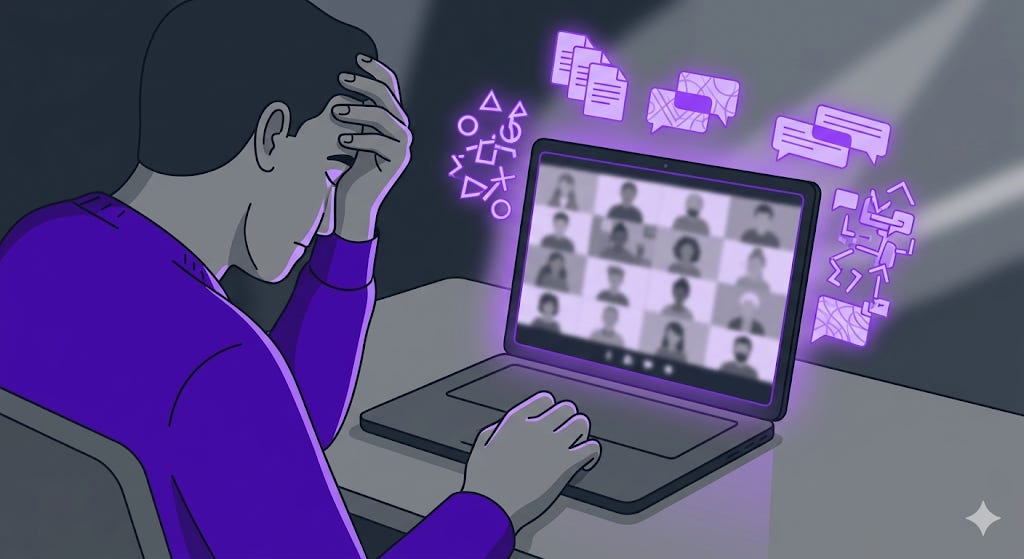
A few things help. First, I try to abide by the same principle from earlier: I unplug my other screens before a virtual meeting starts. If I am on a laptop with no second monitor glowing in my periphery, there’s less to wander toward. Second, I push for phone calls when video isn’t essential. Not every conversation needs to be a Zoom. When I can take a call on my phone and walk around my apartment or step outside, my listening improves noticeably. I ask better questions, and I catch things I’d miss if I were sitting at my desk watching myself in a tiny rectangle.
Third — and this was the biggest change for me — I went back to handwritten notes. For years I took meeting notes on my computer because it was better for search, better for organization, and easier to share. All of that is true, but it was also destroying my ability to listen. When my hands are on a keyboard and I’m looking at a screen, I am one reflex away from checking something. The note-taking becomes a cover story for being on my computer, and my attention fractures.
When I switched back to a notebook, the difference was immediate. Writing by hand is slower, which forces me to listen for what actually matters rather than transcribing everything. My eyes are on the page and the person, not on a screen full of temptations. And the physical act of writing seems to anchor my attention in a way that typing doesn’t. There’s research on this, but I didn’t need the research. I could feel it.
If you need your notes to be searchable later, a product like the reMarkable splits the difference. I get the feel and focus benefits of handwriting without losing the digital archive. (Thanks to Wonder Tools for the recommendation!) But even a plain notebook you never look at again is worth it if it keeps you present during the conversation.
Track what you want to do more of
There’s an old management adage: what gets measured gets done. I’ve found this to be true.
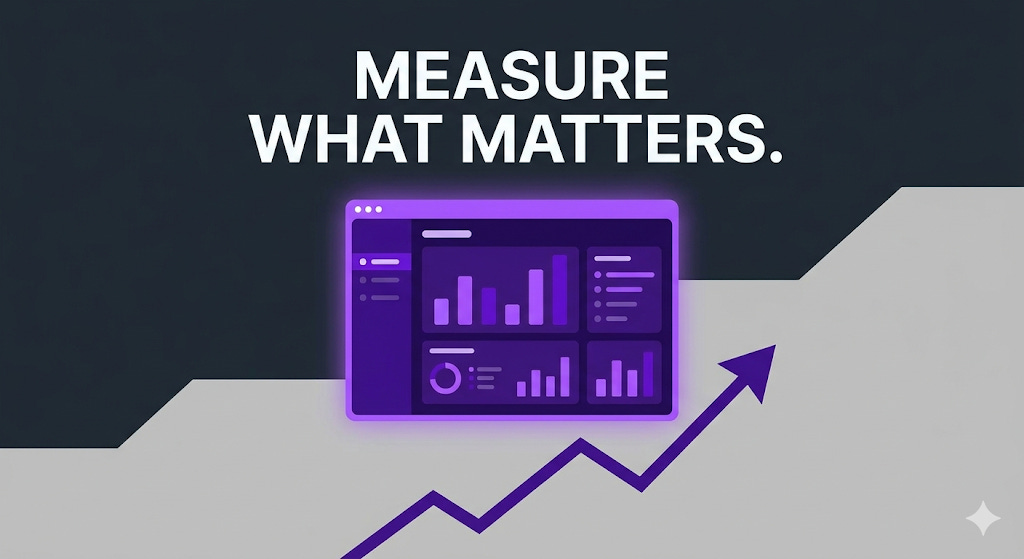
I track my Substack newsletters in my own spreadsheet — when I sent each one, the open rate, the click-through rate, the likes, the shares, and the new subscribers. I track every consulting engagement I’ve ever had: what I produced, how many hours I worked, what I delivered, what I got paid.
The tracking creates the same effect as a manager glancing at my weekly report. It crates an awareness that I said I’d do something, and here’s whether I did it.
If you don’t know where to start, pick one category that matters to your practice and start recording it. Revenue by client. Hours by project type. Business development outreach per week. Proposals sent versus proposals won. The specific category matters less than the act of making your work visible to yourself.
It’s still hard, though!
I have not conquered distraction. I am a person who has built an environment that makes distraction slightly harder and focus slightly easier, and the gap between those two states turns out to be worth a lot.
But the system fails regularly. When I’m tired, my complete lack of willpower can overwhelm even the best system. It fails when a project is in the murky middle — past the excitement of starting but nowhere near the satisfaction of finishing, so I just don’t feel like heading down into the boring salt mines.
On those days, I still check my email when I said I wouldn’t. I still pick up the book that I moved to the other room because I walked in there to get water and there it was. The system hasn’t made me into some kind of focus monk, but I have attained some more-than-marginal gains on most days.
The Emily Berens piece ended with a great line: if a task matters to your practice but you keep postponing it, stop debating willpower and change the environment instead. This is what that looks like in practice for me: it’s a weekly plan on a Friday morning, a book moved to another room, a monitor unplugged, and a phone silenced. These are small rearrangements of a physical space that add up to a fundamentally different workday.
Nobody is going to protect your focus for you. That’s the deal we made when we went independent. But you don’t have to rely on discipline alone to keep the deal. You can build the airplane on the ground.