



In this second installment of our Strategic Agility Reboot series, we explore how self-evaluation serves as a foundational tool for strategic operators. Building on our introduction to the Pause Protocol, we now turn to a practical framework that helps you identify your strategic leverage points with clarity and purpose.
Take the Strategic Operator Self-Evaluation now to pinpoint exactly where your efforts will yield the greatest impact, transforming anxiety about performance into actionable insights that will elevate your strategic leadership and consulting practice.
From defensive to desperate: My relationship with feedback
I have a dark relationship with 360 evaluations: I want them to draw blood, and I can’t wait for it.
Earlier in my career, the anxiety leading up to seeing the results was almost crippling…for days ahead of time. And I would defend myself against the outliers—”I know who gave me that 2, and here’s why they’re wrong.” But somewhere along the way, that defensiveness gave way to something else: an urgent, almost desperate need to know the truth about how I actually show up. Not how I intend to. Not how I hope to. How I actually impact the people around me.

I now understand that my craving for feedback is nothing more than an anxiety management strategy; the thing that makes me crawl out of my skin more than anything else is that I could be spending my time and energy on things that don’t actually matter. That I’m tirelessly doing but not moving forward. That I’m a wheel-spinner; stuck in patterns I cannot see and therefore, cannot change.
There’s a spectrum of intensity, sure, but I’m confident none of us are thrilled about wheel spinning.
Over time, what I have come to understand is that while feedback from others is critical - ongoing self-assessment is foundational. It’s useful to know that your staff think of you as a “strategic leader” or rank you 9/10 on approachability - but as a coach of mine once told me “stop performing competence and start examining reality.” (She was direct in her approach which aligned with my aforementioned coping strategy.)
If you want to fundamentally shift how you operate every day, at work (and in life), you have to treat ongoing evaluation of yourself against the operating must-haves, like coming home.
Because you can’t strengthen a muscle you haven’t located. You can’t close a gap you haven’t identified. And you can’t measure progress without a baseline.
Strategic Agility Reboot #2: Self-Evaluation as the foundation for becoming a more adept strategic operator
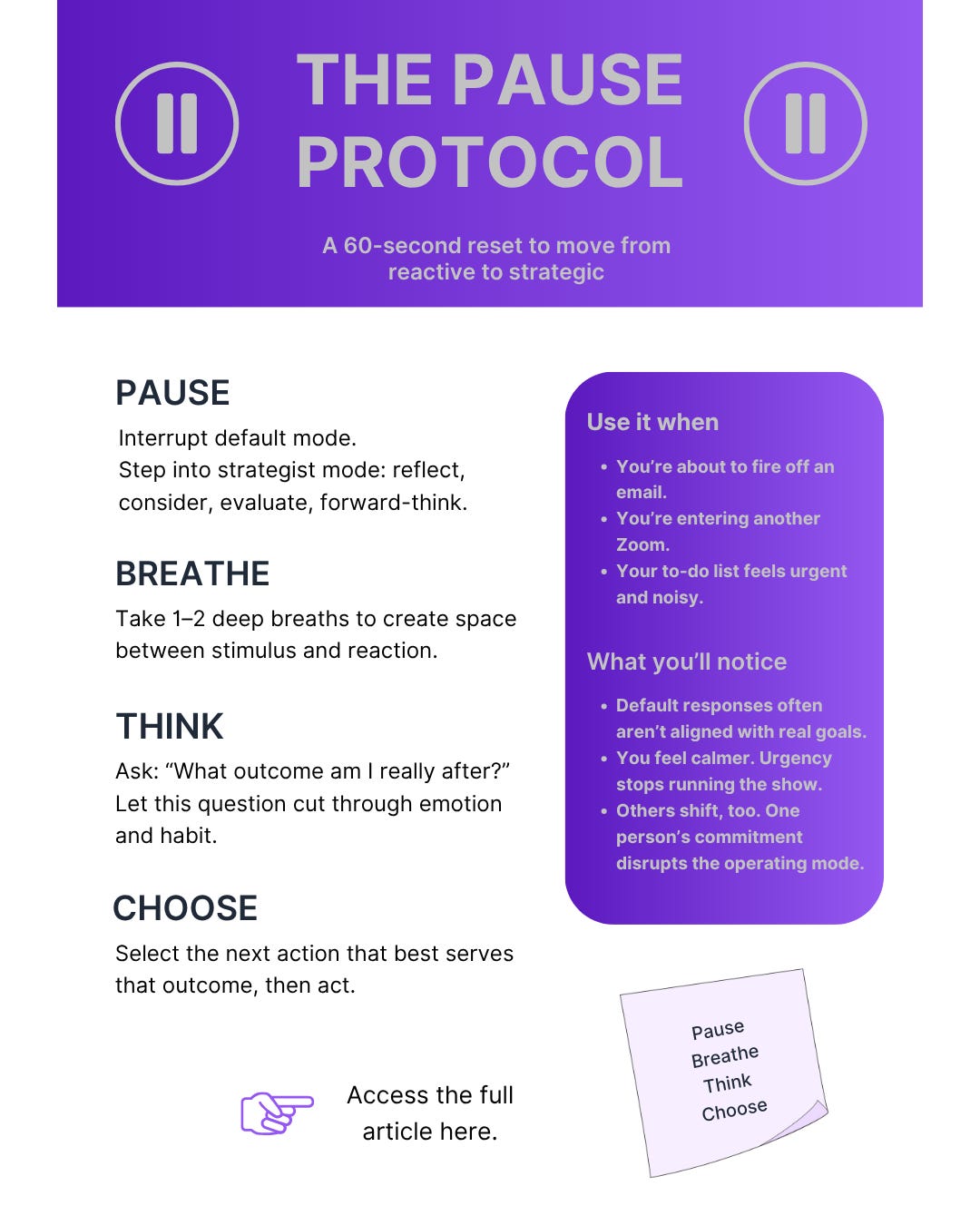
In the first article, we named thinking and acting with strategic intent as the underpinning of strategic operating and rolled out the Pause Protocol as an every-day forcing mechanism.
Today’s Strategic Reboot installment follows the same throughline of “with intent,” and focuses on building your foundation as a strategic operator centered around consistent self-evaluation against the must-haves of strategic operating.
Linked below is the Strategic Operator Self-Evaluation which focuses on your personal behaviors and patterns as a strategic operator—not your team’s performance or your organization’s systems. It shows you, in specific behavioral terms, where you need to focus. It turns “I’m struggling” into “I scored 6/20 in Strategic Discipline, which means I rarely know my priorities, almost never stop unproductive work, and consistently make decisions based on urgency rather than strategy.“ Uncomfortable and worth gold.
This tool offers a strategic approach to developing your strength as a strategic operator: in 15 minutes you will establish your current baseline, identify and diagnose gaps, and then make a intentional choice about ONE thing to course-correct. You focus on that for 30 days and then you step-back and return to reassess.
The goal isn’t to score perfectly; it’s to identify where you are now and what specific shifts will make the biggest difference.
Strategic operating isn’t about overhauling everything. It’s about identifying a strategic leverage point—a shift that will create the most relief and momentum right now.
Superpower #2: The Strategic Operator Self-Evaluation
Because you can’t strengthen a muscle you haven’t located. You can’t close a gap you haven’t identified. And you can’t measure progress without a baseline.
That is uncomfortable. And it’s worth gold.
Action Steps
Click here and take the Strategic Operator Self-Evaluation.
Join our Strategic Fitness Benchmarking Study:
We’ll ask consultants, leaders, staff, and board members to assess strategic fitness inside nonprofits they are connected to: How often do teams pause, ask the right questions, map systems, dig for root causes, run scenarios, and name stakeholders early?
We’ll then publish a report offering practical benchmarks based on organizational size and field, guidance for how to use them, and a collection of industry-sourced tools and practices that you can use and take back to your teams.
Join the study by filling out the (30-second) interest form here.
We want to hear from you
If any of this landed with you—whether you’re in the thick of these challenges or you’ve developed strategies that work—we want to hear about it. We’re scheduling 20 minute conversations with leaders to understand what’s helping you stay grounded as a strategic operator and where you’re struggling. Your insights will shape how we build this series and similar future projects. Send us an email at info@hookrodgersconsulting.com if you want to schedule a conversation.