


It’s 4pm on a Friday. The leadership team is gathered around a conference table littered with cold coffee and half-eaten takeout. The head of strategy just walked them through three possible paths forward. Different resource allocations, different theories of change, different risks.
There’s a pause. Then the Big Boss leans back and says: “I think Option B is the smart play.”
Heads nod. Someone says, “Yeah, that feels right to me too.”
The conversation then turns to operationalizing the “smart play.”
Nine months later, the initial problem is worse. In the debrief, someone says, “We made smart choices with the information we had.” And everyone nods again.
The Anatomy of a Vacuum
That scene was inevitable. Not because of who was in the room, but because of what wasn’t.
No criteria for what makes a choice strategic—so “smart” filled the void. No protocol for how decisions of this magnitude get made—so the first confident voice won. No norm for pressure-testing—so agreement was the path of least resistance. No protected time for strategic thinking—so it got crammed into 4pm on a Friday when everyone was already depleted. No separation between proposing and deciding—so the Big Boss did both in one sentence. No practice at this—so the team didn’t have the muscle to engage even if they wanted to. No learning loop connecting past decisions to outcomes—so nine months later, the same pattern will repeat.
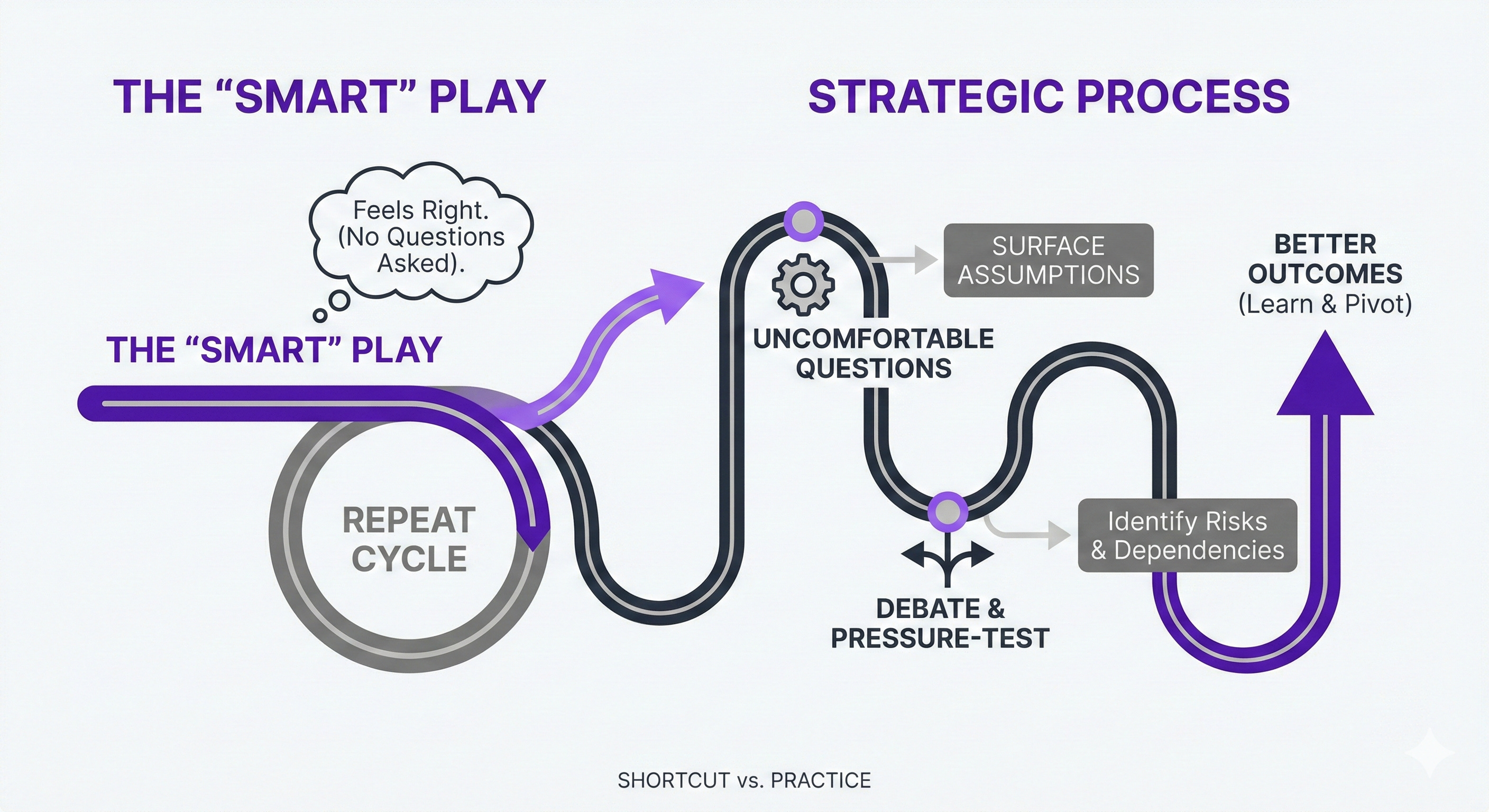
And this isn’t just one room. It’s every room. “Smart” shows up in weekly check-ins, performance reviews, hiring debriefs, feedback conversations, Slack threads. The word has been operationally normalized—baked into how organizations talk about people and decisions at every level. Which means the gap compounds everywhere, all the time.
This is how organizations fail. How promising leaders flame out. How movements that should have won don’t. Not in one dramatic moment, but in a thousand small moments where “smart” papers over two gaps at once: the strategic thinking that didn’t happen, and the strategic operating system that was never built.
Why “Smart” is a Desecration
If you want to save democracy, start by banning the word smart from organizational vocabulary. (And the full set of words at the end of this article.)
You’ve heard it. You’ve said it:
“She’s so smart about this stuff.”
“He’s one of the smartest (fill in role) I’ve ever worked with.”
“That was a really smart call.”
“We need smarter people in the room.”
When you say it, you don’t sound it.
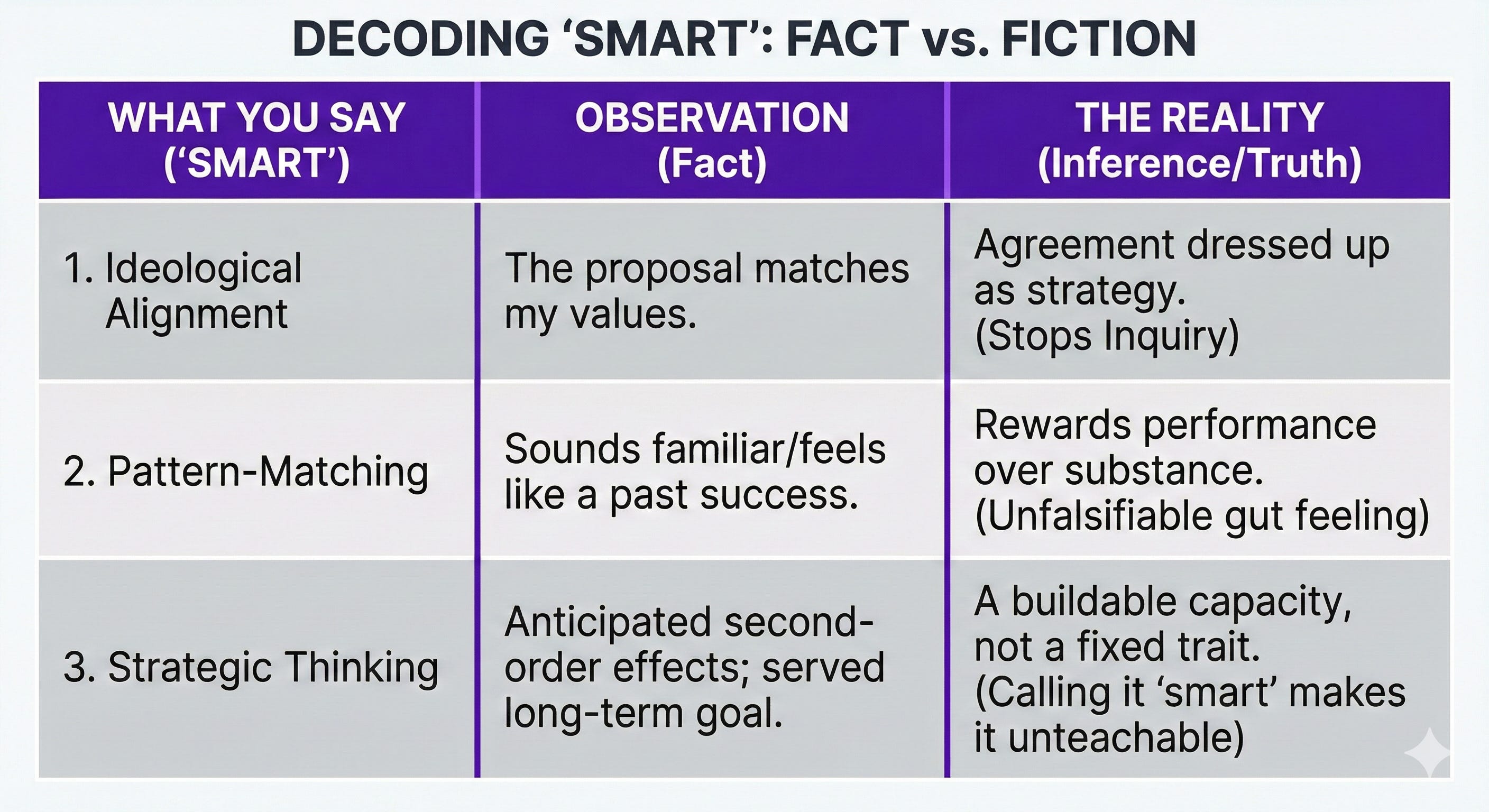
People mean one of three things when they use the word “smart”:
It aligns with my beliefs. The position matches my values, so it must be the right call. This isn’t strategy. It’s ideological agreement dressed up as analysis.
It sounds good. Based on assumptions, gut, pattern-matching to something that worked before (or that we think worked before). This isn’t strategy either. It’s preference.
Strategic thinking. They saw the whole board. Anticipated second and third-order effects. Made a choice that serves the longer game, not just the immediate pressure. Didn’t just react—chose.
None of these are compliments. #3 would be if the person saying it cared enough to actually describe what you did so that you could do it again.
Burying strategic thinking under the word smart, is a desecration.
“It aligns with my beliefs”
It stops inquiry. Once something’s labeled “smart,” we stop pressure-testing it. It becomes settled.
It flatters the speaker. Calling something “smart” positions you as someone who can recognize smartness. It’s self-credentialing.
“It sounds good”
Outcome-agnostic; a prediction dressed as an assessment, rewarding performance over substance.
Credentialist. Used this way, “smart,” codes for educational background, who speaks a certain way. Excludes people who think strategically but don’t perform according to some code that has nothing to do with the quality of strategic thinking and works to stand in the way.
Unfalsifiable. If it works, it was smart. If it fails, “well, circumstances changed.” No accountability.
“Strategic thinking”
Frames this as trait alone, rather than a buildable capacity.
Lets leadership off the hook for developing it in others.
Is lazy.
Leadership Imperative
If you hold a leadership position in this movement, you have exactly three jobs: Think strategically. Build strategic thinking capacity in the people and systems around you. And measure whether it’s actually happening—not activity, not output, not effort, but whether leaders are thinking strategically and developing it in others.
Our potential to make change and have impact – to win – is bound up in our ability to see and address the systemic lack of infrastructure for building and sustaining strategic thinking and developing strategic operators within strategic operating systems.
If we mean what we say about winning, this is the work.
The Tuesday Alternative
It’s 2pm on a Tuesday. Same conference table. Same three options. But this time, when someone says “Option B feels smart,” the Big Boss leans forward instead of back.
“What has to be true for that to work? And how will we know if we’re wrong?”
The room gets uncomfortable. Then it gets productive. Assumptions surface. Someone admits they’ve been pattern-matching to a situation from three years ago that isn’t actually analogous. The CFO points out a dependency no one had named. They build trigger points into the timeline—moments where they’ll check whether their theory is holding.
When they leave at 4:30, no one calls the final choice “smart.” They call it pressure-tested. They call it strategic. They know what they’re betting on. They know what would prove them wrong. They know when they’ll look.
Nine months later, the initial problem isn’t solved—but they caught the misfire at month three and pivoted. They’re ahead of where they started.
This isn’t genius. It’s not even rare talent. It’s a practice. Learnable. Teachable. Buildable.
But only if we stop letting “smart” end the conversation before the real thinking begins.
The Strategy Lexicon
Your moves this week:
(1) Review the list of other useless words and phrases below and start to notice when and why you use them. Get uncomfortable when you do.
“She just gets it” — trait, not teachable
“Great instincts” — unfalsifiable
“Natural leader” — born, not built
“Savvy” — same energy, same emptiness
“No-brainer” — conversation-ender disguised as clarity
“Solid” — sounds like assessment, isn’t
“The right call” — outcome-agnostic approval
“Realistic” — shuts down ambition without analysis
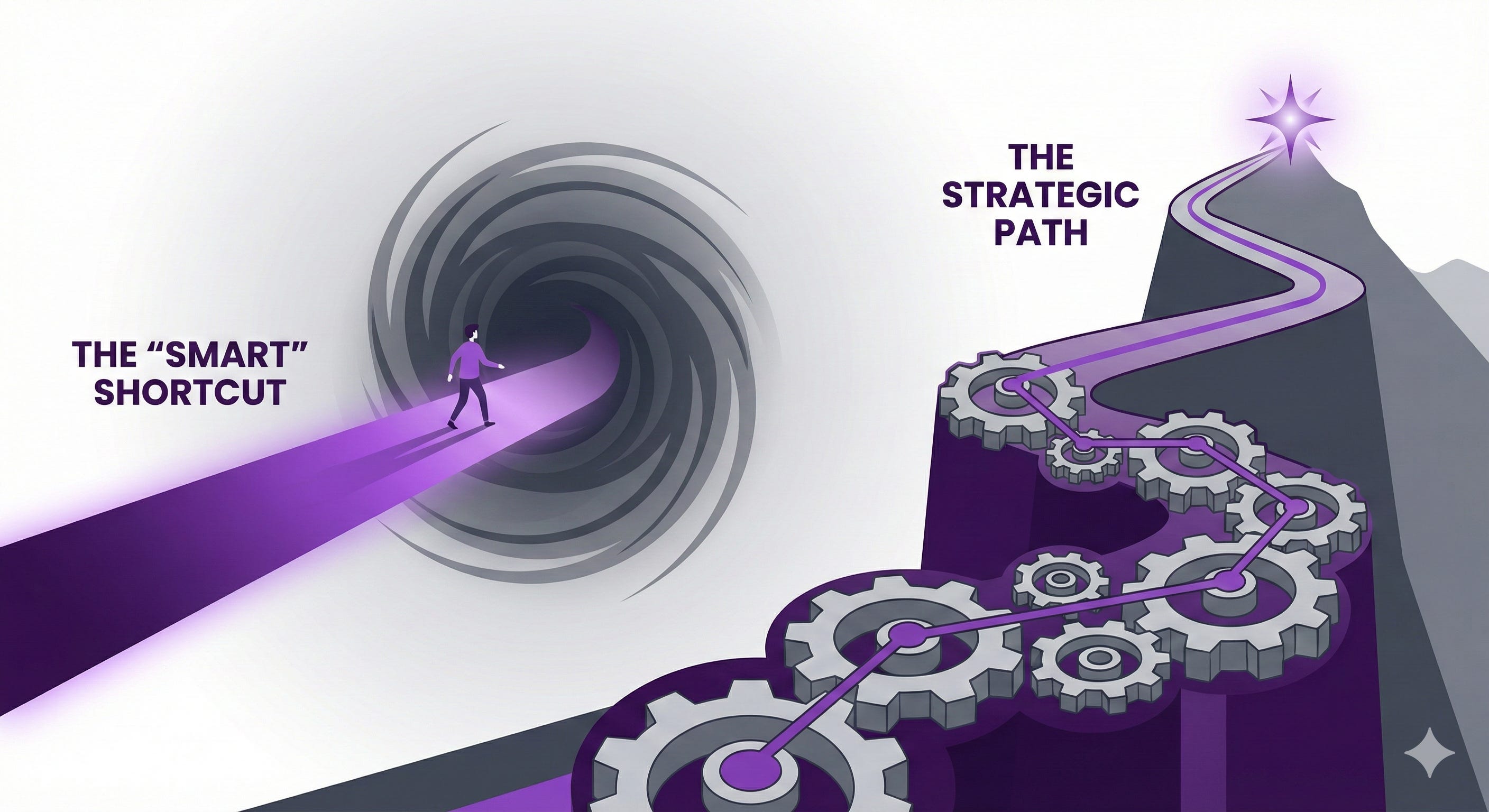
Any word that lets the room skip the work of articulating why—what criteria, what assumptions, what would prove it wrong—is doing what “smart” does.
(2) Practice the better alternatives.
What to say instead of “smart”: If you actually mean it as a compliment, make it one. Name what they did so they can do it again:
“That accounts for how they’ll respond” — names the second-order thinking
“That gives us options if we’re wrong” — names the risk management
“That serves the two-year goal, not just the immediate win” — names the time horizon
“That’s a clear theory of change” — names what’s actually good about it
“You saw something the rest of us missed—what tipped you off?”
If you’re not sure why it feels right, say that:
“Something about this feels right to me but I can’t name it yet. Can we pressure-test it before we commit?”
“I’m drawn to this option. Help me figure out if that’s strategy or preference.”
If you want to open inquiry instead of closing it:
“Walk me through how you got there.”
“What has to be true for this to work?”
“How will we know if we’re wrong?”
“Say more about the second-order effects.”
The goal isn’t nicer words. It’s words that open the next conversation instead of closing it.
(3) Check out the 2 part series on how to train strategic thinking in others.
Part 1:

Part 2:

And we want to hear from you. Really we do.
If any of this landed with you—whether you’re in the thick of these challenges or you’ve developed strategies that work—we want to hear about it. We’re scheduling 20 minute conversations with leaders to understand what’s helping you stay grounded as a strategic operator and where you’re struggling. Your insights will shape how we build this series and similar future projects. Send us an email at Susannah@hookrodgersconsulting.com to get on the books.