


*Note: It’s mid-winter recess in NYC, so there will only be one newsletter this week!*
Several folks wrote back to me in response to an article I sent a couple weeks ago: Organizing Loses When Politics Becomes Identity. I think a lot about these topics, so here is a branch that goes in a slightly different direction about the nonprofit sector. Specifically, how community and identity can also be commercialized in a way that harms the people doing the work, the nonprofits themselves, and the causes everyone is ostensibly trying to advance.
If you’ve ever stayed in a job that was quietly hollowing you out because leaving felt like abandoning your people, this is about that.
And if you’re building organizations (or trying to survive inside one), it’s also about a hard design question: what kind of belonging are we offering, and what does it cost?
I spent 14 years working inside of nonprofits. The first step I saw was politics becoming identity, but the second step and the far stronger one is not belief but belonging. And movements get brittle when they confuse high-intensity social bonding for durable moral purpose.
The hidden retention engine
Let me separate three kinds of claims upfront, so we can be honest about what we know.
Fact: A lot of political and nonprofit work has high turnover.
Observation: Many people describe feeling both meaning and exhaustion, often at the same time.
Inference: The “meaning” often comes less from the stated mission and more from the social experience of being inside a committed in-group.
That inference is the point of this piece.
In Organizing Loses…, I argued that when politics becomes identity, we start treating disagreement as contamination. That dynamic weakens organizing because organizing requires coalition-building, and coalition-building requires negotiating difference without moralizing it into betrayal.
Here’s the adjacent problem: even when people privately sense the identity dynamic is warping the work, they often stay. Even when the strategy isn’t sound, the tactics aren’t effective, and they don’t really believe the theory of change anymore. They stay because leaving would mean losing their community.
And when an organization’s retention is powered by community rather than competence, two things happen:
Leaders get a labor force that will tolerate incoherence longer than they should.
Workers internalize the organization’s needs as personal obligations because “us” feels like “me.”
By belonging I mean: a felt sense that you are known, needed, and morally safe among a particular group of people. You can hate the job, question the strategy, and still feel relief walking into the office because you know the jokes, the rituals, the shared language, the “we survived that night together” shorthand.
That relief is real, and also dangerous.
How the “summer camp trap” gets built
By the summer camp trap I mean a high-intensity bonding environment where shared hardship, moral purpose, and social life fuse together, making exit feel like exile. Anyone who has been on an electoral campaign or canvassed (or worked in theater, etc.) knows what this is like.
You wake up early. You knock doors in weather that makes no sense for a human being. You get rejected all day. You come home wrung out. Then you debrief with the same twenty people who lived the same day. Someone cooks something. Someone’s blasting music. Someone’s flirting. Someone’s crying. You laugh too hard at something that isn’t even that funny. You feel alive and deeply connected with your colleagues.
The work may be inefficient or strategically muddled, but the social system is brilliant. It converts misery into intimacy.
Let me offer another Fact/Observation/Inference framework.
Fact: Hard shared experiences can produce strong bonds (military units, sports teams, disaster response, startups).
Observation: Campaign and nonprofit environments often use shared intensity as a recruitment and retention force.
Inference: When intensity becomes the primary fuel, organizations start selecting for people who crave intensity, not people who build power well.
That last inference is where the trap turns structural.
Because if your retention depends on the “camp” feeling, you will, usually unconsciously, design the organization to keep producing it: urgent deadlines, constant mobilization, moralized framing, a permanent sense of emergency.
And then “politics becomes identity” becomes a business model.
Why I stayed after belief faded
In my early work, there were stretches when I didn’t believe the activity matched the rhetoric. I had doubts about whether we were building power or just producing outputs that looked like power: calls made, doors knocked, dollars raised, signatures gathered.
Those doubts didn’t immediately change my behavior. I still showed up.
Why?
Because the work had become my social world.
It was where my friends were. It was where my romantic prospects were. It was where I felt morally legible. It was where my inner life had a storyline: I’m the kind of person who does this. I craved the sense that the people around me could interpret my choices as good, rather than selfish or suspect.
But when a group controls your moral legibility, it controls your choices more than you think.
So even when I could see the cracks, I was still tethered by the fear of losing the only community where my values felt fluent.

This is the link back to last week’s piece/ In Organizing Loses…, politics-as-identity makes disagreement feel like a threat to self. Here, the summer camp trap makes exit feel like a threat to self.
One punishes dissent. The other punishes departure. Same structure, different pressure point.
Belonging vs. purpose
Let’s define a term that matters here: purpose.
By purpose I mean: a stable commitment to an aim that remains coherent even when your social environment changes. You can leave one organization, lose your friend group, and still work for the same underlying goal, because the goal is not fused to a particular tribe.
Belonging is not purpose. Belonging is a human need, and it’s important we all have it! The mistake is using politics to meet it in ways that make the work fragile.
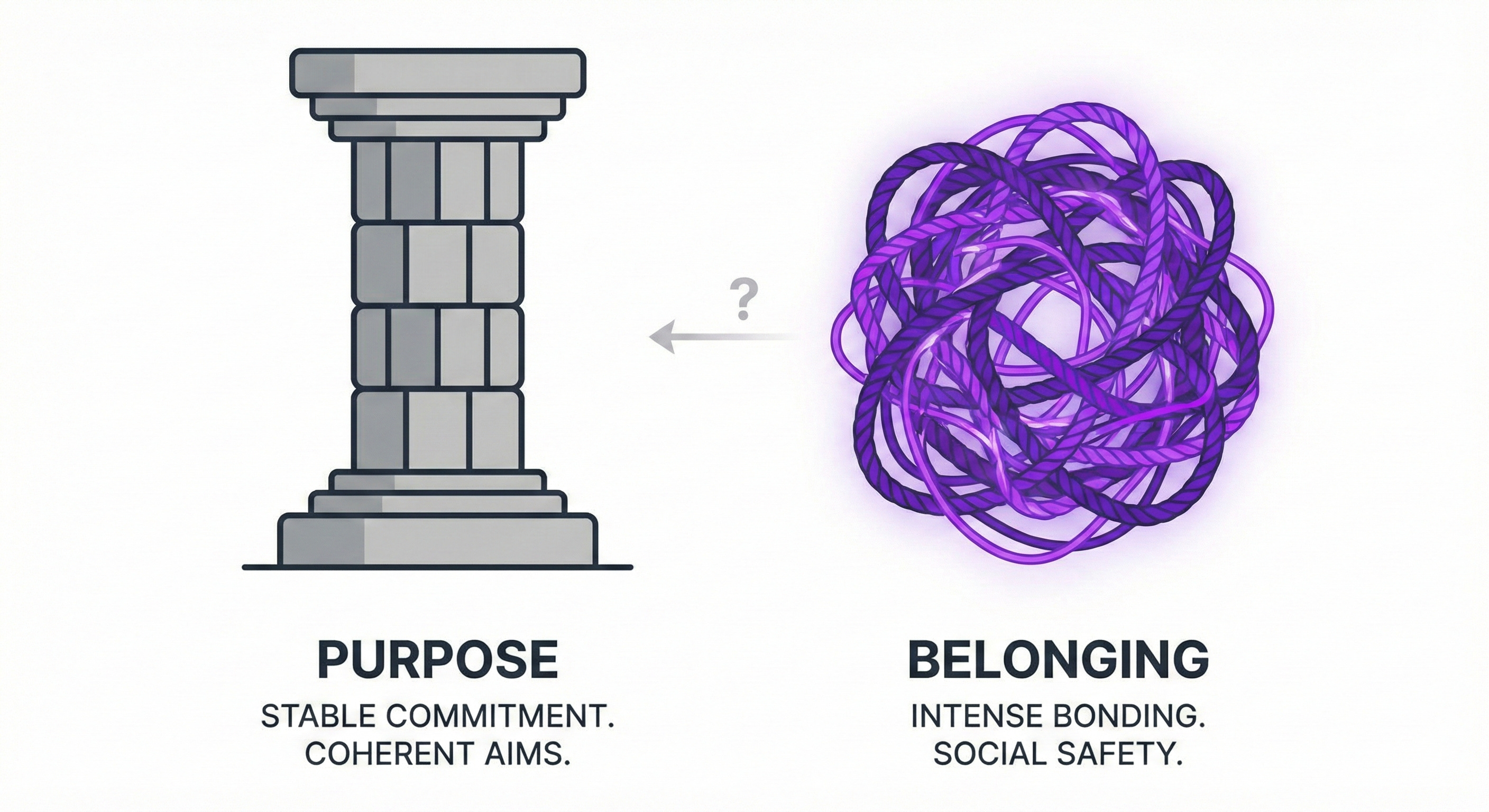
Here’s how the fusion happens:
Shared moral language gives the group a sense of righteousness.
Shared hardship gives the group a sense of intimacy.
Shared enemies give the group a sense of clarity.
Scarcity (time, money, sleep) gives the group a sense of urgency.
Together, they create a strong identity field, a social environment where your status, belonging, and self-worth are strongly conditioned on visible alignment with the group’s moral story. In those circumstances, you’re not evaluated only on outcomes or craft, but on how you speak, what you signal, and which disagreements you are willing to publicly perform.
In an identity field, the safest move is often to intensify your alignment. which means the organization becomes worse at reality-testing.
And that’s where organizing loses…again. Because organizing requires reality-testing: What do people actually care about? What will they show up for? What tradeoffs are they willing to make? What message travels? What coalition is possible?
A strong identity field substitutes “what we say about ourselves” for “what we can build with others.”
Counterargument: But what about community?
A fair counterpoint is: Of course the community matters. People join movements for relationships. Solidarity isn’t a side effect—it’s the goal.
I agree with the best version of that argument. In a fractured society, political work is one of the few places people experience cross-class intimacy, mutual aid, and shared meaning. Asking movements to be “less identity-based” can be a disguised demand to be emotionally sterile, which tends to advantage people who already have community and security elsewhere.
That’s a real and necessary critique.
Here’s my response, also in accountable form:
Fact: Humans need belonging; movements often provide it.
Observation: Belonging can be a source of courage, sacrifice, and sustained engagement.
Inference: Belonging becomes corrosive when it becomes the primary retention mechanism and the primary moral credential, because then the organization starts optimizing for social coherence over external effectiveness.
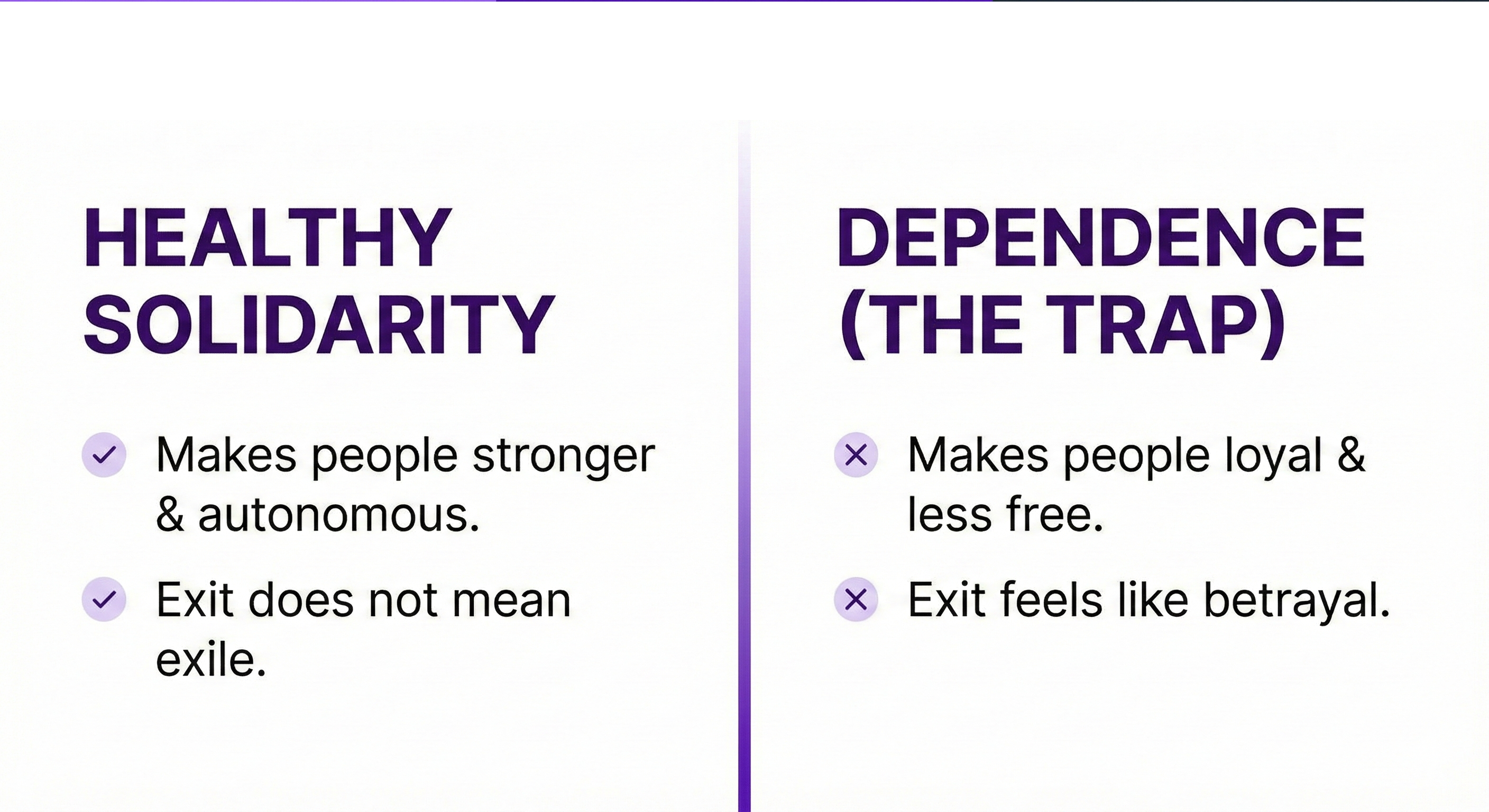
In other words: I’m not arguing against solidarity. I’m arguing against dependence, which is the condition where you can’t leave without losing your identity, and where leaders can implicitly leverage that dependency to keep the machine running.
Healthy solidarity makes people stronger and more autonomous. The summer-camp trap makes people more loyal and less free.
What the trap does to movements
1) It selects for intensity-seekers, not builders
Builders are people who can recruit, train, and retain others while translating values into durable structures. We need people who can create a volunteer ladder that keeps people engaged for months, not days; teach them how to run a meeting; and build relationships with groups you don’t like.
When an org confuses intensity for progress, it burns out builders and rewards performers.
2) It turns moral language into social currency
When belonging is scarce, moral performance becomes a way to secure it.
This is one reason “politics becomes identity” becomes hard to reverse. Even if people privately soften, the social incentives reward hardness.
3) It makes exit feel like betrayal and that warps honesty inside the org
If leaving is treated as defection, then staying requires self-justification. Self-justification makes people less able to name what’s not working, because naming it would threaten the very thing they’re relying on: membership.
So the organization loses feedback. The work decays. The community tightens. The identity field thickens.
A simple question
Am I staying because the work is right, or because the community is my identity?
If it’s the latter, you don’t have to panic. You just have to start disentangling. Find belonging that isn’t contingent on your politics. Find purpose that isn’t contingent on your tribe. Then you can re-enter the work with clearer eyes, and movements will get stronger people, not just loyal ones.
That’s the kind of identity worth building: one that doesn’t require captivity to feel like commitment.
Oh wow, Sam. This really hits home! Thanks for writing on this topic.