


Rather than trying to write about what’s happening in Minnesota or elsewhere directly, I instead wanted to think about two other related things and what they mean. I think there are some important ways this article converges with the main conversation, but I felt it was best to leave it to readers to apply it for themselves.
If you want to catch up on some previous pieces that are also about this set of topics, check them out here:


A Room We’ve All Been In
A friend once described a certain kind of progressive event as “a TED Talk wearing a Patagonia vest.”
You know the scene. “Good” and “smart” people. Fancy seltzers and solid snacks. I always leave feeling sad, inspired, and a little judged by a trifold about climate grief.

And then… nothing changes. Or worse: the other team changes things. Again.
The thing that I’ve written about a lot on this Substack is how the folks inside these rooms often care so so so much. Many took lower pay, higher stress, and long hours because they wanted their lives to mean something. I had this life for almost 15 years, so I get it.
But I think these folks are part of a deeper problem. When politics becomes a form of identity — when our movements start optimizing for who we are rather than what we can win — we drift toward tactics that feel righteous but fail to build durable power.
That’s not a blanket critique of “identity politics” as in “people have identities and those identities matter.” Of course they do. By identity-politics (hyphenated), I mean something narrower: politics used as an identity badge. Politics when it becomes a way to sort people into “us” and “them,” to prove moral membership, and to secure belonging inside a tribe.
I recently read one new piece that brought to mind an older piece from a couple months ago:
A New Yorker essay about what Democrats could learn from MAGA’s organizing, and how the left gets tied up in infighting and litmus tests.
A Voice of San Diego story about the Sierra Club trying to expand in working-class, majority-Latino South County and struggling to become relevant to locals.
These are the subjects of today’s article.
The left is loud, but not sturdy
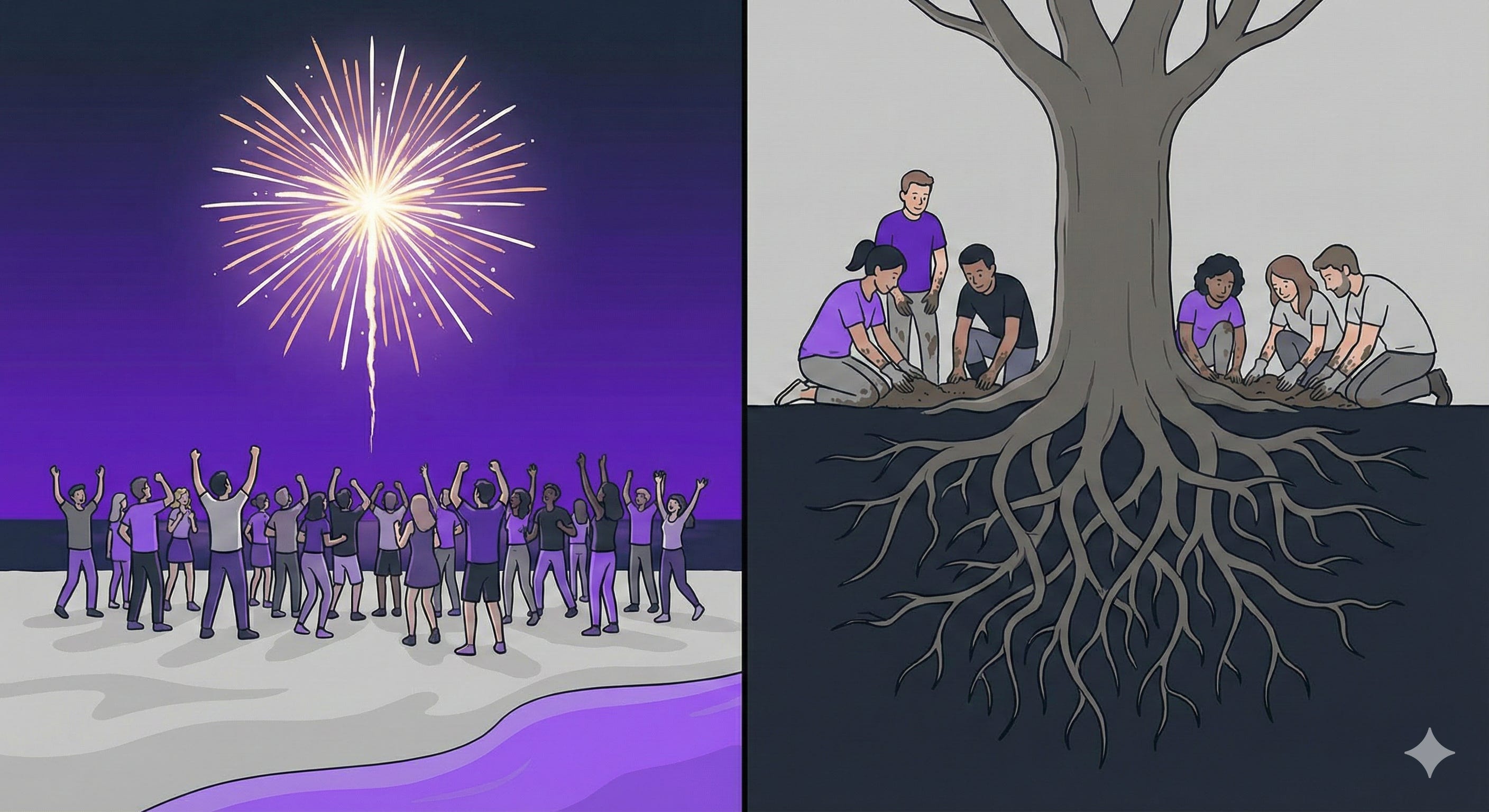
Charles Duhigg’s New Yorker essay makes the case the left is good at mobilizing: getting lots of people to do a thing on demand like march, donate, call a senator, repost a graphic, or attend a rally.
The author argues, though, that the left is worse at organizing: building local infrastructure, leadership, relationships, and habits that persist after the dopamine wears off.
The New Yorker quotes political scientist Hahrie Han’s clean distinction:
“Mobilizing is about getting people to do a thing, and organizing is about getting people to become the kind of people who do what needs to be done.”
I want that printed on a tote bag that no one is allowed to bring to a march until they’ve hosted a precinct meeting.
Because here’s the problem: mobilizing looks like impact. It photographs well. It feels like history. Most of all, it feels great to do and is highly photographable. Organizing looks like someone’s basement and a spreadsheet and a pot of coffee that tastes like regret.
But organizing is how you get wins that survive.
The New Yorker diagnosis: litmus tests eat coalitions
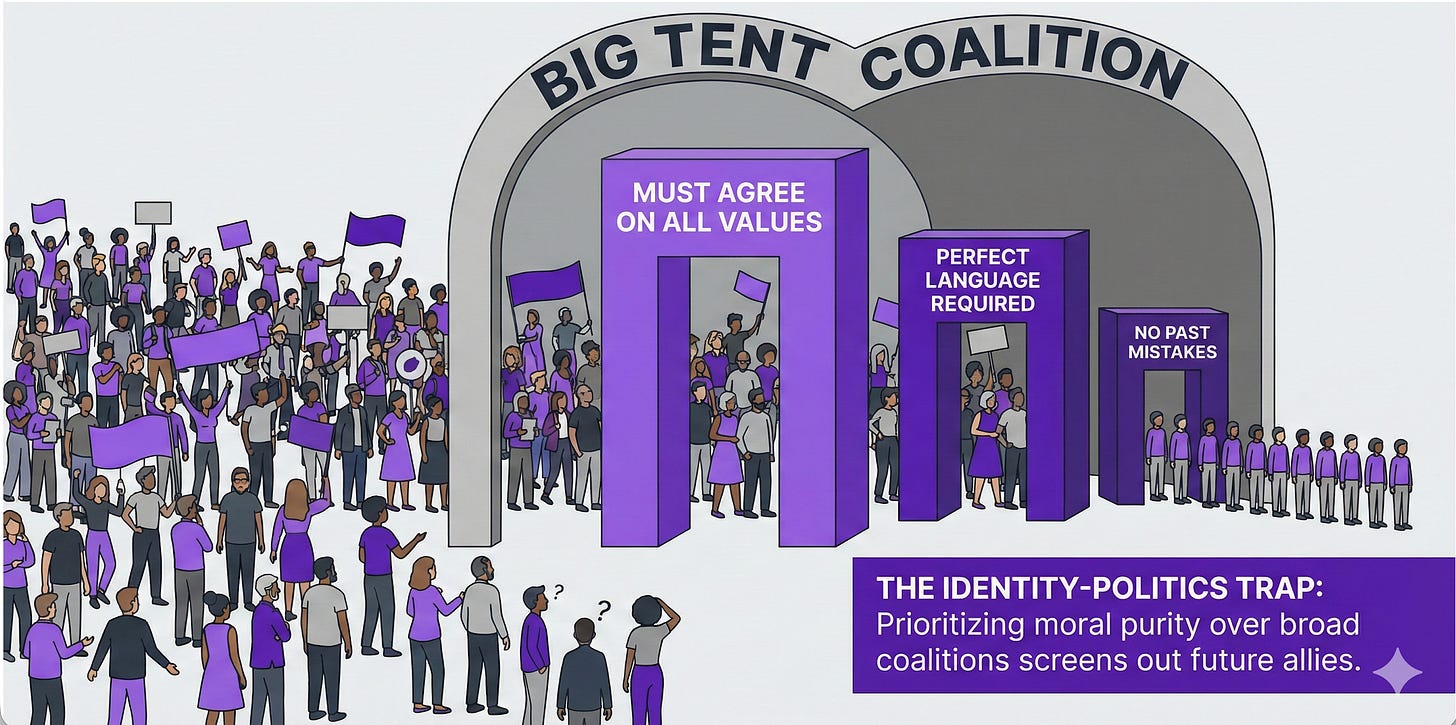
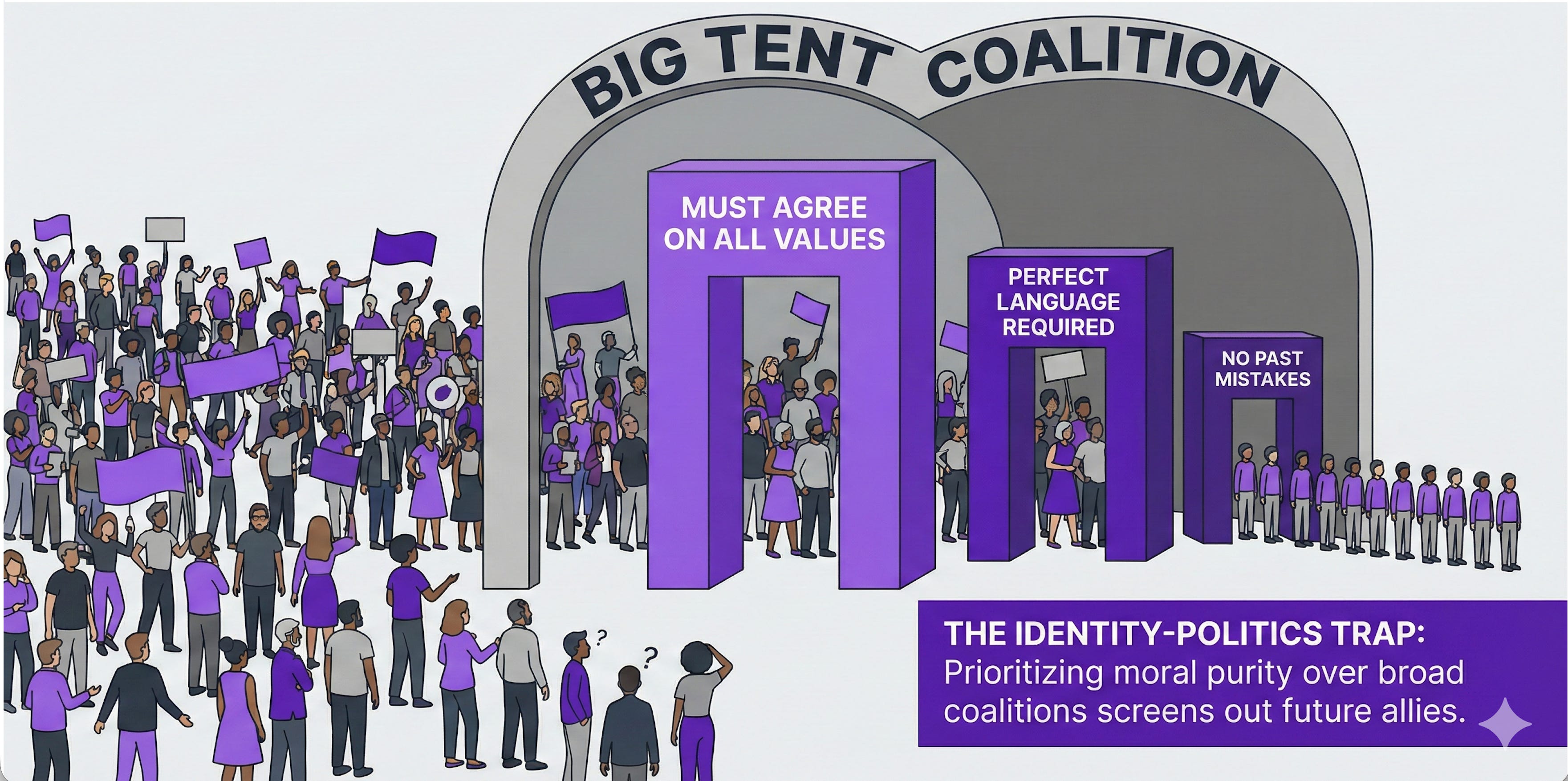
Duhigg’s piece (and the researchers he quotes) makes a claim that would have shocked me 15 years ago when I came of age during the Obama years: conservatives have gotten better at building broad coalitions, while Democrats often fracture over litmus tests.
A movement can have values without demanding identical values from every participant. The article quotes sociologist Liz McKenna: movements need shared core values, but “the requirement can’t be that every value is shared,” and “making room for difference… is table stakes.”
The piece gives concrete examples of exclusion dynamics (who gets ejected, who gets disinvited, which flags are unacceptable), and then connects that dynamic to a broader strategic failure: if you screen out the ambivalent, you screen out the future committed.
There’s also a quietly devastating story about the Women’s March: massive turnout, rapid professionalization, internal disputes over inclusion and ideology, leaders accusing one another of racism and antisemitism, and then the groups “fell into factional infighting or drifted apart.”
This is what identity-politics (hyphenated) does at scale. When the movement is a moral community first and a power-building project second, the dominant questions become: Who belongs? and What feels good? Not: What wins?
And once the central task is proving belonging and optimizing for spiritual fulfillment, you get a predictable playbook:
symbolic actions (high moral signal, low power transfer),
internal policing (status competition disguised as virtue),
and fragile coalitions.
The microcosm: Sierra Club’s South County problem
Now zoom in.
Voice of San Diego profiles Charles Rilli, a deputy director in the Sierra Club’s San Diego chapter, hired to boost membership in majority-Latino South San Diego County.
[T]hough South San Diego County has some of the region’s fastest growing communities and worst environmental problems, fewer than 10 percent of the Club’s 13,000 San Diego County members currently live south of downtown San Diego.
There is no South County equivalent to the Club’s North County local chapter subgroups. None of the Club’s senior San Diego leaders lives in South County. And, until recently, the club was not a major voice in many of the region’s most high-profile environmental debates, including the Tijuana River sewage crisis.
And the story gives you two contrasting scenes.
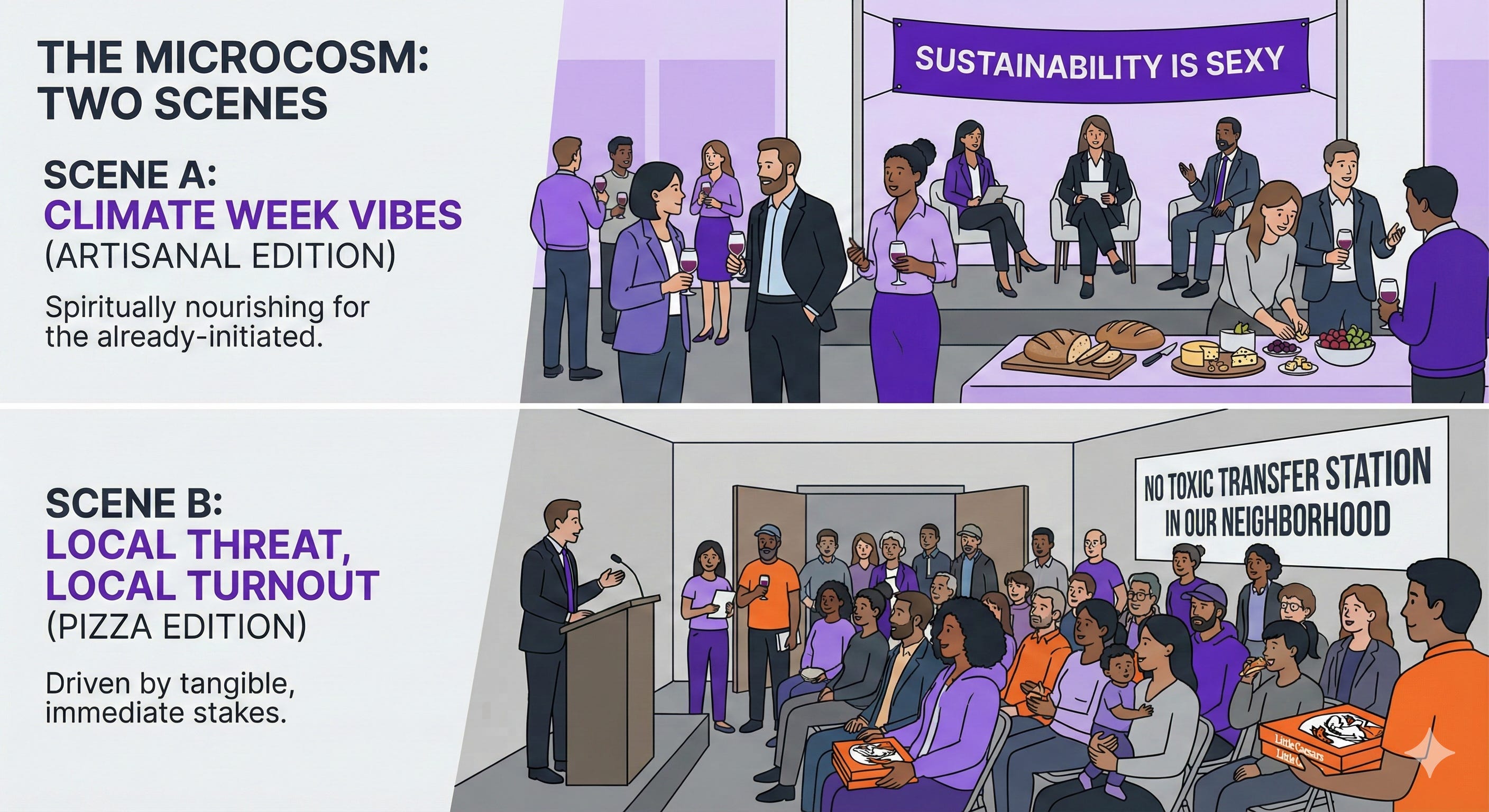
Scene A: Climate Week vibes (artisanal edition)
An October 3 climate event is well attended, but “few attendees appeared to be South County natives.” Many are affiliated with organizations headquartered outside the area. There’s even a table for a zero-waste nonprofit called Sustainability is Sexy.
After the panel, guests “linger with drinks in hand” and snack on “artisanal breads, cheeses, fruit and wraps.”
Scene B: A local threat, local turnout (pizza edition)
Two weeks earlier, in National City, residents (many Spanish speakers) pack a Planning Commission meeting to oppose a diesel fuel transfer station near homes and a school.
They fuel up on Little Caesars, march around City Hall, line up to speak, and the commission votes 4–1 against the project.
The story draws an inference that feels right: working-class South County residents respond most readily when the issue is framed as an imminent threat or injustice affecting daily life—not as an abstract moral cause.
This is the whole thing in miniature.
Not “Sierra Club bad.” Not “climate grief fake.” Not “artisanal cheese is the enemy” (though it is occasionally complicit).
It’s that mobilizing without local belonging and local stakes produces events that are spiritually nourishing for the already-initiated and politically irrelevant to everyone else.
Even Rilli says it plainly: “Mobilizing members here is hard,” because working-class communities are focused on getting by and supporting families—and the organization has to “reframe environmental issues as economic issues.”
That’s organizing talk. That’s meet people where they are talk.
But the microcosm shows how easy it is to slide back into identity-politics (hyphenated): the movement becomes a place where already-aligned people gather to affirm shared moral reality, rather than a machine that converts the unaligned into allies through material stakes, relationships, and repeatable pathways to leadership.
Identity-politics as a strategy substitute
A lot of left-of-center institutions (nonprofits, advocacy orgs, movement spaces) are trying to solve two problems at once:
Make the world better.
Make the participants feel like good, coherent people while doing it.
When resources are scarce and outcomes are uncertain, Problem #2 can quietly dominate. It’s easier to deliver belonging than to deliver policy wins.
Identity-politics (hyphenated) is what happens when Problem #2 becomes the hidden product.
By identity-politics (hyphenated), I mean: a system where political participation is rewarded primarily as moral performance and group membership.
Concrete examples:
The biggest penalty is not “we lost the vote,” but “someone on our side thinks I’m harmful.”
The biggest prize is not “we gained a precinct captain,” but “I’m seen as one of the good ones.”
Meetings drift from planning to purification rituals: statement edits, language policing, symbolic resolutions—anything that produces consensus-as-belonging.
This is where my old taxonomy shows up. Every movement ends up recruiting some mix of:
Table-flippers: people whose nervous system wants confrontation and rupture.
Defenders: people who keep the institution from collapsing (sometimes by smoothing over hard truths).
Do-gooders: people who want to help, be kind, and feel useful—and can be recruited into endless “support” tasks that never touch power.
(And yes, we contain multitudes.)
I’m not calling anyone fake. But I believe this incentive structure is real.
Here’s the strongest counterpoint I can offer: Identity isn’t just a vibe; it’s lived experience. Movements that ignore identity reproduce harm. “Big tent” politics can become a cover for telling marginalized people to swallow injustice for the sake of unity. Sometimes exclusion is rational: you don’t want your movement captured by people who oppose your basic dignity. You don’t want “diversity of opinion” to mean “welcome the folks who want you gone.”
All true. Here are two responses, offered carefully.
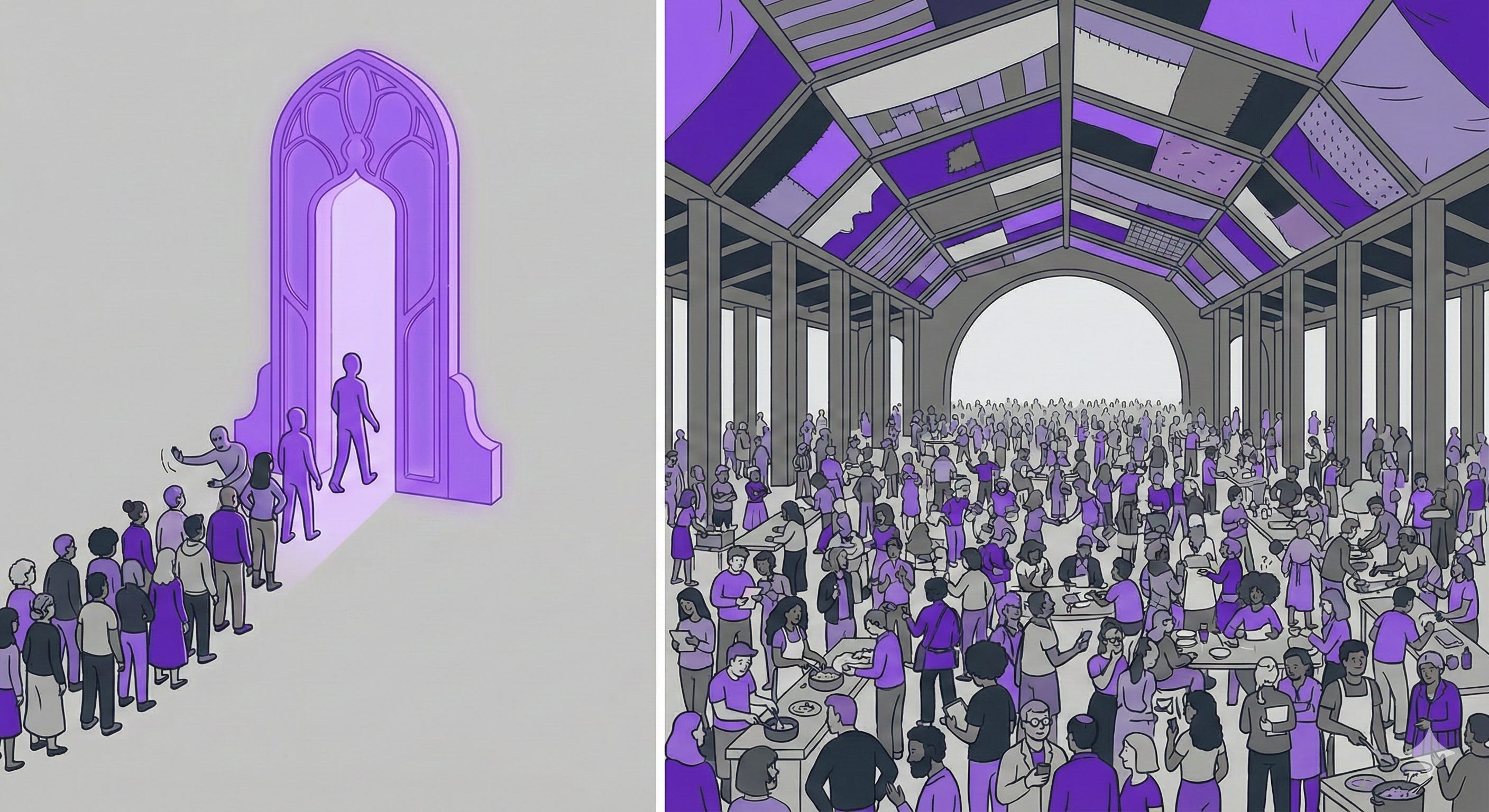
First: there’s a difference between boundary-setting and boundary-addiction. A movement needs non-negotiables. But it also needs a conversion pathway—a way for ordinary, inconsistent, half-formed humans to move toward commitment. If the only safe entry point is full ideological fluency, you will not build power at scale. The New Yorker quotes Munson’s research that many activists become committed because they find community first, not because they arrived pre-pure.
Second: we can protet people from harm while still not narrowing our focus to optimizing for only moral unanimity.
If you want power, you have to make it someone’s problem
The Sierra Club story contains a quiet lesson about recruitment. Rilli talks about door-to-door composting work in Queens: people cared more about rats than “the environment,” and he had to understand their concerns rather than tell them what to do.
Organizing starts when you stop trying to win arguments and start trying to win people—with stakes that are real in their lives.
And it’s not just messaging. It’s structure:
local leaders who can act without waiting for headquarters,
repeated touchpoints that turn strangers into friends,
and pathways that turn participants into decision-makers.
The New Yorker’s critique of some organizations is instructive here: local groups were impactful, but national leadership focused on high-profile protests and “maintaining ideological unity,” even discouraging chapters from endorsing certain candidates.
Theda Skocpol’s blunt line from the New Yorker piece lands: if you want real change, stop funneling resources into “symbolic maneuvers and purist politics.”
Ouch. Also: yes.