


An independent consultant in her second year shared a frustration I hear all the time. After she facilitates a meeting for a client, they see her as “the meeting facilitator.” Not as someone who can develop campaign strategy. Not as someone who can help with implementation or evaluation. Just the meeting person.
She admitted part of the challenge is that she’s still figuring out exactly what services she wants to offer. That’s something I can relate to. When you’re early in your consulting career, you need client work to figure out what you’re good at and what you want to do. But every piece of client work can narrow how people see you.
All About The Differentiation
Around the same time, another consultant asked me to review their website copy. I found myself giving similar feedback. The language sounded good. My head nodded as I read it. But here’s the problem: I bet every one of their competitors would read that same copy and nod in agreement. Every potential customer would too.
When everyone agrees with what you’re saying, you’re not standing out.
I’ve started asking consultants to fill in this statement: “UNLIKE [competitors], MY FIRM [key differentiator].” You don’t have to put those exact words on your website. But you need to know what goes in those blanks. If you can’t fill them in, neither can your potential clients.
I saw this on one website recently:
“We believe that success isn’t just about having great people or smart strategies in isolation—it’s about creating the right environment where they can work together effectively. Our experience shows that organizations achieve their best results when their talented team members operate within a well-designed system that amplifies their strengths and provides clear direction.”
True statement, but literally every consultant in this space would agree with it. There’s no differentiation there.
So I’ve been thinking about what it takes to actually stand out. On the one hand, to avoid being pigeonholed by clients. On the other, to define yourself clearly enough that the right clients find you and understand what you bring.

The Work Behind the Words
I went through this process myself a few years back. I sat down and made a list of everything I’d accomplished. All the metrics. The budget sizes I’d managed. The revenue I’d generated. The retention rates. The capital raised.
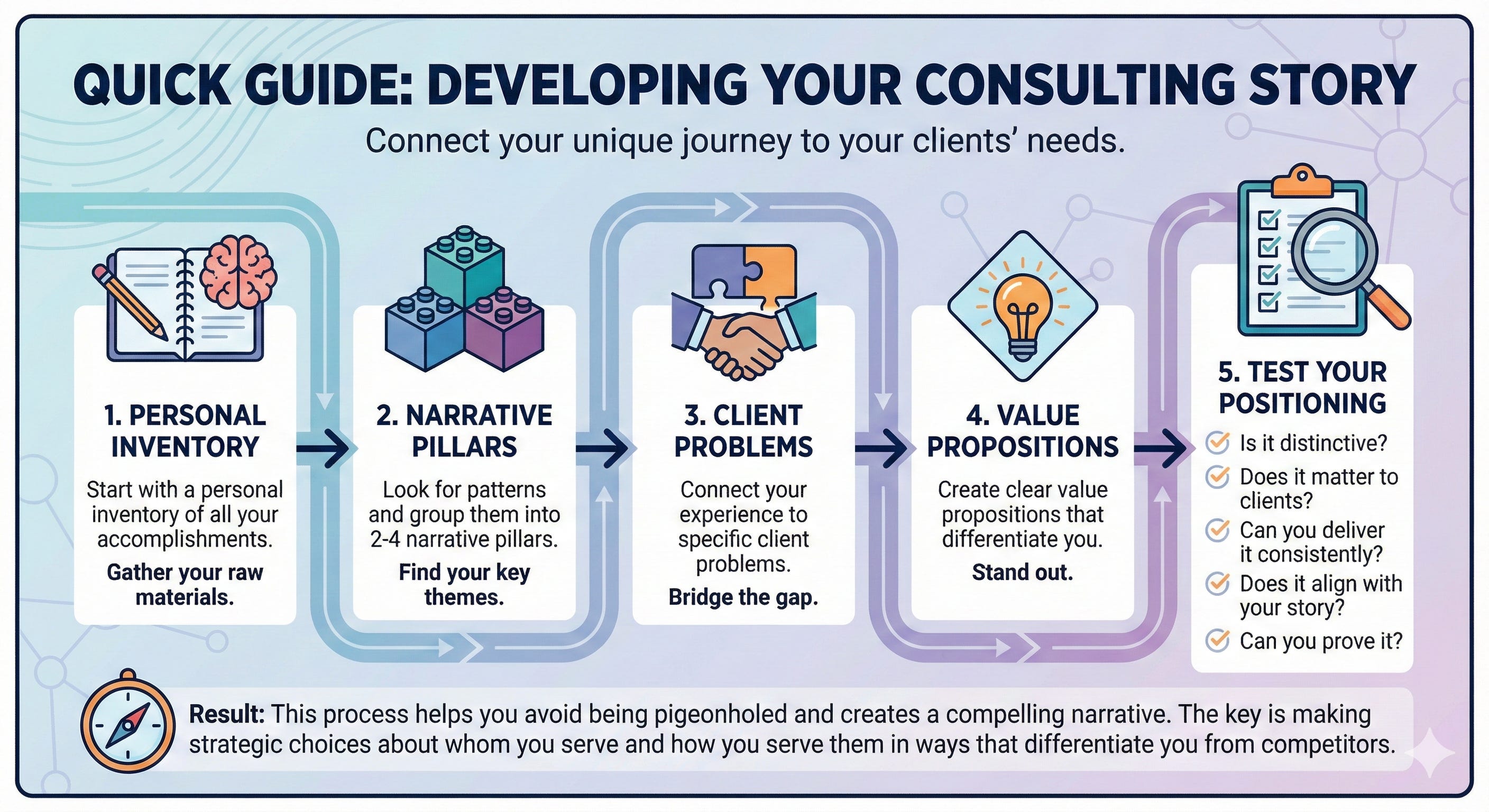
Then I looked for patterns. What grouped together naturally? For me, it was three things: deep operational experience in nonprofits, entrepreneurial ventures I’d built, and the ability to connect strategy to implementation. Those became my narrative pillars which eventually helped me realize that what I could do was help launch new things.
But what I learned is that having pillars isn’t enough. You need to connect them to actual client problems.
I started asking myself harder questions. If someone came to me and said they were considering hiring my competitor instead, what would I say? Not the polite version. The real version. What do I do that’s different? What do I bring that they don’t? Why would it be a mistake to hire them instead of me?
Those questions felt uncomfortable, but they forced me to get specific about my value.
Making It Concrete
The next step was stating the value in plain terms. Not “I help organizations achieve their strategic goals” (because who doesn’t?), but something concrete.
For example, with Chorus, we say “Lift your fundraising and action rates by 10-20%.” Someone reading that knows exactly what they’re getting.
I think about this in terms of client problems. What specific problem am I solving? How am I uniquely qualified to solve it? What evidence do I have that my approach works?
One consultant I know works on strategic planning. but so do dozens of other consultants. What makes them different is that they came up through nonprofit operations. They led organizations. They’ve actually implemented the strategies they now help others develop. That’s their differentiator. They don’t just create strategic plans that sit on shelves. They create plans that get executed because they understand what execution actually requires.
That distinction needs to come through in everything they say about their work.
Who This Is For
The other piece I’ve found critical is naming who you serve.
When I review website copy, I often see phrases like “our clients” without any indication of who those clients are. Is this for anyone? For executive directors? For board members? For development directors?
The instinct is to cast a wide net. More potential clients means more opportunities, right? But in practice, being specific helps more than it hurts. When someone reads your materials and thinks “this is exactly for people like me,” that’s powerful.
You also want some people to read your materials and think “this is definitely not for me.” That sounds counterintuitive. But if everyone wants what you’re offering, you haven’t differentiated. If no one wants it, you don’t have a product. The sweet spot is in between.
I want a competitor to forward my website to one of their clients and say “Hey, aren’t you glad I’m not doing it this way?” And I want a potential client to read it and say “Oh I for sure DO NOT want that approach.”
Not every competitor. Not every potential client. But some of them, because that means I’ve taken a stand. I’ve made a choice about how I work and who I work with.
The Test
I’ve developed a few questions I use to test whether I’ve actually differentiated myself. These questions have saved me from making claims I couldn’t back up. They’ve also helped me see where I have real advantages I wasn’t talking about.
Are my services distinctive? Would my competitors claim the exact same thing?
Does it matter to clients? Am I solving a problem they actually have?
Can I deliver it consistently? Or am I promising something I’ve only done once?
Does it align with my story? Does my background actually support this claim?
Can I prove what I’m claiming? Do I have specific evidence?
Living With It
The consultant who reached out about being pigeonholed asked what she should do. I told her she’s actually in a good position. She has client accounts. She’s seeing what resonates. Now she needs to step back and do this positioning work.
What problems is she actually good at solving? What makes her approach different? Who are the ideal clients for that approach? What evidence can she point to?
Then she needs to get that clarity into everything she shows potential clients: the website, proposals, and conversations. All of it needs to reinforce the same story about who she is and what makes her different.

My own positioning has shifted as I’ve learned more about what I’m good at and what clients need. The work I did three years ago looks different from the work I do now. My story has evolved.
But I keep coming back to those core questions. What’s my differentiator? What specific value am I delivering? Who is this for? Can I prove it?
When I can answer those clearly, everything else gets easier: business development conversations, proposals, and client relationships. Because both of us know exactly what we’re getting into and why we chose to work together.
That clarity is what keeps you from getting pigeonholed. Not just by clients, but by yourself.
Want more resources? Check out this guide I put together.
A New Report Coming
But before getting to the rest of the article, please contribute to our survey!
We’re launching a Strategic Fitness Survey to understand how nonprofits make decisions and implement strategic thinking practices. It takes less than 10 minutes to complete, and we invite nonprofit staff, leaders, board members, and consultants to share their experiences. Your participation will help build a comprehensive picture of strategic practices across the sector, with findings to be published in early 2026. Please take the survey and share it with your network to help us gather diverse perspectives!