



And meet the Strategic Agility Series’ new co-author, Emily Berens, who has deep expertise in what makes management effective across organizations. She partners with social change leaders to build strong teams and create the conditions for consistent, mission-driven impact over time. Emily is the founder of Trellis Strategies.

For those new to the Strategic Agility series: a strategic operating system is the set of structures, rhythms, and decision-making infrastructure that make it possible to build for the long-term while executing in the short-term.
In our most recent work, we’ve been focused on three non-negotiable capabilities of this system for your organization:
Bring the right people in.
Manage them effectively once they’re there.
Move them out if and when you need to.
We’ve written about #1, bringing the right people in (hiring) and #3, moving them out when you need to (firing). This article kicks off a dedicated series on #2 — managing people effectively across the organization once they’re there.
Over the course of this series, we will walk you through everything you need to build the infrastructure that makes great management the default, whether your organization has one manager or 100.
To get us started, we’re going to talk about how cars work
Let’s Talk About How Cars Work
A car has an engine.
The engine generates power.
But engines don’t move cars.
Transmissions do.
The engine creates force. The transmission converts that force into motion. It transfers power from the engine to the wheels. Without it, the engine can roar all it wants. The car won’t go anywhere.
Or worse — it will lurch, grind, overheat, and eventually break down.
Let’s talk about how organizations work.
An organization has a strategy.
Strategy generates direction and force.
But strategy doesn’t move organizations.
Management does.
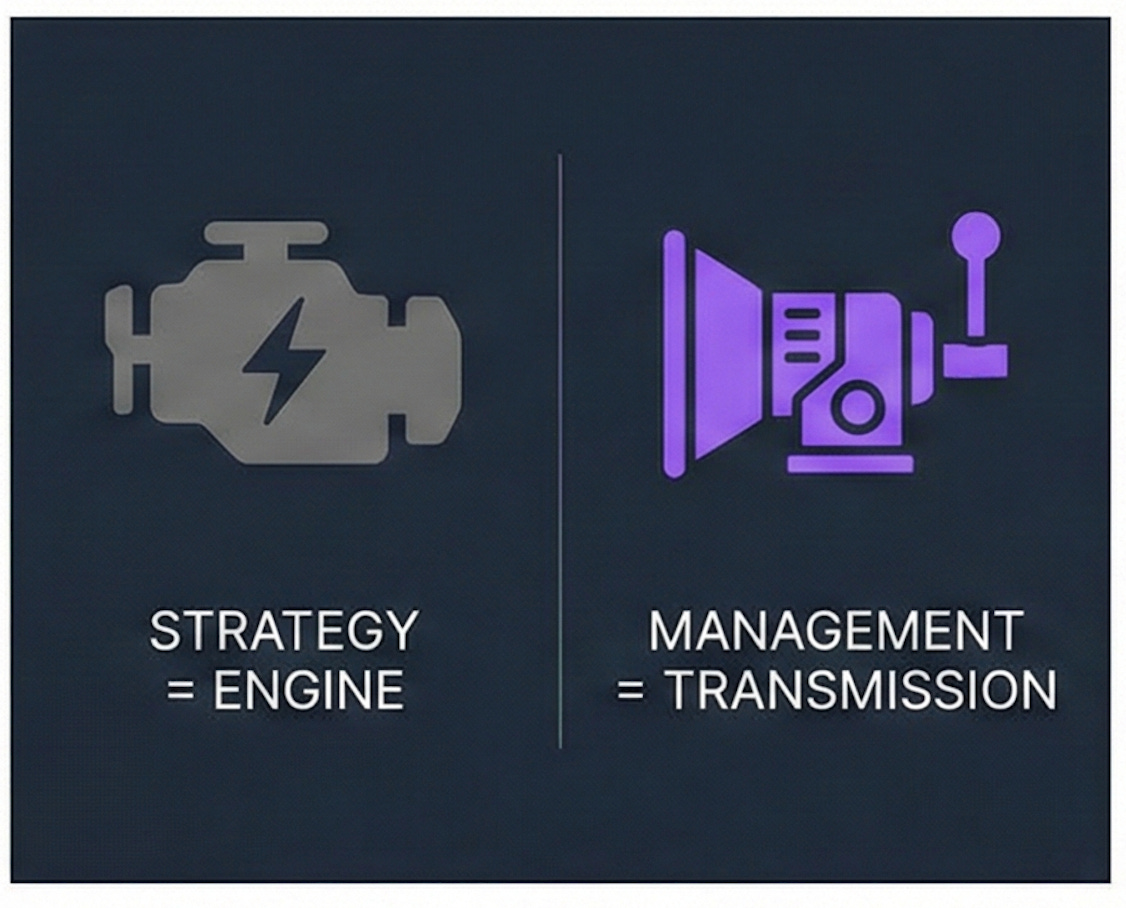
Before we go further, this isn’t an argument that managers aren’t doing enough. Most managers are working incredibly hard. They care. They’re trying. Many are holding more complexity than their roles were ever designed to carry.
It’s an argument that committed, skilled managers who are asked to manage without a solid management infrastructure are ultimately being set up to fail.
Good managers operating within a strong management infrastructure are what convert strategic power into effective execution.
Without those components, the strategy can be bold, ambitious, and logically sound — and the organization still won’t move.
Or worse — it will surge in one area, stall in another, overextend in a third, and burn people out in the process.
When a car roars but won’t move, we don’t blame the engine. We don’t blame the driver.
We inspect the system that converts power into motion.
In organizations, when execution falters, we point to almost everything else:
→ The strategy — “We had the wrong plan.” (Execution failed, so the plan must be wrong.)
→ The people — “We have the wrong people.” (Talent should fix the system.)
→ The culture — “We don’t have a culture of accountability.” (As if culture exists outside structure.)
→ The external circumstances — “The environment shifted.” (Volatility explains inconsistency.)
→ The individual — “They’re not strong enough.” (We never defined strong.)
These are the easiest explanations to reach for. So we reach for them.
The plan might be part of it. The people might be part of it.
But when execution falters, it’s usually a breakdown in the system — the management system.

Transmissions are infrastructure — deliberately engineered systems built for precision and performance. They regulate power. They synchronize movement. They absorb strain. They ensure force reaches the wheels without tearing the system apart.
And when execution is steady — when talented people collaborate effectively and deliver sustained impact over months and years — that is a system working.
Management must be built the same way: as infrastructure.
When that infrastructure is weak, undefined, or inconsistent, no amount of horsepower will move you forward.
But when it’s strong, clear, and supported, power and momentum compound.
People, strategy, culture, and circumstances matter but infrastructure is what aligns them.
That’s what this series will show you how to do: build the infrastructure that makes strong management across your organization the default.
We’ll introduce the full management infrastructure in the next article. From there, we’ll go deep on each component — the templates, the frameworks, the tools.
But today, start here.
Define what good management looks like in your organization.
It sounds simple. Most organizations have never done it.
If you haven’t, or don’t, define it, every manager builds their own version. Standards drift. Expectations vary. Accountability becomes personality-dependent.
Some managers quietly hold the bar or raise it. Others quietly lower it. And some never realize there’s a bar in the first place.
No one is operating from the same definition. And no one is being held to one or fully supported to reach it.
The fix isn’t more training. It isn’t better feedback. It’s clarity.
A written management framework outlines the following:
Why management matters here — and what “excellent” management looks like in practice.
How managers will be supported to meet that standard.
It doesn’t have to be long.
It has to be deliberate.
And it has to be written.
Because if it isn’t written, reinforced, and tied to hiring and promotion decisions, it isn’t infrastructure.
It’s preference.
And preference is not a system.
Your move this week: Write it down.
Take 30 minutes and answer these two questions:
This is just for you — for now. And it’s just the first draft. Soon, you’ll want to gather input and share it with your management team, and we’ll give you tools to do that. For now, use this exercise to capture your own thinking.
We’ll share how we answer these questions as part of this series, but this step is about capturing your answers.
1. Why does management matter here? What does “excellent” actually mean?
You might write things like:
Ensuring each person has what they need to succeed
Flagging patterns, risks, and opportunities across the organization
Translating organizational decisions into clarity for their teams
Serving as a connective tissue between strategy and day-to-day work, and between their teams and the broader organization
Then think through what those things actually need to look like in your organization.
2. How will we support managers in meeting that bar?
What development, coaching, and infrastructure exist — or need to exist — to help them get there?
If there’s a gap between what you just wrote down and what you are seeing, that is okay. It’s normal and it’s fixable.
Not by asking people to try harder and not by (only) sending them to training, but by building the infrastructure that makes good management the default over time.
That’s what this series will show you how to do.
Start with the 30 minutes above.
We want to talk to you!
If any of this landed — whether you’re in the thick of these challenges or you’ve developed approaches that work — we want to hear about it. We’re scheduling 20-minute conversations with leaders to understand what’s helping you stay grounded and where you’re struggling. Your insights shape how we build this series.
Send us an email at info@hookrodgersconsulting.com to get on the books.