


A quick note from Sam:
Hi everyone! I’m happy to introduce a mini-series on the Chorus Consultant Community substack that is launching today. It’s all about strategy and how to cultivate the art and science of strategic thinking within ourselves, our organizations, and our clients.
For this series, my longtime friend and colleague, Susannah Hook-Rodgers, is joining me as an author for this substack. I’ve known Susannah since 2007 when she was a Green Corps field organizer and I was an Assistant Organizing Director. In nearly 20 years of partnership and collaboration, I’ve never stopped being in awe of Suannah’s brilliance, empathy, kindness, commitment to social change, and work ethic. I’m not alone in thinking that; Suannah has held executive team roles at Indivisible, MoveOn, Courage Campaign, Citizen Engagement Lab, and more.
The Strategic Agility Reboot series will run here every week for the next 3-4 months. We’ll keep to the Tuesday/Thursday newsletter schedule, with one day per week being the usual stuff here and the other day part of the Strategic Agility Reboot series. Sometimes I’ll share a byline with Susannah, other times she’ll be coming to you solo.
I’m really excited for all the great writing and resources we have queued up. I think you’ll love it. Now, over to Susannah for the inaugural piece.
Welcome to the Strategic Agility Reboot series
Practical tools and simple practices to reground as a strategic operator and build strategic stability around you.
How we got here
Leadership is hard. And powerful, rewarding, and at times, exhilarating. It isn’t just what you do — it’s somehow, fundamentally, who you are.
Leaders move with intention. We do good work and feel good doing it, stabilized by strategy. We set others up to do the same. New information doesn’t derail us — it energizes us. We absorb, recalibrate, and move forward with sharper clarity. The unknown and difficult questions excite us. We trust our processes, our systems, our people, and ourselves.
Momentum builds. Strategic thinking, decisions, and actions compound, scale, and adapt. Our team operates with laser focus and we lead with grounded power toward progress and impact.
But then reality hits. Chaos. Urgency. A million things throw us off course and disrupt our clarity. Anxiety grows from the persistent sense of motion without progres — and worse, the guilt of watching our teams fill the vacuum with their best guesses, colleagues recalibrate without clear direction, and staff wonder what their work ladders up to.

I’ve worked with incredible leaders throughout my 20+ years in-house. Two years ago, I started my own practice to focus on what matters most to me: helping leaders and emerging leaders develop more effective leadership strategies. Each person comes through the door with their own presenting issue — ’I need to fix team dysfunction,’ ‘I want to roll out this new initiative,’ ‘I want to be more effective.’ But regardless of what brings them in, how many years of experience they have, or the size of their staff or budget, we invariably end up working on the same underlying capacity: their ability to operate as a proactive strategist, and whether the operating system around them enables or constrains that.
Here’s what I’m hearing when we start to dig in: Your day is full before it starts. Your inbox triggers panic. Your to-do list has replaced intention and screams, ‘Your value is measured by your output.’ Strategy slipped — you’re not sure when or how. Campaigns that plateaued six months ago are still consuming resources. Underperformance has become normalized. Decisions are now driven by fear, conflict avoidance, and ‘the way things have always been done.’ You know what needs to happen, but there’s no time. Even your best work feels fragile.
These leaders are strong strategists who worked hard to get where they are — they’re not struggling because they lack skill or discipline. They’re struggling because they’re trying to lead at speed without a system built for it. Trapped in the urgent and immediate, the absence of a strategic operating system that stabilizes their role as a proactive strategist compounds daily. And so do the costs.
My job is to help leaders reground as strategic operators and build systems that provide strategic stability and clarity — so they can do good work, feel good about it, and set others up to do the same.
Strategic operating takes time and intent. It’s not a straight line, it’s a way of being that drives how we operate: think, decide, build, and adapt.
That’s why we’re building this series: each week, we’ll provide practical tools and simple practices that don’t take more time but change how you use it.

Throughout this series, you’ll get:
Practical “superpowers”: outcome focus, anticipation, long-term balance, better decisions, root-cause fixes, purpose-led leadership.
A strategic thinking evaluation with a diagnostic guide and guidance for what to do based on the results.
A bundle of tools, each one usable in <30 minutes.
Superpower #1
Strengthening the foundational muscle of a strategic operator – your ability to create space for intentional choice so that you can think and act strategically even when everything feels urgent. You can do this in less than 60 seconds and can start using it immediately.
The Pause Protocol
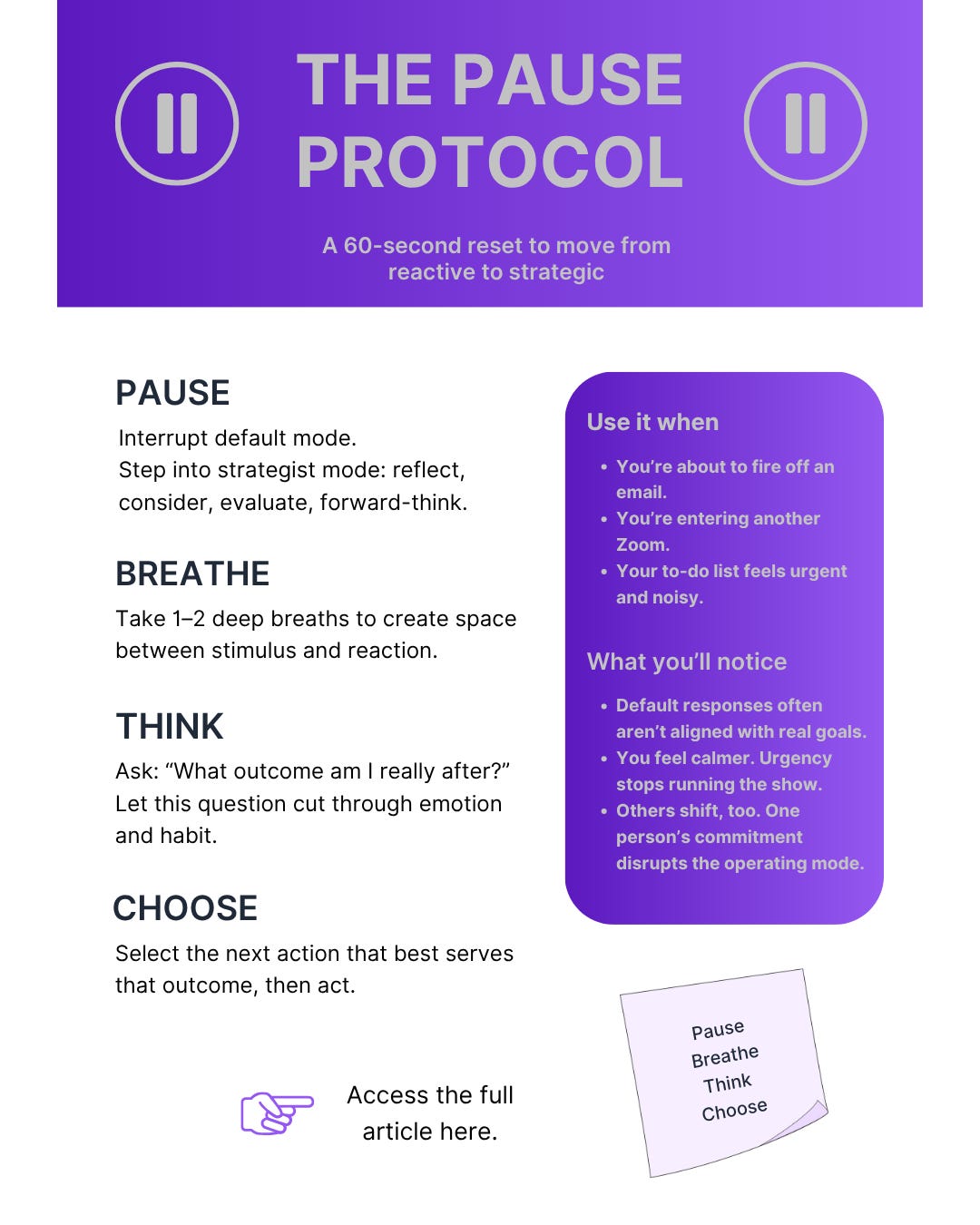
The next time you’re about to fire off an email, walk into another meeting, or feel urgency rising—stop. And run the protocol:
Pause. Don’t think, don’t speak, don’t type.
Breathe. Or move your body, whatever works to create space between stimulus and reaction.
Think. Ask yourself: “What outcome am I really after?”
Choose. Decide on an action (or in-action) based on what immediate next step will move you toward it.
What you’ll notice:
Alignment; your action aligns with the direction you want and need to go.
Relief; you feel better. Reactive urgency turns you into a machine.
Empowerment; intentional action turns you back into a leader.
Others shift. One person’s commitment to operate differently can disrupt the system around them.
Action Steps
Download the Pause Protocol Reminder Card here. Hang it up on your bulletin board, tape it to your desk, make it your screen saver.
Join our Strategic Fitness Benchmarking Study:
We’ll ask consultants, leaders, staff, and board members to assess strategic fitness inside nonprofits they are connected to: How often do teams pause, ask the right questions, map systems, dig for root causes, run scenarios, and name stakeholders early?
We’ll then publish a report offering practical benchmarks based on organizational size and field, guidance for how to use them, and a collection of industry-sourced tools and practices that you can use and take back to your teams.
—> Join the study by filling out the (30-second) interest form here.
Coming up next in the series
The next step is a Strategic Thinking Self Evaluation, with a diagnostic guide and an action plan based on your results.
The goal: to meet you where you are and give you a clear path forward—not a framework, but a targeted plan that works to address specific gaps.
We want to talk to you!
If any of this landed with you — whether you’re in the thick of these challenges or you’ve developed strategies that work — we want to hear about it. We’re scheduling 20 minute conversations with leaders to understand what’s helping you stay grounded as a strategic operator and where you’re struggling. Your insights will shape how we build this series and similar future projects. Reach out directly at info@hookrodgersconsulting.com to meet with Sam and me and discuss.