



Here’s the uncomfortable truth: certainty isn’t coming. Not because you’re missing something. Because it doesn’t exist.
Every meaningful decision you make as a leader happens under conditions of uncertainty. The 80/20 principle applies: you’re almost never going to have more than about 80% of the information you want. You can commission another report, schedule another meeting, wait another quarter—and you’ll still be at 80%. The certainty trap is spending your energy chasing that final 20% that may not even exist.
The trick isn’t to get more information. It’s to manage the uncertainty you’ve got.
That’s the real superpower. Not the ability to predict the future. The ability to move forward without needing to.
What follows are four tools to build into your Strategic Operating System.
They won’t eliminate uncertainty. They’ll give you infrastructure for moving through it.
Tool #1: The Uncertainty Audit
A practical uncertainty audit forces you to separate what you know from what you’re assuming.
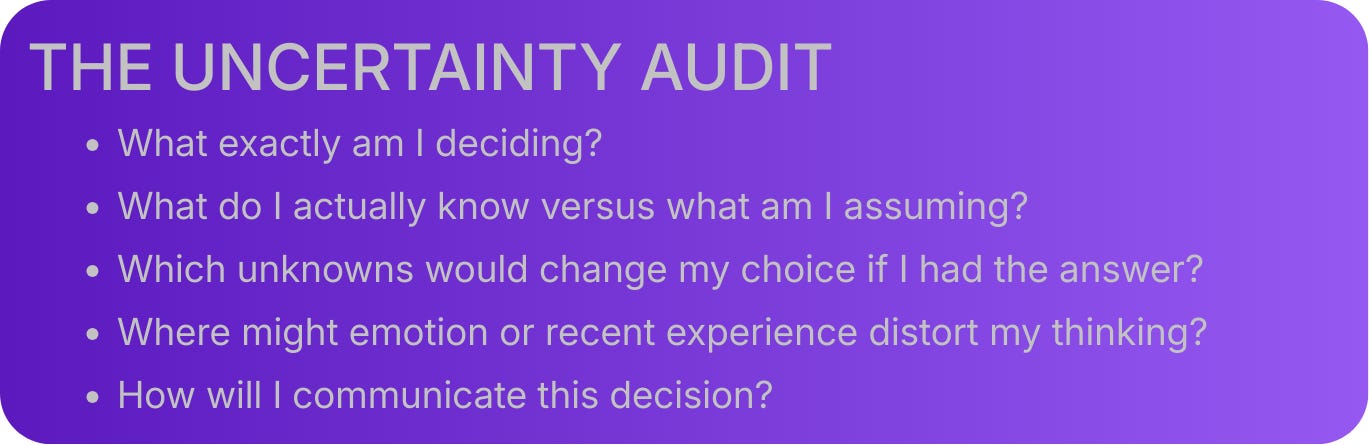
The real value shows up in two places. First, it helps you identify which unknowns actually matter. Second, it reveals where you might be fooling yourself—where emotion, recent experience, or habit is doing the work that strategic thinking should be doing.
Finally, an uncertainty audit changes how you communicate decisions to others. Instead of presenting a conclusion as though it emerged fully formed from certainty, you can show your reasoning: here’s what we know, here’s what we don’t, here’s the bets we’re making and why.
Tool #2: The Reversibility Test
Before you decide how much deliberation a decision deserves, ask: Is this a one-way door or a two-way door? One-way doors—decisions that are expensive or impossible to reverse—warrant slower, more careful thinking. Two-way doors can be walked back through; decide faster, learn, adjust.
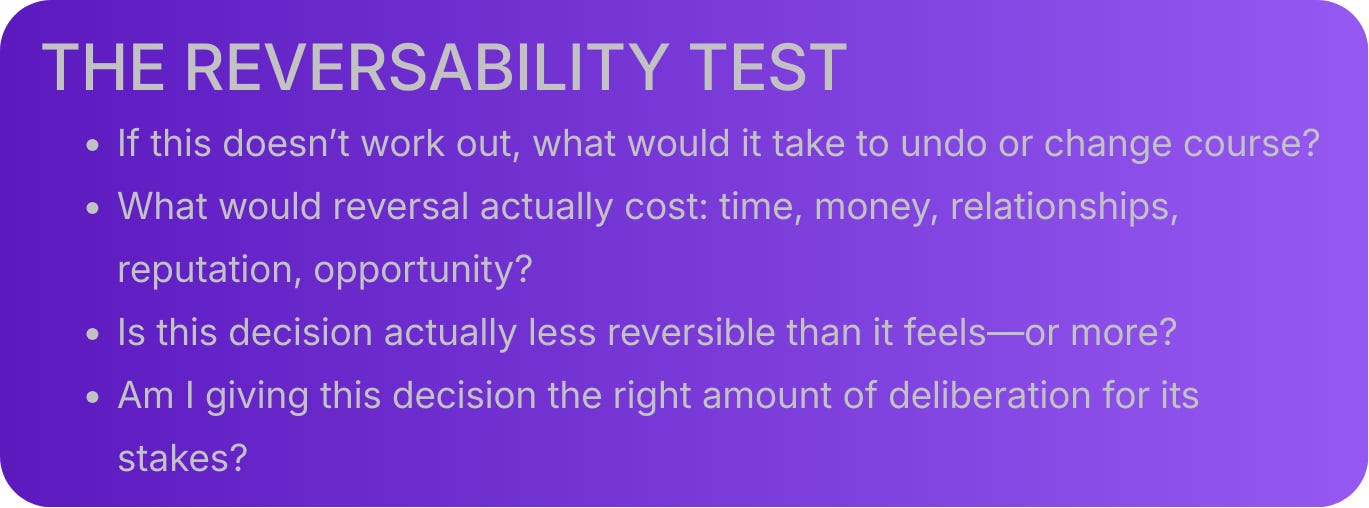
Most decisions are more reversible than they feel in the moment. Leaders often burn significant time and energy deliberating two-way doors as though they’re permanent, while under-examining the ones that actually are. The reversibility test helps you match your process to the actual stakes—and frees up operating capacity for the decisions that genuinely require it.
Two-way doors deserve speed and a review date. One-way doors deserve deliberation and input.
Tool #3: The Pre-Mortem
Assume the decision failed. Spectacularly. Now work backward: What happened?
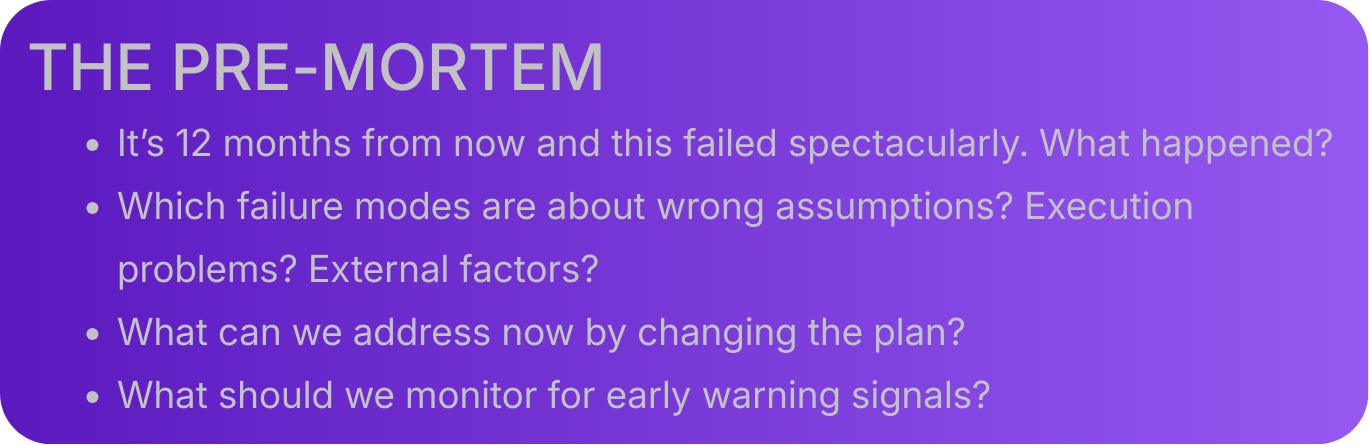
This isn’t pessimism—it’s a structured way to surface what your current thinking is missing. Optimism bias is real; when we’re leaning toward a choice, we unconsciously downplay the ways it could go wrong. A pre-mortem gives your team explicit permission to name concerns that might otherwise stay unspoken.
The pre-mortem works because it changes the psychological frame. Instead of asking people to critique a plan (which feels like criticism), you’re asking them to explain why a hypothetical failure occurred (which feels like analysis). The shift is subtle but significant. Concerns that would feel disloyal or negative in a planning meeting become legitimate insights in a pre-mortem.
Tool #4: The Cheap Test
What’s the smallest move that would generate real information?
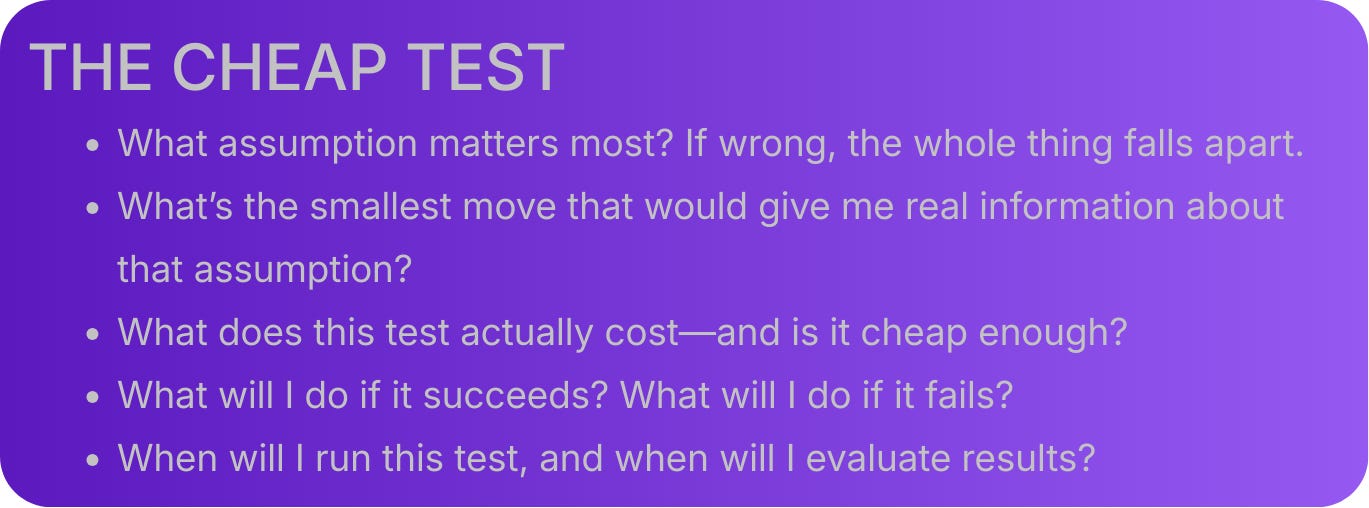
Under uncertainty, analysis has diminishing returns—at some point you’re just rearranging your assumptions. Action creates data. The discipline is designing experiments that are low-cost but high-signal: pilot programs, limited rollouts, conversations with the five people who’d be most affected.
A good cheap test has two characteristics: it’s actually cheap (in time, money, political capital, or attention) and it generates a real signal (not just confirmation of what you already believe). Before you run it, define what success and failure look like—and what you’ll do in each case. Otherwise you’ll end up rationalizing whatever result you get.
Building Your Decision-Making Infrastructure
These four tools work together as decision-making infrastructure: the uncertainty audit surfaces your thinking, the reversibility test calibrates how much deliberation the decision deserves, the pre-mortem stress-tests your blind spots, and the cheap test biases you toward learning through action.
You don’t need to use all four tools for every decision. The reversibility test alone might be enough to tell you this is a two-way door that deserves a quick call and a review date, not a week of analysis. A major strategic bet might warrant all four tools in sequence.
None of these tools promise certainty. All of them help you operate strategically without it. Build them into your system, and navigating uncertainty stops being something you white-knuckle through and starts being something you have a practice for.
Start Here
Pick one decision you’re currently facing—something meaningful enough to matter but not so high-stakes that you need to get it perfect on the first try. Run the uncertainty audit. Notice what surfaces when you separate what you know from what you’re assuming.
Download the worksheets for all four tools and keep them accessible. The goal is to build the muscle memory of thinking this way until it becomes your default.
Download the Decision-Making Toolkit:
Here’s an example of how the tools work together, summarizing the toplines from each step along with the filled out worksheet.
Example: Maya, an ED of a regional environmental advocacy org, who is deciding whether to expand into Ohio to support a pipeline fight.
Uncertainty Audit: Maya separates what she knows (has $150K, coalition asked for help, PA precedent) from what she’s assuming (coalition will work well, playbook transfers, funders will approve). She identifies which unknowns matter most and realizes she’s overweighting the PA win while underweighting team capacity.
Example-Uncertainty-Audit-Filled.docx
Reversibility Test: She realizes this isn’t one decision—it’s two. The exploration phase is a two-way door (decide fast). The full commitment is a one-way door (slow down, get input). This reframe lets her move quickly on the first stage while building in checkpoints.
Example-Reversibility-Test-Filled.docx
Pre-Mortem: The leadership team imagines spectacular failure—coalition implodes, wrong hire, funder pulls out, home state work suffers. They sort failure modes and identify three major changes: funder-first conversation, protected capacity for home state, and staged commitment with explicit kill switches.
Example-Pre-Mortem-Filled.docx
Cheap Test: Before committing, Maya designs a strategy session with the coalition—20 hours and $3K to test whether they’ll actually defer on regulatory strategy or just want her name and money. She defines what success and failure look like before she goes.