



Strategic operators understand something that reactive leaders don’t.
Not all wins are equal.
Some wins create capacity. They build infrastructure, develop people, establish systems, strengthen relationships, or generate resources that compound over time. These wins make the next win easier. They create momentum.
Other wins deplete capacity. They extract energy, burn goodwill, create technical debt, or consume resources that aren’t replenished. These wins look good on this quarter’s scorecard but leave you weaker for the next challenge. They create a treadmill.
The tricky part is that both kinds of wins feel the same in the moment. Both give you that hit of accomplishment. Both show up on your to-do list as “done.” You can’t tell the difference by how productive you feel at the end of the week.
You can only tell the difference by what’s true six months later.
A New Report Coming
But before getting to the rest of the article, please contribute to our survey!
We’re launching a Strategic Fitness Survey to understand how nonprofits make decisions and implement strategic thinking practices. It takes less than 10 minutes to complete, and we invite nonprofit staff, leaders, board members, and consultants to share their experiences. Your participation will help build a comprehensive picture of strategic practices across the sector, with findings to be published in early 2026. Please take the survey and share it with your network to help us gather diverse perspectives!
The Trap: We Keep Choosing Short-Term Wins
If the choice is so obvious when I lay it out like this, why do smart leaders keep making the wrong one?
Because the system rewards short-term wins.
Your board wants to see quarterly metrics. Your funders want deliverables on their timeline. Your staff want to know the crisis is handled. The win you can show today feels more real than the capacity you might build over the next year.

And here’s the part nobody tells you: sustainable success is invisible until it compounds. When you’re investing in capacity-building wins, you often can’t point to anything tangible for months. You’re building infrastructure that won’t be stressed until the next crisis. You’re developing people who won’t be ready for bigger roles until next year. You’re creating systems that won’t show their value until the tenth time you use them.
The short-term win is legible. The sustainable success approach requires faith that the compounding will happen.
That faith gets harder to maintain when you’re exhausted, when the inbox is screaming, when everyone around you is rewarding activity over impact.
What This Looks Like in Practice
Let me make this concrete.
Scenario: Your communications director just resigned. You need to fill the role fast—there’s a major product launch (or campaign, or fundraising push) in eight weeks, and the board is already asking questions about the gap.
Short-term win approach: Hire quickly from your existing network. Get someone in the seat who can execute the launch. You don’t have time for a real search—you’ll deal with fit issues later. The important thing is showing the board you’ve handled it.
Sustainable success approach: Take a beat. Ask why the previous person left—and whether anyone bothered to find out before they walked out the door. Look at whether the role is scoped correctly or whether you’ve been asking one person to do three jobs. Consider whether the eight-week deadline is actually immovable or whether you’re just terrified to push back on stakeholders. Run a search that prioritizes finding someone who will build capacity, not just execute one launch.
The short-term win gets someone in the seat. It solves the immediate problem. It gives you something to report at the next board meeting. It feels productive.
The sustainable success approach might mean the launch happens a few weeks late—or that you adjust scope and have an honest conversation with your board about tradeoffs. But eighteen months from now, you have a communications director who’s built a team, established systems, developed a real strategy, and positioned you for growth you can’t even imagine yet.
I’ve seen this play out hundreds of times. The reactive leader makes the quick hire and spends the next year managing underperformance, filling gaps, apologizing to partners for dropped balls, and eventually doing another search. The strategic operator takes a short-term hit but creates long-term capacity.
A Necessary Nuance: When Short-Term Wins Are Part of the Strategy
I want to be clear: short-term wins aren’t the enemy. Sometimes they’re exactly what sustainable success requires.
The difference is whether the short-term win is the strategy or whether it’s in service of a strategy.
There are moments when you need a quick win to buy credibility with a skeptical board. Times when your team needs a visible success to rebuild momentum after a hard loss. Situations where demonstrating early results is what unlocks the resources for longer-term investment. Political realities where you have to show progress before you’ve earned the capital to make bigger moves.

Strategic operators understand this. They’re not allergic to short-term wins—they’re intentional about them. They can articulate why this particular win matters, what it’s building toward, and how it connects to the larger picture. They know when they’re making a tactical choice to bank a quick result and when they’re genuinely building something.
The trap isn’t pursuing short-term wins. The trap is pursuing them by default —letting urgency dictate your choices because you’ve never built the infrastructure to do anything else. It’s the difference between a chess player sacrificing a piece as part of a larger strategy and a chess player losing pieces because they’re only thinking one move ahead.
When you find yourself chasing a short-term win, ask: Am I choosing this, or is it choosing me?
The Test
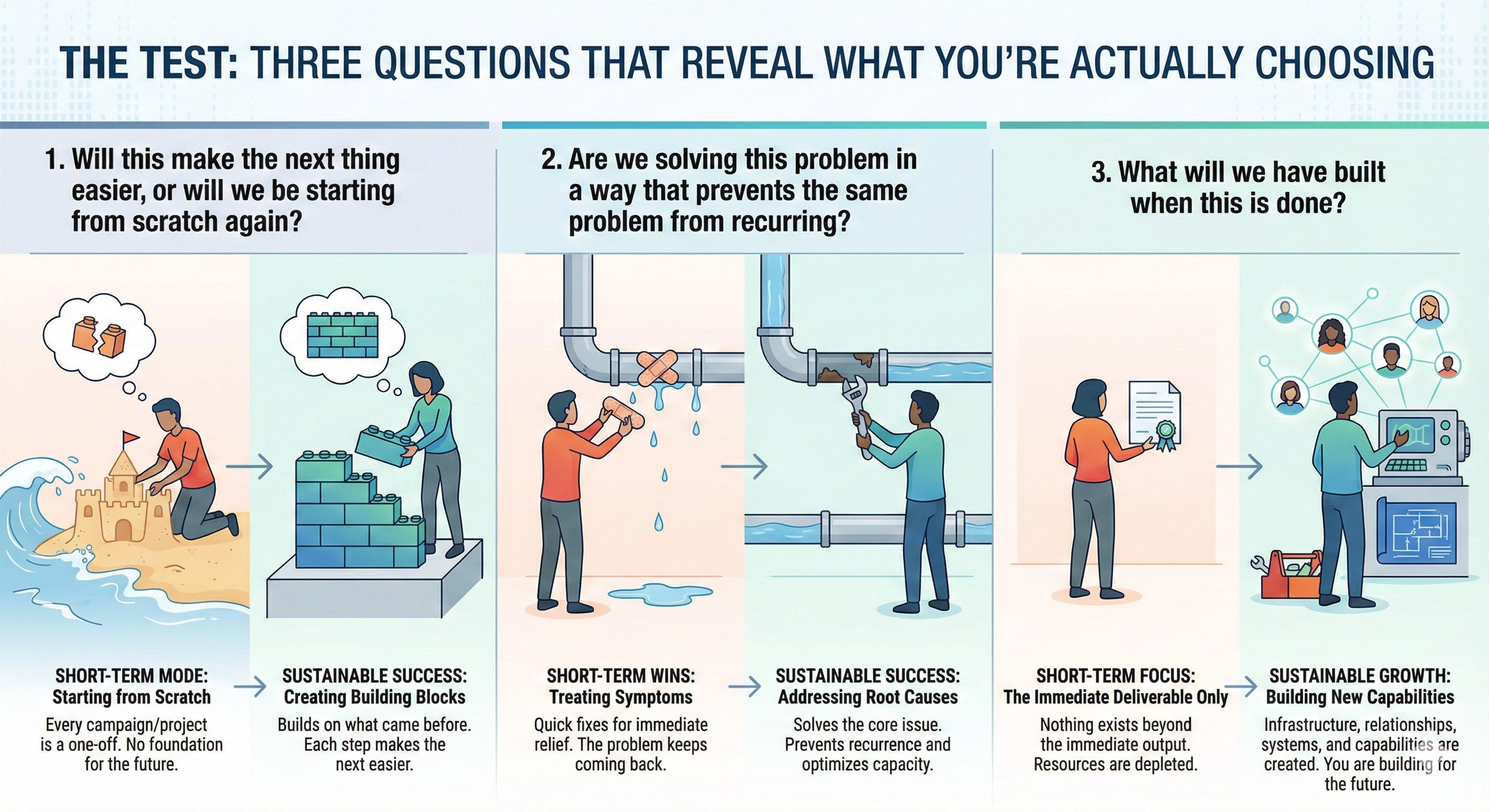
When you’re about to commit significant time, energy, or resources to something, pause and ask:
Building the Infrastructure for Long-Term Thinking
Strategic operators don’t magically resist short-term pressure. They build infrastructure that makes long-term thinking possible.
They create space for strategic reflection. Not occasional retreats—regular rhythms where they step back and ask whether the wins they’re chasing actually ladder up to the outcomes that matter.
They name their non-negotiables. They’re clear about what they won’t sacrifice for a short-term win—what investments in people, systems, or relationships are protected even when the pressure mounts.
They track leading indicators, not just lagging metrics. They pay attention to capacity measures—team health, system robustness, relationship depth—not just outcome measures like revenue or deliverables.
They get comfortable with temporary underperformance. Building capacity sometimes means accepting slower progress in the short term. Strategic operators can explain why a dip today enables acceleration tomorrow.
The Pattern to Break
Here’s what I see over and over with the leaders I work with: They know the difference between short-term wins and sustainable success. They can articulate it clearly. They agree with everything I’ve written here.
And then Monday morning arrives.
The inbox explodes. A crisis demands immediate response. A funder asks for something yesterday. A board member has an urgent concern.
And they make the short-term choice. Not because they don’t know better—because the pressure is real and the infrastructure for resisting it doesn’t exist.
The superpower isn’t knowing the difference. It’s building the muscle memory and the organizational scaffolding to choose sustainable success even when short-term wins are screaming for your attention.
Reflection Questions
Take fifteen minutes this week to sit with these:
• Think about the last three “wins” you celebrated. For each one: Did it build capacity, or did it deplete resources?
• What problem are you solving repeatedly—quarter after quarter, year after year—that signals you’re treating symptoms rather than causes?
• Where are you making short-term choices because you don’t have infrastructure to support a different decision?
• If you looked at your organization eighteen months from now, what capacity would you wish you had started building today?
Action Steps
1. Apply the Three Questions this week. Before you commit significant time or resources to anything, ask: Will this make the next thing easier? Are we solving this in a way that prevents recurrence? What will we have built when this is done?
2. Identify one capacity-building investment you’ve been postponing. What system, what hire, what process have you been putting off because the short-term pressure is too intense? Name it. Put a date on starting it.
3. Add one leading indicator to what you track. Pick something that measures capacity rather than output. Team morale. System uptime. Relationship health. Start paying attention.
4. Keep practicing the Pause Protocol. That 60-second reset creates space to ask whether you’re about to make a short-term choice or a sustainable one. Use it before committing to anything significant.
5. Join our Strategic Fitness Benchmarking Study.
We’re asking consultants, leaders, staff, and board members to assess strategic fitness inside nonprofits: How often do teams pause, ask the right questions, map systems, dig for root causes, run scenarios, and name stakeholders early?
We’ll publish a report with practical benchmarks based on organizational size and field, plus a collection of industry-sourced tools and practices.