



You can feel it before you can name it: the strategy is clear, the team is strong, and still things don’t quite seem to be landing.
Priorities get interpreted differently across teams. You’re losing too many great people. Issues surface late — or not at all.
Nothing is broken enough to force a reset, but you have the sense that your organization, as strong as the people are, isn’t making the impact it could.
This is not a strategy problem. It’s a management problem.
Good strategy fails too often. Not because the plan was wrong, but because there was no reliable way to carry it through the organization. When teams are spinning their wheels or getting stuck, it is almost always because the management layer doesn’t have the systems and support it needs to function well.
If you’re new to this series, we’ve previously covered why management infrastructure matters and what excellent management looks like in practice. Both are worth your time.
This piece shows you the whole system, and the rest of the series will give you practical, low-lift ways to strengthen each element of your management infrastructure.
Here’s what we’ll cover. Management infrastructure has three distinct domains, each solving a different problem. Structural Clarity is about whether managers actually know what the job is and have what they need to do it consistently. Collective Leadership is about whether managers operate as a coordinated layer or just a group of individuals who happen to share a reporting structure. And Management System Continuity is about whether your management strength holds when people leave, roles shift, and the organization evolves…or resets every time. For each, we’ll lay out what strong looks like, what happens when it breaks down, and a few diagnostic questions to help you figure out where you stand.
What Management Infrastructure Actually Is
Strategy is the plan for how you’ll win. Execution is the work that gets you there. Management is everything in between — the mechanism that converts intent into action, across teams, over time.
When that mechanism is strong, strategy travels. When it’s weak, it gets lost in translation, reinterpreted by each manager, filtered through each team, and diluted by the time it reaches the people doing the work.
Infrastructure is what makes the mechanism strong. Not just individual managers but the system they operate within.
Management infrastructure is a system, built deliberately, operated collectively, and strengthened over time.
That system has three parts. Each solves a different problem.
Domain 1: Structural Clarity
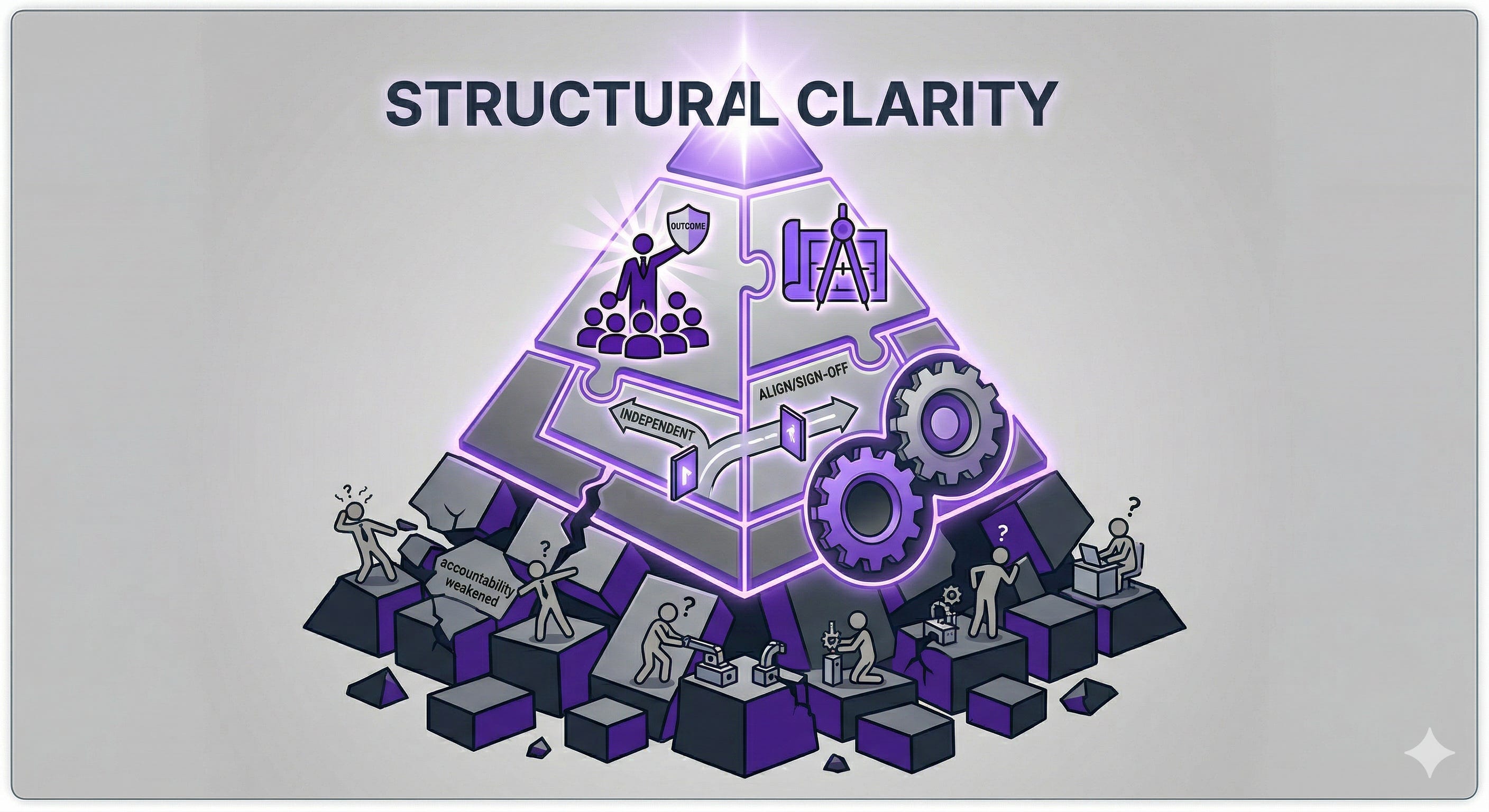
Structural Clarity is about the role itself. Do managers actually understand what the job is, and do they have what they need to do it consistently?
Strong structural clarity means four things are true:
There’s a shared definition of what excellent management looks like (and it’s used consistently)
Managers understand their job is to own team outcomes, not to be high-performing individual contributors who play a largely administrative role with direct reports
Decision boundaries are clear enough that managers know when to move and when to align
Core practices — 1:1s, feedback, performance conversations — are defined and used consistently.
When this breaks down: expectations vary by team, accountability weakens, and managers fill in the gaps — each in their own way. And over time, those differences become the system.
Quick check:
Do you have a shared, explicit definition of excellent management and management goals and are they regularly used to guide, support, and make hiring and promotion decisions?
Do your managers fully embrace their role of owning team outcomes, or are they still doing too much of the work themselves?
Are decision boundaries clear? Do managers know when they can act independently vs when they need to align or get sign-off?
Do managers have access to the core practices of strong management, and are they using them consistently?
Domain 2: Collective Leadership
Collective Leadership is about how managers operate together. Do they function as a coordinated leadership layer or as a set of individuals who happen to share a reporting structure?
This is a domain organizations often skip entirely.
When managers operate as a team, their impact can multiply — and the management layer becomes more than a collection of individuals doing the same job in parallel.
Strong collective leadership means three things are true: managers have a consistent shared forum to align, calibrate, coordinate and solve problems together; they are getting the context they need to lead and have clear pathways to surface what senior leaders need to hear with a consistent information flow across the management layer — downward with context, upward with signal; and there is one person with explicit responsibility for owning the health and strengthening of the management layer.
When this breaks down: Managers often receive information too late, without context, or inconsistently. Teams move in different directions. Decisions conflict and alignment is hard to find. Issues that cross team lines fall through the gaps — and senior leaders lose the signal. Cross-organization learning happens sporadically at best, and managers are left to navigate through challenges alone. The responsibility for addressing any of this doesn’t quite belong to anyone, so it persists, and even the strongest managers can struggle.

Quick check:
Do your managers have a consistent, shared forum for alignment, collaboration and shared problem-solving?
Does information flow reliably in both directions, with managers receiving the context they need and having clear pathways to surface what senior leaders need to hear?
Is it someone’s actual, explicit responsibility to manage the management layer and do they have capacity dedicated to strengthening it and tools to do that?
Domain 3: Management System Continuity
Management System Continuity is about durability. Does management strength hold as people change, roles shift, and the organization evolves — or does it reset every time someone leaves?
The pattern is familiar. A strong manager builds a strong team. That manager gets worn down without a system built to support them. They leave.The team struggles. The senior team scrambles. A replacement is found and the cycle starts again. This isn’t a talent problem. It’s a continuity problem, and it’s entirely solvable.
Strong continuity means three things are true: Manager support and development is ongoing and embedded in the work, not understood as solely a one-time training; managers have the time and capacity to manage well, not just carry individual workload with a new title; and potential new managers are identified and have opportunities to build their skills before they’re promoted, not starting after.
When this breaks down: Management quality fluctuates with individuals and there’s no consistent path for improvement. Strong managers build strong teams and when they leave, team performance drops and resets. Development is episodic. New managers are underprepared. Managers don’t have enough time or capacity to manage as well as they want to and need to, so the work may still get done, but performance issues go unaddressed, development conversations don’t happen, and team problems compound. Some of your top staff start to leave. Organizational effectiveness becomes dependent on whoever happens to be there at the time.
Quick check
Is manager development ongoing and embedded in the work — or treated as a one-time event only, with minimal follow-up?
Do your managers have the time and capacity they need to manage well?
Do you know who your next managers might be — and are you supporting them to build their skills now, before they’re promoted?
Where to Start (No Overhaul Required)
You very likely have many of these elements in place already and others that are missing or not as strong as they could be. If you see gaps in more than one domain, that’s normal.
You don’t need to fix everything at once (and we encourage you not to). Strengthening even one part of the system makes the whole layer stronger.
If you don’t yet have a written, shared definition of what excellent management looks like, that’s your foundation. Start there. (See Article 2.)
If you have that, look at the three domains and pick something that won’t take a ton of effort, but will move things in the right direction — strengthen something that already exists or begin building where the gap is sharpest.
Just make one deliberate move. A single structural fix, a clear decision boundary, a consistent 1:1 practice, a manager forum that meets and is useful — any one of these will make a substantive difference and add strength to the system.
Management infrastructure isn’t built in a sprint. But it also doesn’t require a total overhaul. It requires someone deciding that the management layer is worth investing in as a system and then doing that systematically and consistently.
Making that decision gives you a lasting advantage — a deeper impact and the ability to hold up when things get hard.
The goal is not perfection. The goal is to make the system you have stronger than it is today.
From here, we’ll focus on the how — practical ways to make real improvements that fit inside the work you’re already doing.