



If you’re an independent consultant, there are lots of things you love about the work, and you may also still miss a few things from your W2 days.
Some people miss the paycheck cadence. Some miss the camaraderie. Some miss the simplicity of “I’m here; I’m doing the thing.”
But the sneaky one—the one almost nobody names—is management. We blame Office Space! (Yes, children of the 80s here.)
Not “being managed” in an infantilizing sense or check-the-box performance reviews or corporate rituals. We mean the invisible scaffolding: the steady rhythm, the expectation that you’ll do what you say you’ll do, and the moment someone asks “How did that go?” and your brain magically finds traction.
Independent consulting strips that away. And in the social impact ecosystem—where many of us didn’t become consultants because we dreamed of running a business—it can create a specific kind of drift: you can get excellent results for clients and still feel oddly unmoored. The story we keep coming back to in this Substack is simple: social impact consultants want sustainable, fulfilling practices with autonomy and impact, but they lack the built-in professional development resources and peer support that employment often bundled for free.
So here’s the angle I wanted to think about with my friend and longtime colleague and collaborator Emily Berens. Emily runs Trellis Strategies, where she coaches executives and leadership teams at social impact organizations through their hardest management challenges. Before that, she spent nearly a decade as a Partner at The Management Center, coaching leaders of major social change organizations and—as TMC’s first-ever talent lead—rebuilding their hiring systems with equity at the center while the organization tripled in size. She is, in other words, a person who has spent her career thinking about what makes management actually work, and then helping people do it. I wanted her brain on this because independent consultants face a version of the same problem her clients face inside organizations: the systems of great management are missing, and nobody is going to install them for you.
By management, we mean the system that helps a person keep expanding their impact while getting consistently excellent work out the door. It’s a set of functions. And independent consultants are missing those functions right when they need them most.
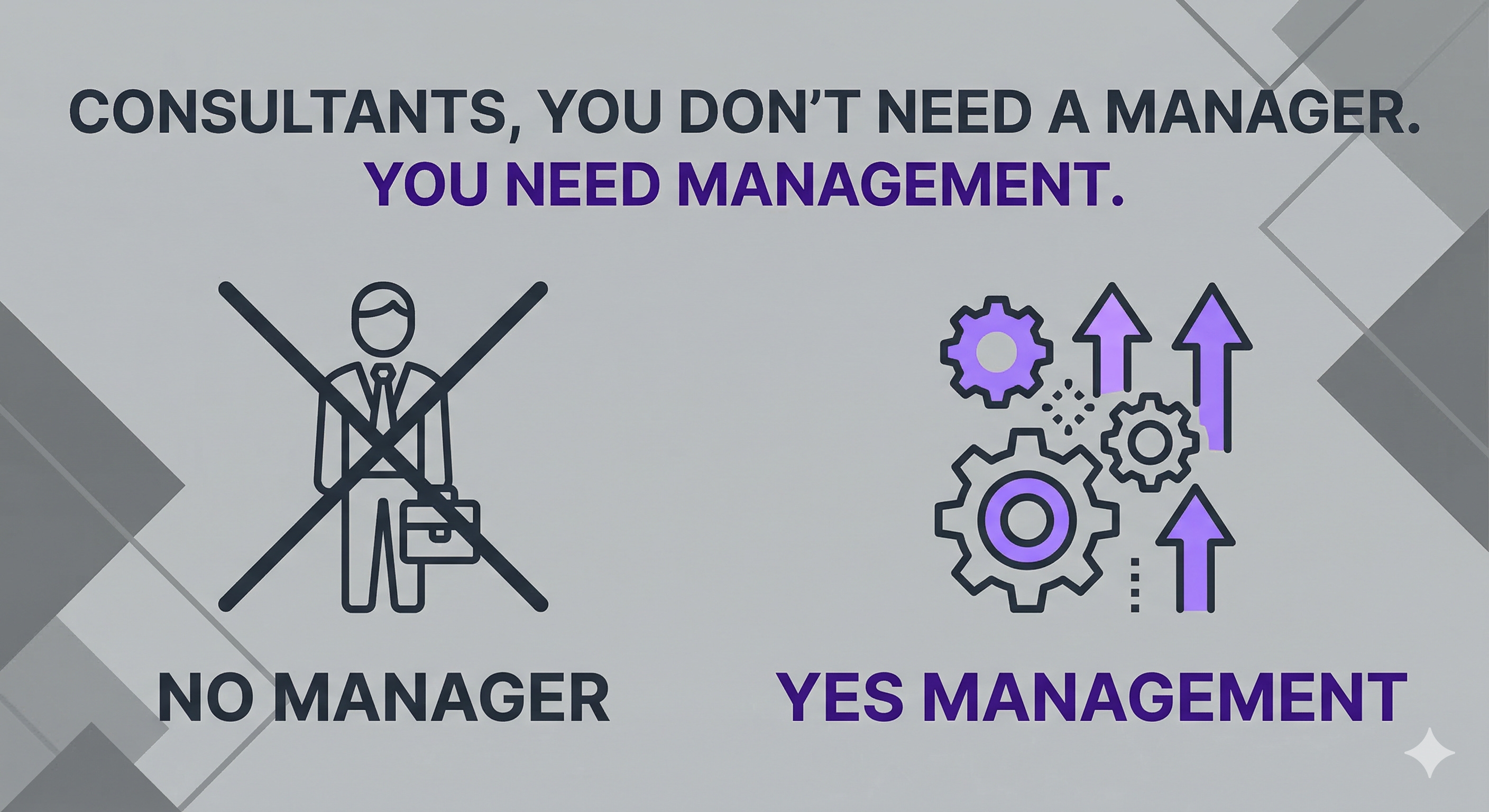
Thesis: Independent consultants don’t need a manager, but they do need management. We can deliberately recreate the most valuable parts of management, and that’s what this article is about.
The Missing Layer You Only Notice When It’s Gone
Most consultants we know are highly accountable to their clients. They deliver. They respond. They show up prepared.
But there’s a second kind of accountability that employment provides and consulting often dissolves: accountability to your own practice and the work that compounds over time.
Emily put it bluntly: she feels highly accountable to clients for getting them results, but basically no accountability to anyone other than herself for the work that builds the business or the craft over the long run.
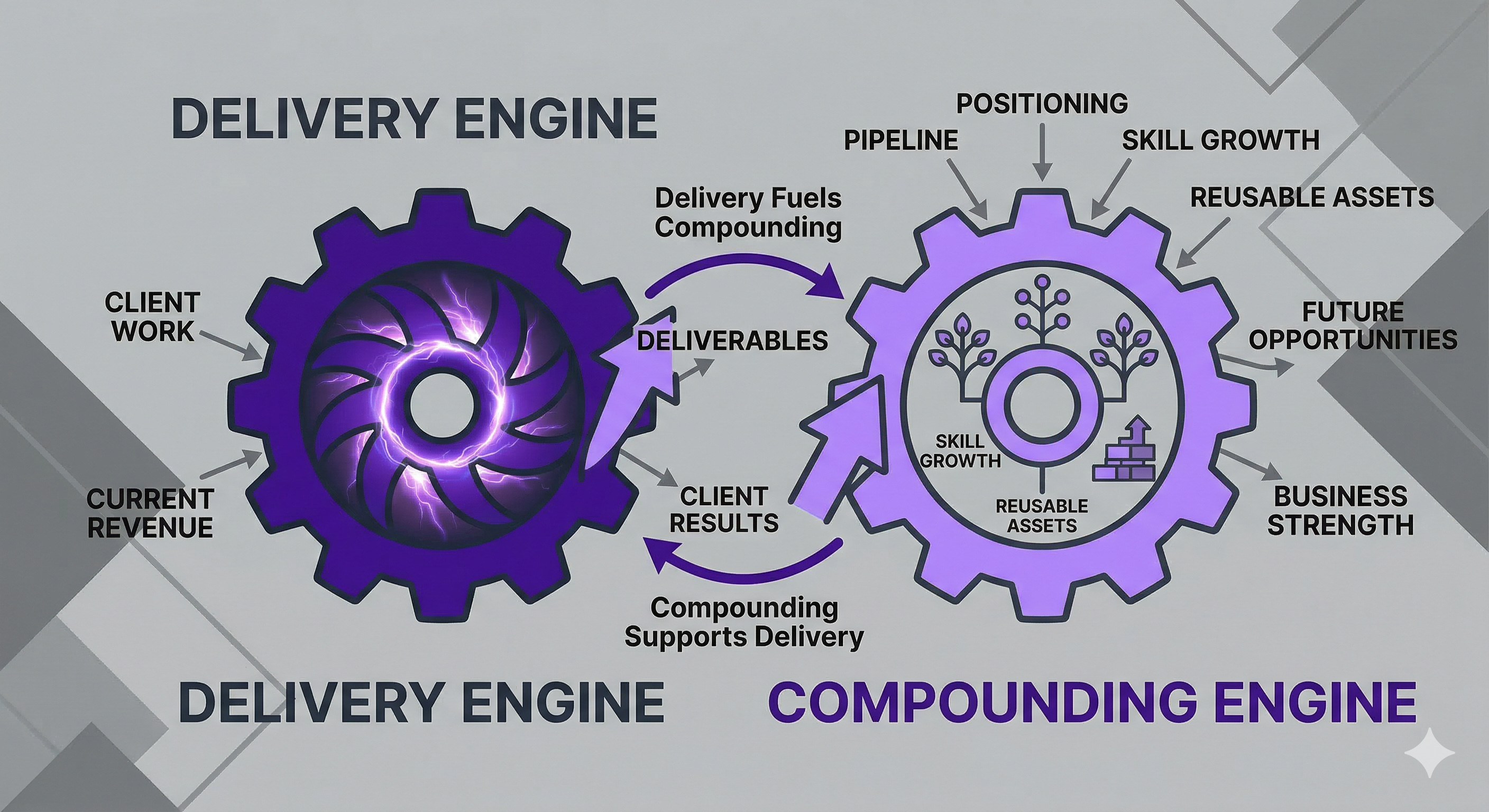
That distinction matters because a consulting practice has two engines:
The delivery engine (current clients, current work, current revenue)
The compounding engine (pipeline, positioning, reusable assets, skill growth, relationships, leverage)
Well-run organizations give you compounding-engine support by default: managers, peers, recurring meetings, training budgets, mentorship, and feedback and reflection loops. Independent consulting asks you to build that infrastructure yourself while still doing the delivery work that pays the bills.
This is a systems problem. If you feel stuck, it’s worth asking: what was your old environment doing for you that you now have to do on purpose?
What Great Managers Actually Do (That You Can Steal)
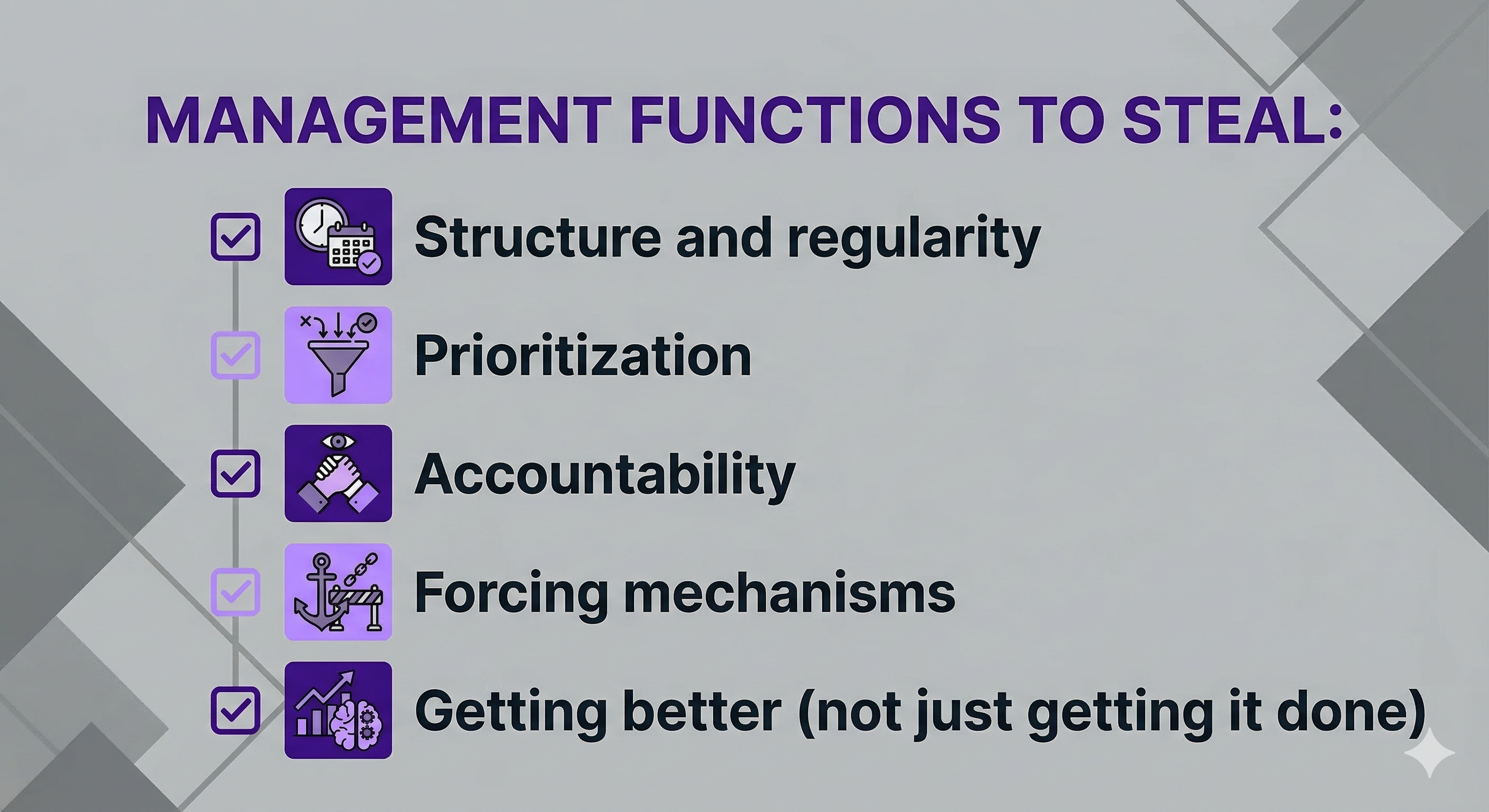
In our conversation, Emily broke the missing pieces into five buckets that independent consultants can recreate:
1) Structure and regularity
Organizations create rhythm automatically: weekly check-ins, planning cycles, clear milestones, and recurring reviews. When you go independent, you have to provide the rhythm, so it often disappears first.
By structure, we mean a repeating cadence that reduces “reinventing the week.” It’s the calendar and rituals that make progress more likely than procrastination.
2) Prioritization
Great managers help you figure out what actually matters right now—and, just as importantly, what doesn’t. They force the question: of everything you could be doing, what are the three things that will move your practice forward most?
Independent consultants can do this for themselves, but most don’t do it with any regularity. Without a forcing function, priorities tend to drift toward whatever feels most urgent or most comfortable, which isn’t the same as what’s most important. A regular practice of stepping back and naming your top priorities—quarterly, monthly, even weekly—is one of the highest-leverage habits you can build into your routine.
3) Accountability
Accountability means “someone will notice whether you did the thing.” We recommend just enough social reality to keep the important work from evaporating.
Clients create accountability for delivery, but they rarely create accountability for business development, sharpening your positioning, or building reusable assets.
4) Forcing mechanisms
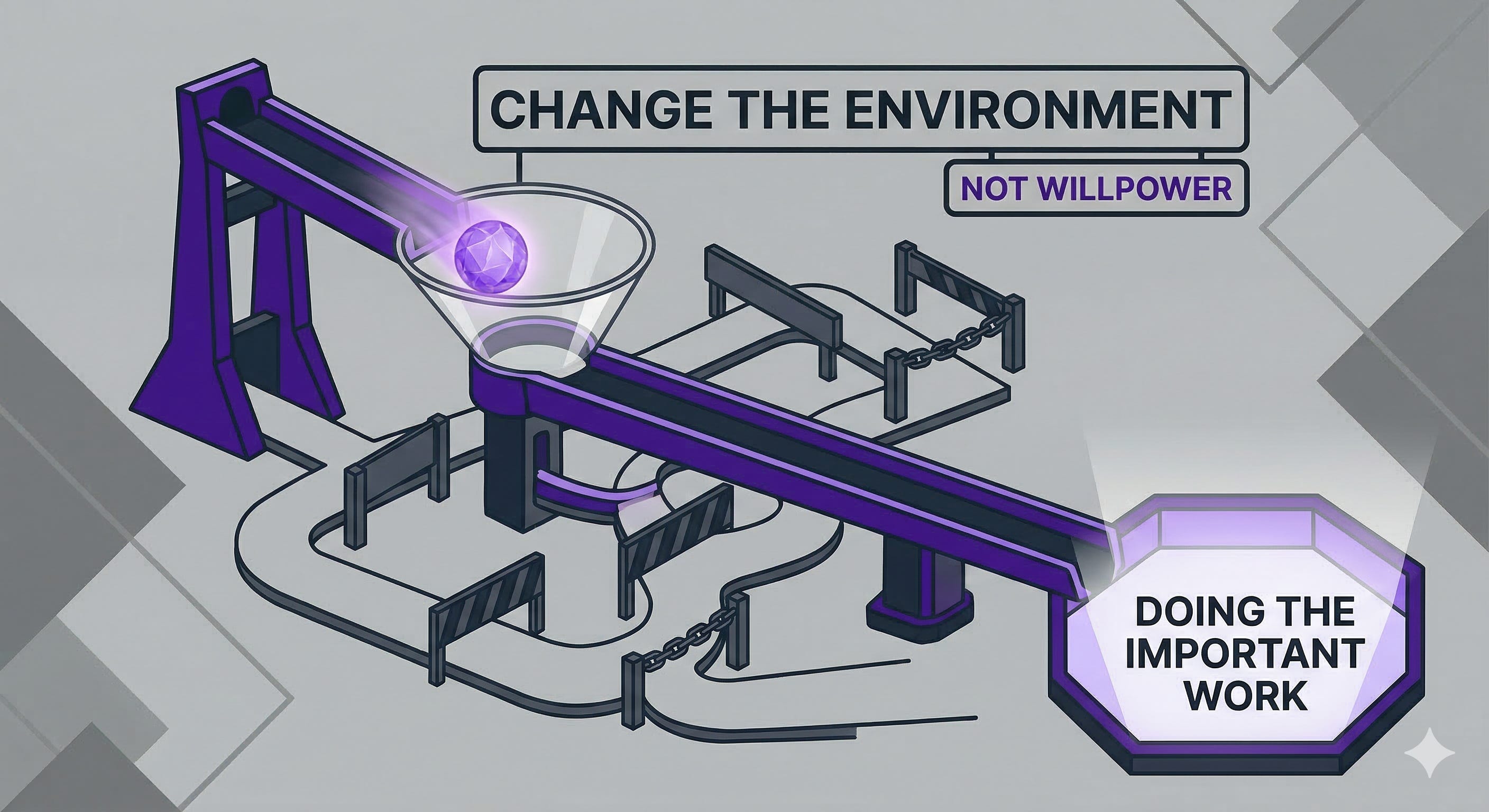
Forcing mechanisms mean a constraint that reduces reliance on willpower. It’s a setup where doing the thing you need to do becomes the path of least resistance.
This came up because “I should do business development” and “Why can’t I make myself do business development?” are different problems. The second one isn’t solved by more intention. It’s solved by changing the environment.
A concrete example: as a manager, Emily used simple progress-tracking tables and regular check-ins. The value is not the spreadsheet, it’s that you can’t hide from the question “Am I on track: yes/no?”
5) Getting better (not just getting it done)
This is the layer most consultants never formalize, which is wild because it’s where compounding lives.
Getting better involves creating feedback and reflection loops that improve your consulting craft (how you work) and your expertise (what you know), not just finishing the next deliverable.
A DIY Management System for Consultants
Don’t overhaul your life. Install one layer at a time.
Rhythm: make compounding work non-optional
The delivery engine will happily consume every hour you give it.
So give the compounding engine a protected slot. A small one is fine. The goal is continuity.
Example: a Tuesday 60-90 minute “compounding block” that is not optional. If you miss it, you don’t “make it up sometime.” You reschedule it within 72 hours. That rule is what turns it from aspiration into a system.
This block is where you do the unbillable work that prevents future chaos: pipeline outreach, skill-building, proposal templates, a case study, a pricing page, a reusable workshop deck, or outreach to a referral partner.
Prioritization: decide before you do
Before you fill that compounding block, you need to know what goes in it. Set a brief quarterly check-in with yourself—even 30 minutes—where you ask: what are the two or three things that would most change my practice over the next 90 days? Write them down. Put your other ideas for compounding work on a “not now” list.
Then at the start of each week, pick one compounding task that connects to those priorities. Not five, just one. The discipline is in the choosing, not just the doing.
Accountability: add one human who will notice
Emily’s simplest version is a text message-based pact.
You tell someone, “I’m going to do X, and I will text you by noon on Friday that it’s done.” If it’s not done, they text you Friday afternoon asking where it is.
A next-level version is setting up a regular call—every week or every other week—with an accountability partner. There’s a lot you can do with a regular call, but as part of it, you each say specifically what you’re committing to get done, knowing you’ll hold each other to that on the next call.
Two details make this work:
The commitment you make should be small enough that you’ll actually follow through. You’re building a habit of keeping promises to yourself, not training for a marathon.
The partner doesn’t have to be an expert. They do have to be someone whose opinion matters and who you don’t want to let down.
A peer, a former colleague, or a fellow consultant would all work. If you can’t find one, a small group can substitute as long as it stays specific and lightweight.
Forcing mechanisms: stop negotiating with yourself
If you keep waiting to feel like doing something, you’re choosing willpower. If you pre-commit with time, money, or social expectation, you’re choosing a forcing mechanism.
Two forcing mechanisms Emily mentioned (and we’ve both seen work in practice):
Borrow the organizing playbook. Say what you’ll do, disappear for a fixed window, report back. It’s boring, but it works.
Spend money. Hire someone—designer, editor, coach—for a defined output and deadline. The cost creates momentum and focus.
The point is to manufacture follow-through.
Feedback: ask clients about your delivery, and ask yourself
Most consultants get feedback from their clients when something is broken or when a client is thrilled. That’s a terrible sampling method. Or they get feedback at the end of an engagement through a survey or exit interview. This has its uses, but it means they learn something to improve on that could have been incorporated months ago if they had just asked.
A better pattern: a midpoint check-in that is short, direct, and normalized.
Here are a couple questions we like:
What am I doing that’s especially helpful and I should keep doing?
What could I do better in how I’m showing up?
A useful approach is to offer a self-critique first (“Here’s one place I think I could improve…”). It lowers the social risk for the client to be honest.
This feedback improves your craft: communication, facilitation, speed, clarity, stakeholder management, and expectation-setting.
For expertise (the actual domain), clients usually can’t coach you. That’s where peers, mentors, and community matter. Setting up a regular call with another expert in your field, or cultivating a relationship where you can check in when you’ve got a thorny challenge, can be invaluable in helping you continue to sharpen your thinking.
Self-reflection can matter as much as external feedback. One way Emily recommends building this in is keeping a doc called “lessons learned”: after every client engagement, write at least one thing you did well and one thing you could do better. It doesn’t have to be profound — just the act of reflecting in itself has a lot of power. Building this in at the end of every engagement is one natural place to do it; doing it every week (perhaps as the first 2 minutes of your compounding block) is even better.
Client ≠ Manager
A note of caution before we wrap up. If you treat clients as your sole manager, you’ll optimize for their short-term needs, not your long-term practice. But if you can get results that thrill your clients while also managing your own growth, you will be setting yourself up to make an even bigger impact over the long term.
Clients are great at making the urgent feel urgent. But the work that compounds—positioning, pipeline, reusable IP, skill growth—is important and rarely urgent. Without some self-created management, the important work becomes the thing you “get to when you can,” which is another way of saying “never.”
The Point of All This
Consulting sells autonomy, but it quietly takes away something many of us depended on: a shared container for getting better. Strong management does a few unglamorous things extremely well: it creates rhythm, makes progress strategic and visible, keeps you growing, and forces the important work to happen before it becomes a crisis.
Independence doesn’t remove the need for those functions. It just transfers full responsibility for them onto you.
The good news is that this isn’t an all-or-nothing project. You don’t have to become a different person or build an elaborate operating system. You can start small and still get real lift. Add the minimum viable structure that protects the autonomy you care about. If a task matters to your practice but you keep postponing it, stop debating willpower and change the environment instead.
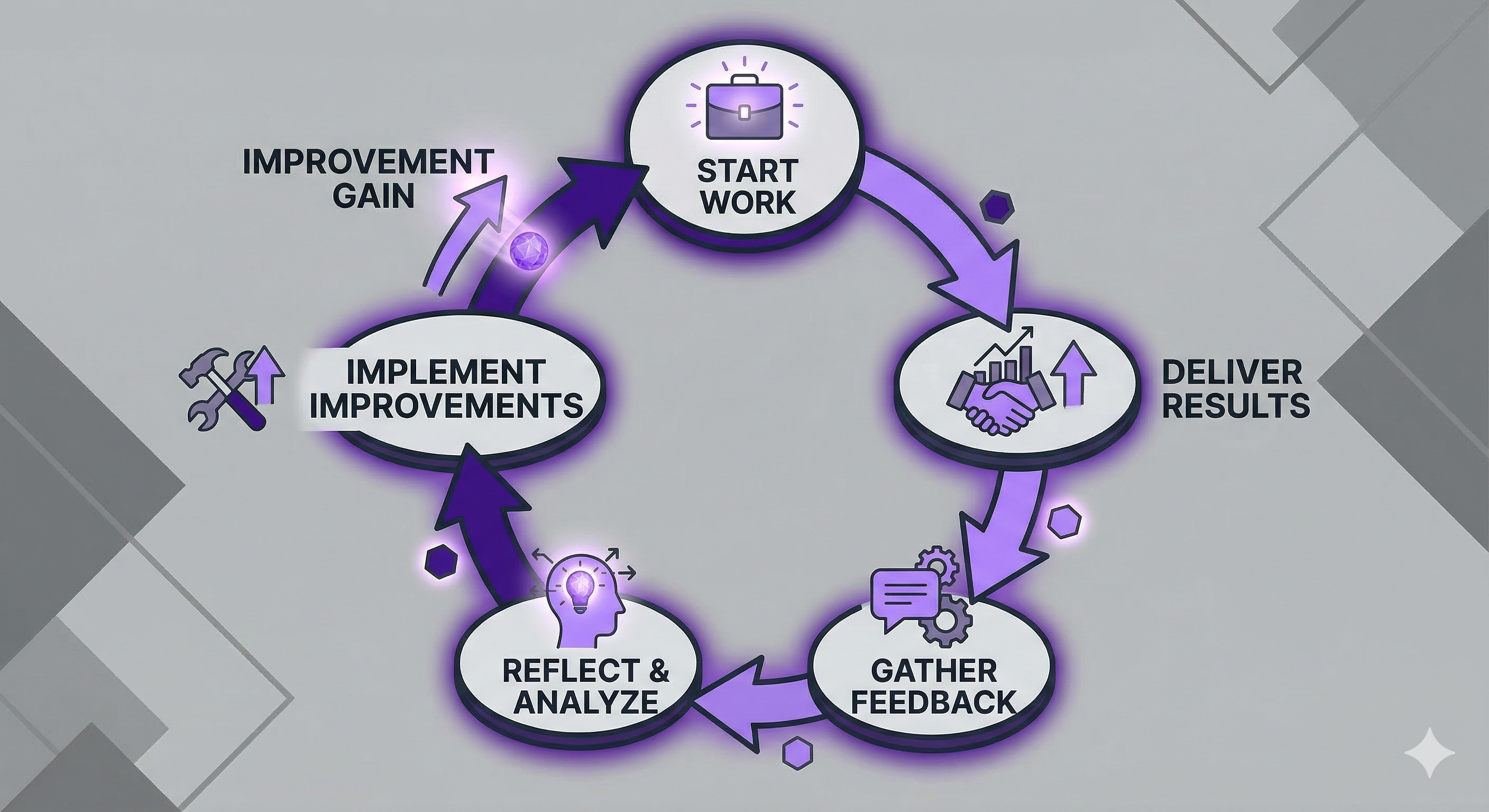
Pick one thing to try this week:
Put a recurring compounding block in your calendar with a reschedule rule (not a “skip” rule).
A quarterly priorities check-in, even if it’s just you and a notebook.
Add a human who will notice and text you Friday afternoon if you don’t follow through.
A small financial commitment like a designer or a coach who creates a deadline you can’t ignore.
If we had to compress the whole argument into a single line, it would be this: don’t wait for management to arrive—borrow it. The consultants who sustain long, high-impact careers aren’t just talented; they create the conditions that help their talent compound. Build the minimum structure that keeps your practice moving, improving, and feeling like yours.
A few questions to ponder as we wrap up:
Where do you feel the accountability gap most: pipeline, ops, writing, skill-building, or something else?
How do we design community structures that create accountability without turning into constant interruption?
If you added one midpoint feedback check-in to every engagement, what question would you ask first?
What would a truly valuable community of practice look like for your specific consulting niche?