


I’ve been to a lot of conferences and trade shows over the last few years. The first big one I ever went to was Bridge, back in the mid-2010s. I remember walking in and immediately feeling overwhelmed. Thousands of people. Dozens (hundreds?) of sessions. I was genuinely excited to learn, and I had this idea in my head that the right way to do a conference was to cram my schedule full and sprint from room to room.
But pretty quickly I noticed something that confused me.
A bunch of the heavy hitters weren’t in the sessions at all.
At one point I saw a well-known progressive pollster posted up in the lobby for most of the day, just sitting there, chatting with people as they passed by. And I remember thinking: wait, what are they doing? Did they not care about the content? Did they already know everything?
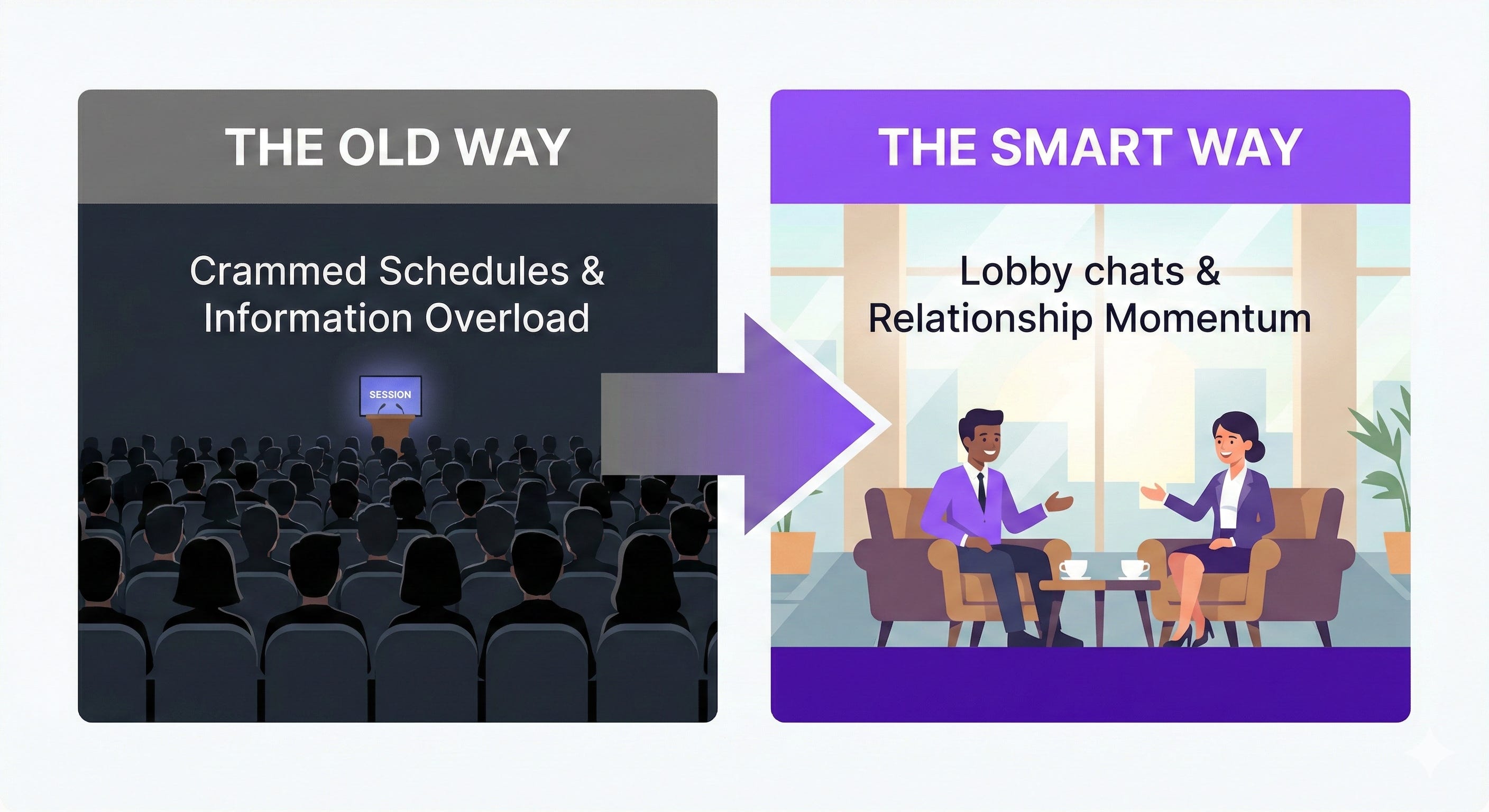
Over time and after going to a lot more of these events, I think I understand what was going on. Conferences aren’t just places you go to learn things (or not just to learn things!). They’re temporary little cities where your industry gathers, and the real advantage is how much relationship momentum you can build in a short window.
Conferences can be expensive and exhausting, and it’s easy to come home with a tote bag full of swag and exactly zero new work. But with a little intention, they can also be one of the best ways to strengthen existing client relationships, start a few new ones that actually go somewhere, and build the kind of long-term reputation that makes your business feel steadier.
Why conferences still matter
It’s become oddly difficult to meet clients in person. Offices are emptier. Travel is more deliberate. Even when budgets exist, calendars are jammed and meetings default to Zoom.
Conferences are one of the last places where in-person time is socially sanctioned. People expect to run into peers, to grab a coffee between sessions, or to talk shop in a hallway. That expectation is the asset.
Because the setting reduces friction, a conference can compress months of “we should catch up sometime” into a few hours of real interaction…if you arrive with a plan.
And one more layer of stakes specific to social impact consulting: the ecosystem is dense, values-driven, and reputation-sensitive. A warm introduction and a couple of high-signal conversations can matter more than a giant email list.
Start by choosing how you’ll attend
The tricky part is that conferences feel like they should work the way school works: you show up, you absorb information, you take notes, and you go home smarter. Some of that should happen! But if your goal is to grow a consulting practice, “getting smarter” is rarely the bottleneck. The bottleneck is time, follow-up, and a steady enough flow of relationships that you’re not constantly starting from zero.
So when I talk about “making the most” of conferences, I’m not talking about becoming some kind of glad-handing extrovert or running around handing out business cards like Halloween candy. I’m talking about choosing a simple plan you can actually execute.
Conferences are most valuable when you treat them as a relationship accelerator—first for existing clients, and then for a small number of well-chosen new conversations—rather than as a learning buffet or a pure lead-gen sprint.
With that framing, the question changes from “Which sessions should I attend?” to something more practical: What role am I playing at this conference, and what would have to happen for this trip to be worth it?
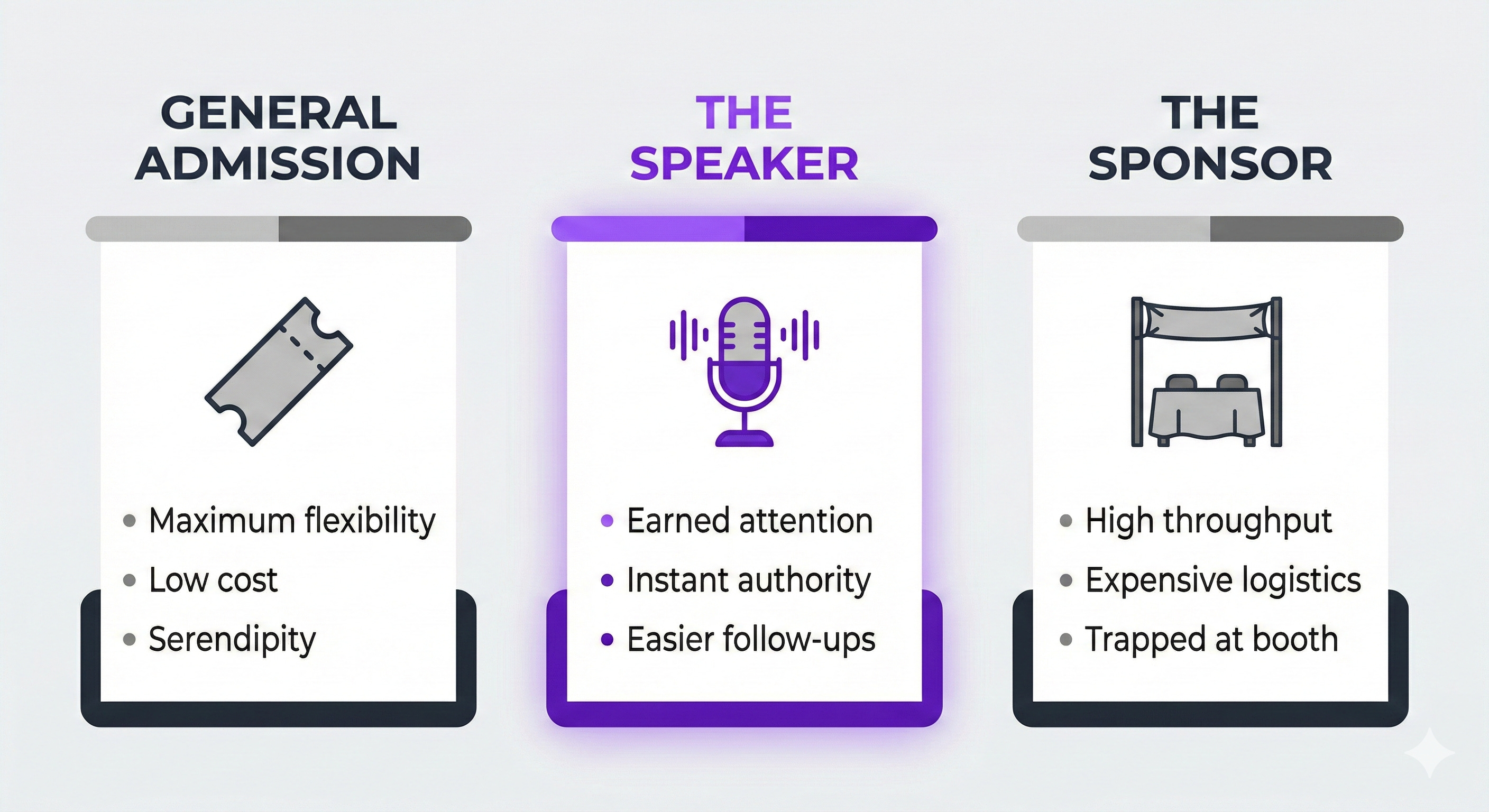
There are three common modes, each with different economics:
General admission: the default that’s usually correct
By “general admission,” I mean you buy a regular ticket that gets you into sessions/plenaries/exhibit hall and puts you in the social stream.
For most independent consultants, this is the sweet spot. It is the lowest cost, offers maximum flexibility, and you can move between learning, meetings, and serendipity without being tethered to a booth.
Speaker: the “free ticket” that pays twice
By “speaker,” I mean presenting a session or training, or serving on a panel.
Often it comes with a comped ticket (sometimes not), but the bigger payoff is earned attention. People have a reason to talk to you that isn’t “so what do you do?” It’s “I liked that thing you said.”
Example: if your talk includes a specific framework or case study (even anonymized), you’ve created a shared reference point. That makes follow-ups easier and less salesy.
Sponsor/exhibitor: expensive, high-throughput, hard to pull off solo
By “sponsor,” I mean paying for visibility and usually a booth/table in the exhibit hall.
This can work, but the trap is thinking you’re buying attention when you’re really buying logistics. Many conferences charge not just for the sponsorship tier, but also for furniture rental, electricity, and the little fees that quietly stack up. Most of the time, the sponsorship starts off around $1,500-$2,000 and then the extra fees are another $1,000.
Booths can deliver strong volume. Chorus has averaged roughly 40 stops per conference in the exhibit hall. But that model fits best when (a) you have a clear offer that makes sense in 30 seconds, and (b) you can staff it without losing the rest of the conference. If you’re a solo consultant, you need a strong theory for why high-throughput conversations at a table beat targeted meetings elsewhere. My advice is to start off smaller and attend the conference with a general admission ticket. See if it’s the right mix of potential clients and the right vibes for your business. If it is, then maybe try this out in a future year. I wouldn’t recommend doing anything that just gives you visibility (e.g. “coffee break brought to you by Sam Landenwitsch”) unless you are an egomaniac. Kidding.
Pricing notes:
Most conferences price-discriminate by time. The earlier you commit, the cheaper the ticket/sponsorship. If you might attend, get on the email list and watch pricing 9-12 months out. Also, some events trade discounted/free admission for volunteering. This is worth considering if cash is tight and time is flexible.
The highest-leverage use case: conferences for existing clients
If you do nothing else, do this.
Conferences are disproportionately good for deepening relationships with people who already pay you (or have paid you). In a world where consulting can drift into transactional Zoom check-ins, a 30-minute in-person coffee can reset trust and momentum.
Here’s the simple playbook:
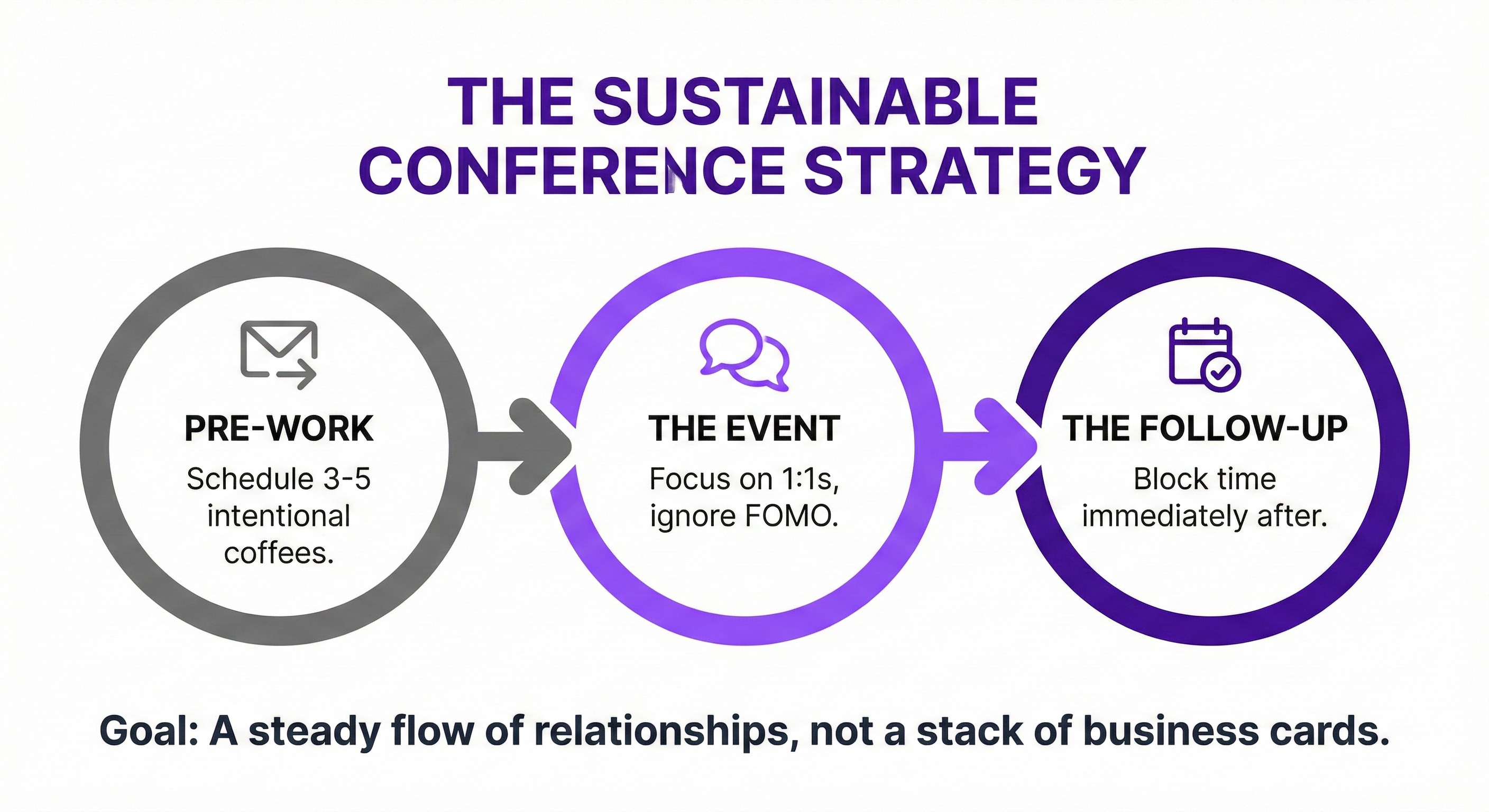
Email clients 3-4 weeks ahead: “Are you going to X? I’ll be there and would love to grab coffee.”
Offer two specific windows (“Wed 9-11am or Thu 2-4pm”).
Keep it light: your goal is to reconnect, trade notes, and spot new needs, not to force an upsell.
Why it works: your client is already at the conference for their own reasons. You’re not asking them to make a separate trip or carve out a special meeting. You’re just taking advantage of overlap.
How to land speaking slots
Most conferences open calls for speakers 6-9 months in advance. The easiest mistake is to submit generic topics that sound fine but don’t match the conference’s selection logic.
In practice, conferences tend to want one of two things:
Category 1: papers/results
Some events want rigor: research, data, case studies with clear outcomes. Bridge is often in this category.
If you have repeated patterns across clients like a before/after process improvement or a measurable lift, and you can turn it into a real case study, and you can translate that into a talk that’s both useful and credible, even if you anonymize details…then you have a shot at being selected! Point is the bar is high.
Category 2: trainings/panels
Other events want practical skill-building or viewpoint diversity. NTC and Netroots often lean this way.
Here, topicality matters. If the ecosystem is debating a new tactic or facing a new constraint, strong proposals meet the moment. For example, last summer all the talk was about “flooding the zone,” so I saw a bunch of sessions touching on this topic.
Conferences often limit submissions (commonly 3-5). Having great co-presenters is a real plus to getting selected. Some conferences also let the community vote so you can use that to improve the odds of being selected.
“Low-cost conference success” is mostly pre-work
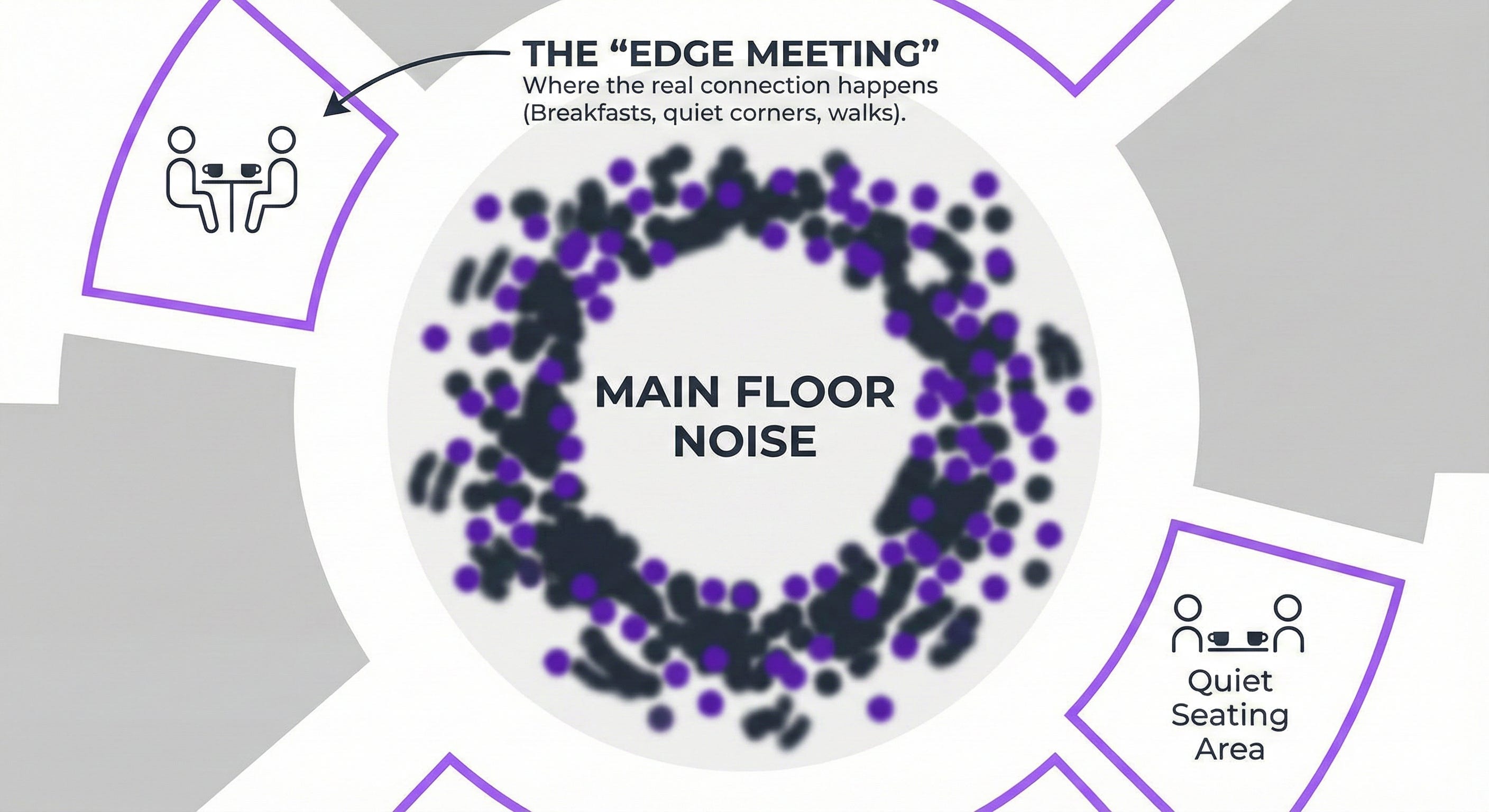
Let me define a term: edge meetings.
By “edge meetings,” I mean conversations you schedule just outside the official programming like breakfast, coffee, a quiet walk, or a late-afternoon snack where you can actually hear each other.
Edge meetings are where independent consultants win, because they let you network without the performative vibe of a loud happy hour.
A minimalist system for making this happen:
Ge a seaking slot.
Tell your list you’ll be there and invite meetups before or after your session.
If someone can’t attend your session at the conference, offer a follow-up webinar or recap call afterward.
That last piece matters because it turns the conference into a content engine instead of a one-off trip.
Repeat attendance for the win
The first year you attend a conference, you’re mostly learning who’s there, what people care about, what the sub-tribes look like, and which rooms feel like your people. The second and third years are when it starts to pay.
Then you’re continuing conversations instead of starting from zero. You recognize faces. You have context. The relationship cost drops.
This is one reason conferences are uniquely helpful for social impact consultants who feel isolated and reinvent the wheel alone: repetition turns a big room of strangers into a loose peer network.
Networking for introverts
By networking, I mean creating the conditions for future collaboration.
A few tactics that work even if you hate milling around:
Arrive early to social events. Before circles form, people are more available.
Set a bounded goal. “One hour, four conversations” turns dread into a finite task.
Pick two or even just one event. Don’t try to do everything; do one thing well and then treat yourself to a milkshake afterward.
Go, but then invite to a structured format. Rather than digging in at the loud bar, spend a few minutes getting to know each other, then invite them to a coffee tomorrow.
Know what you want to say. First, have your personal elevator pitch ready and practice getting into it from a variety of intros. Second, have a couple good questions ready to break the ice. “Tell me about something cool you’ve worked on lately.” “What do you think of the 2028 primaries?” things anyone can answer!
The 2026 slate
Here’s what I’m planning in 2026:
NTC (Detroit, March 10–13): this year the emphasis is fewer random collisions, more intentional 1:1s. One-day table presence, but the real plan is pre-scheduled meetings.
Netroots Nation (Philadelphia, June 4–6): the payoff here is compounding familiarity. Returning feels different once you have continuity because conversations resume instead of reboot.
BridgeTECH (National Harbor, July 28): a tighter, tools-and-tech-stack crowd (nonprofit technologists + fundraisers). Smaller can be better when you’re trying to find “your” people.
Bridge (National Harbor, MD, July 29–31): historically solid lead quality for us, but I’m pushing harder on speaking proposals because I think that’s where leverage lives.
TNPA Leadership Summit (San Antonio, Sept 14–16): new addition. The sponsor list signals a high density of senior nonprofit leaders running big direct response/digital programs.
NonProfit POWER (Baltimore, dates TBD but usually early December): expensive, but unusually qualified attendees and structured networking that tends to produce real conversations instead of vague “let’s connect.”
If you’re an independent consultant, pick events where (a) your clients already go, and (b) the format creates enough repeated contact that reputation can do work on your behalf.
See you there?
Generally speaking, go to conferences if you can name three people you’ll deepen relationships with and three people you’ll try to meet, then block time for follow-up the week after.
If you can’t name the people, you’re not going to “figure it out there.” You’re going to wander, learn some things, and call it networking.
And learning is fine. But if your goal is a sustainable consulting practice, then conferences work best when they’re designed as relationship accelerators.
If you’re wondering “who is going,” you usually have to sign up to get an attendance list. But if you’re wondering about a specific person, ask me! I’ve been to many conferences, and I know who usually goes. I’m happy to help. sam@chorusai.co