



Anything specific you’d like us to cover in this series? Tell us here.
Imagine it’s the third Thursday of the month. All of the people managers across your organization gather for an hour together, conference room or a Zoom, take your pick.
One of them, Abigail, has been stuck on a management challenge for the last few weeks: a team dynamic that she’s been turning over and over in her head. Today she puts it in front of the group with three minutes of context, then a flood of clarifying questions, sharing of lessons learned and new ideas from her colleagues in the room, the people who best understand the context of her job and the job itself.
By the end of the hour, Abigail leaves with three things: a clearer picture of what’s really going on, a concrete next step, and a confidence that comes from feeling the depth of support she just received from her colleagues on the management team.
Every other manager leaves the hour with something too. Terin is going to try a different approach to a 1:1 structure they heard about. Ayal finally realized why the new campaign rollout kept feeling off. Kidashi figured out that she and Kate had been sending their teams mixed signals about a shared process and within 4 minutes they had a plan to get everyone aligned and moving in step.
Norah, two weeks into her first management job, leaves feeling calm and confident. She just saw real support and practical tools traded across the room, and she can see that leadership is serious enough about management to build systems and structures around it.
None of this is magic. It’s just what happens when organizations build infrastructure to support managers as a team.
Where we are in the series
That scene is what management infrastructure looks like in practice. This article is about how to build one piece of it — but first, a quick orientation to where we are in the series.
In the first two articles in our series, we made the case for management infrastructure: the systems and structures that support a strong management layer, the strategic transmission system of your organization; and talked about what excellent management actually means and how to define it for your team.
In our most recent article, we laid out the three domains of management infrastructure (Structural Clarity, Collective Leadership, and Management System Continuity) and the specific elements within each, and encouraged you to pick any of those elements to make your current infrastructure stronger.
This article is dedicated to getting you set up to take advantage of one of the highest leverage points within infrastructure: a regular monthly manager meeting for all of the people managers across your organization or your team.
Whether you’re already doing management team meetings and know you could be getting more out of them or this will be your first go, we’re confident there’s something in here for you.

What a regular monthly manager meeting actually does
The regular monthly management team meeting sits squarely inside the Collective Leadership domain: the one that asks whether your managers operate as a coordinated layer or just a set of individuals who happen to share a title.
A consistent shared forum is a key part of that: it’s what lets managers align, calibrate, coordinate, and solve problems together — working from a common playbook instead of improvising in parallel. It’s where they sharpen their skills, build shared vocabulary and tools, and learn from each other’s real situations. Over time, it helps managers build stronger relationships so colleagues become trusted resources, and tensions that might have lingered get surfaced and resolved before misalignment spirals.
It’s also where the senior team shares organizational decisions and updates — ensuring every manager gets the information they need — and where the senior team collects meaningful input from people who have valuable insight and expertise to share.
There’s something else worth naming: a good manager meeting signals that it’s okay to not have all the answers. A meeting that models learning out loud, and treats real challenges as material for collective thinking rather than evidence of failure, is one of the most powerful culture signals you can send.
If you want an active learning culture in your organization, start here.
Monthly Management Team Meeting: Quick Start Guide
Your managers have a lot on their plates, and some likely already feel fully loaded. Asking them to spend an hour together every month means pulling their focus away from things that may feel more urgent. It also means bringing together a set of people with enormous collective potential — but to unlock that potential you have to do the work to make that hour each month worth their time.
Here are the steps:
1. Name why the team matters: give it a mandate
If your managers don’t already see themselves as a team with a shared purpose, lay the groundwork for that shared purpose as you launch the meetings. It doesn’t need to be elaborate. A handful of bullets or a couple of short paragraphs that answer two basic questions: Why does this group exist as a structured team, and what are we accountable for achieving together?
Here’s a mandate you can use as is or tweak as needed:
As a management cohort, we exist to…
Make sure that management across our organization is consistent, strong, and working well for everyone — so that every person on our team has what they need to thrive and make their biggest impact
Learn from and support each other in doing the work of management
Coordinate across teams so we’re building together, not working in silos
Make sure the organizational strategy reaches every team as clearly and directly as possible
Give meaningful input on decisions that affect the organization
Understand the context for organizational decisions so we can support them, even if they weren’t the ones we would have made
Create and model the shared culture we want to build across the organization
You may not need all of these. You may have others. And it’s OK if this is a working draft. The point isn’t perfection, it’s to have a solid picture of “What we’re responsible for as a group” going into the first meeting.
2. Clarify the purpose of the meetings overall
The mandate says why the team exists. The purpose says what the monthly meeting is for – what you most want this hour to do for the organization and the managers in it.
Start with yourself: What would make this the best use of everyone’s time? What issues or opportunities could an hour with all managers help you solve or maximize?
Then ask your managers. A short note or survey is fine. It doesn’t have to be elaborate. What are they finding hardest? What would help them do their jobs better? What would make this hour not just worth their time, but as valuable as possible? (Sample email here.)
Treat the first four months as an experiment, and say so explicitly. Tell managers you’ll collect input officially at the end of that stretch, and let them know how to share feedback along the way. Put a four-month check-in on your calendar now.
Before the first meeting, collect what you heard, decide what to integrate, and share back your plan. Getting managers’ input up front makes it clear these meetings aren’t (just) another obligation handed down from above. They’re genuinely built to set the team up for success.
Here’s a sample email you can use.
Finally, collect what you hear, decide what to integrate, and share back what you’re planning before the first meeting. Put a reminder on your to-do list or calendar to collect input three months in, and then follow up on that. Getting managers’ input makes it clear from the start that these meetings are not (just) another obligation handed down from above, but are genuinely intended to help set the team up for success.
3. Prep each meeting — POP it
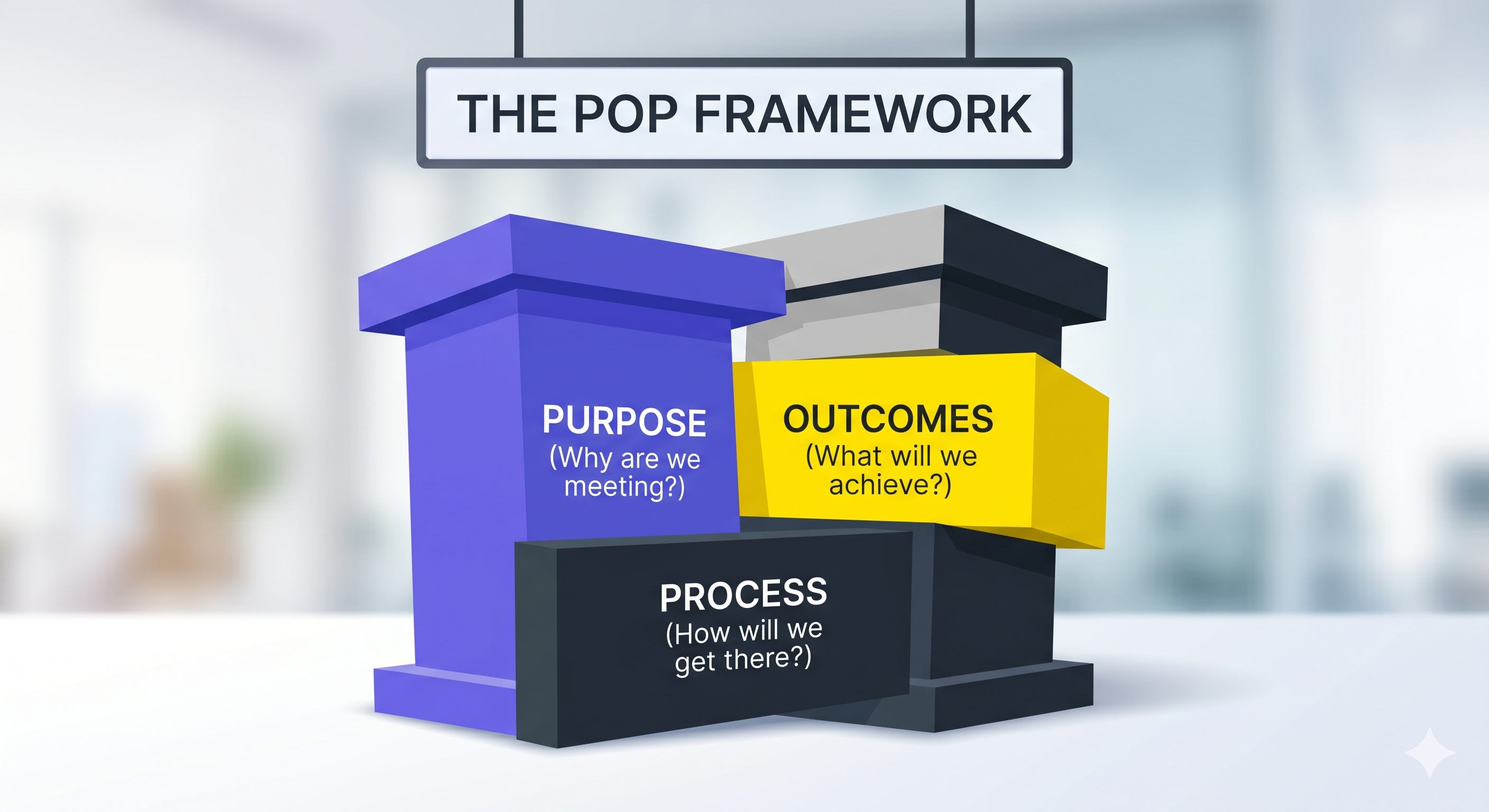
Great meetings don’t happen by accident, they’re intentionally designed. The framework we use is POP: Purpose, Outcomes, Process. (The POP framework was developed by Leslie Sholl Jaffe and her colleague Randall Alford. Leslie was a brilliant strategic thinker and leadership coach who passed away this year.)
Purpose is the overall intent of the meeting (why it exists). Use what you noted above as the purpose for these meetings overall.
Outcomes are the concrete objectives that you want to walk away from this meeting having accomplished. Not “we discussed X” but what will people have, know, or be able to do coming out of this meeting?
Process is how you’ll get there: the agenda, the prep, and how you’ll manage any dynamics in the room you need to plan for.
The outcomes are the biggest load-bearing element, so we’ll focus on that here. You can also see more details about each piece in this tool for using the POP model and sample POP for a management team meeting.
Clarify the outcomes
When you’re clear about the outcomes you want to achieve, you have a clear guide for what goes on the agenda and what needs to happen ahead of time, and a real way to assess whether the meeting worked and adjust for the next month.
Here are some example outcomes. The point of the list is to give you a sense of the range, not a checklist.
[Manager] has concrete next steps and new clarity on the challenge they’re bringing
Each manager leaves with one new tool or approach to try in their own management this month
Everyone has a clear understanding of what’s happening across teams and what’s coming up
I get thoughtful input on X decision, and everyone’s clear about the next steps for me to make the final call
We’ve made decisions and are aligned on how we’re setting expectations with our teams about X
Managers leave knowing each other better and trusting each other more
Managers practice thinking out loud about real challenges, and see that not having the answer is normal
Each month you’ll likely focus on two or three outcomes rather than trying for all of them. Before every meeting: what will be true at the end of this hour that isn’t true right now?
Design the process
Once you’re clear on the outcomes, the process is what you build to reach them. There are three elements to process design:
Agenda. What happens in the hour, in what order, to move you toward the outcomes?
Prep. What do you need to do before the meeting? What do other people need to do, know, read, or think about before the meeting?
Dynamics. How do you set the meeting up so everyone can participate fully?
In the example at the top of this article, we described a meeting where our manager, Abigail, brought a specific real challenge to dive into as a case study. The case study format is one of the most valuable things you can do with this time – it can give managers real insights and concrete next steps, and gives them practice thinking through hard situations collectively, builds genuine trust, and starts to shift the culture toward we figure things out together instead of each of us figures it out alone.
But it’s not the only option. Some months you’ll use the time for skills training, or troubleshooting from a previous session. Others for getting real input on an organizational decision. Others for calibrating expectations across teams that have started to drift.
4. Wrapping up
Taking the time to make sure take-aways and next steps from each meeting are clear and communicated makes it more likely that the take-aways will be incorporated and the next steps will happen. It’s also an important way to communicate that the organization values the time and energy managers brought to the meeting. When the person running the meeting circles back on what participants are taking from the meeting, captures themes, and follows through on next steps, it tells the group that what happens in the room matters.
Before people leave the room
Make sure every next step has an owner. Don’t leave the room with any task un-owned. Any next step that doesn’t have an owner is unlikely to happen.
In the days after
Capture cross-cutting themes. What came up that points to a skills block, a decision that needs to be made, or a conversation worth picking up next month?
Note individual follow-ups needed. A check-in with a manager who was quieter than usual, a promise you made to share something, a connection worth making between two people in the room.
Follow through on any next steps you committed to share. Modeling follow-through on your items helps build momentum for the others.
Plan to circle-back on the case study. When it’s useful, give the manager who presented a few minutes at the next meeting to share what they tried and what happened.
Simple, consistent follow-through can help turn a good meeting into real change over time.

Your next steps: Checklist for launching (or resetting) your Monthly Manager Meetings
Before the invitation goes out:
☐ Mandate drafted — why this group exists and what you’re accountable for together
☐ Draft your Purpose for the monthly meeting
☐ Note sent to managers asking what would make the hour valuable to them (Sample here)
☐ Four-month experiment framing communicated, three-month check-in on your calendar.
☐ Finalize the Purpose and share it out before the first meeting
Schedule the meetings:
☐ Four meetings blocked on the calendar
(You may not be able to get the first meeting on the calendar right away. That’s fine. Pick the soonest available time and book the four meetings starting then.)
Before the meeting itself:
☐ Clarify the Outcomes for the meeting (Purpose is set in “Before the invitation goes out.”)
☐ Design the Process
☐ Agenda – What happens, in what order, to move you toward the outcomes?
☐ Prep – What do you need to do before the meeting? What do other people need to do, know, read, or think about before the meeting?
☐ Dynamics – How do you set the meeting up so everyone can participate fully?
☐ Send the agenda and any prep materials out a few days ahead of time
Wrapping up:
Before people leave the room:
☐ Every next step has a clear owner
In the days after:
☐ Cross-cutting themes and individual follow-ups captured
☐ Your own committed follow-through completed
☐ Circle-back on the case study scheduled into next month’s agenda
What would be most useful next?
We’re building this series to be as practically useful as possible, and we want to hear from you.
Help shape what we build. What do you most want us to cover next?
A template for the very first manager meeting
A topic list to help you map out your first few months of meetings
How to build reliable information flow across the management layer
Who should be taking all of this on in the first place
More low-lift moves: small things that punch above their weight
Something else entirely
Let us know by emailing Susannah@hookrodgersconsulting or submitting here.